Western Imperialism Breeds Terror
Jul 20, 2016 11:25 UTC
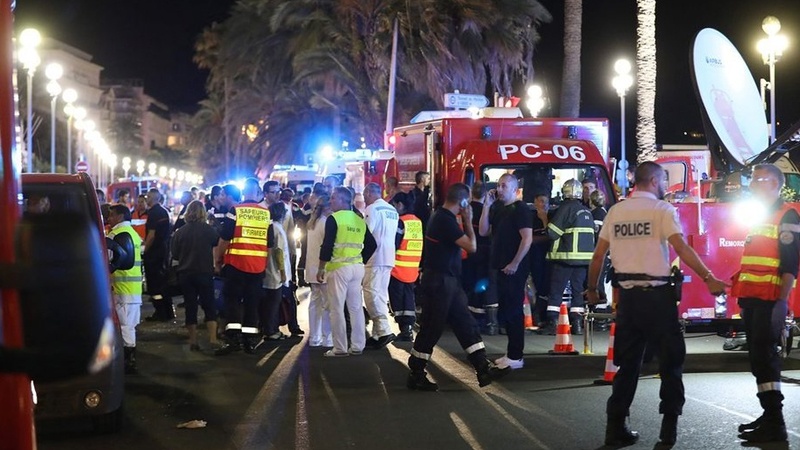
Perhaps one of the most striking features of the attack in Nice is not what occurred in France, but instead how the reaction exemplifies the selective humanity that we exhibit depending on where terrorism occurs.
The public, politicians, and the media all rightfully displayed outrage over the string of attacks that have been plaguing France over the past 18 months, as well as the recent Orlando shooting in the US, yet the level of outrage and media coverage never reaches the same levels when terrorism strikes other parts of the world, in particular West Asia.
This in turn breeds a skewed perception in the West that it is a “battle of civilizations” that is being fought. It obscures by omission the fact that most of the terrorism committed by groups like al-Qaeda and DAESH is perpetuated against other Arabs in Muslim-majority countries.
This flawed perception then leads to the painting of all Muslim’s as terrorists, fueling the ignorant racism of calls by the likes of Donald Trump to discriminate against them, completely neglecting the fact that it is Muslims and Arabs that are on the forefront of this battle sacrificing their lives to rid the world of the jihadis. It paints a picture in Western minds that the cause of all of this is an ethereal religious ideology, or that this is a problem inherent in Arab and Muslim “blood, in their DNA”, when in reality the extremism is mainly an outgrowth of the practical imperialism that is arming, training, and financially supporting the terror groups for purposes of geopolitical expansion, the main driver of which being the United States. For example, not many spoke out when recently nearly 300 were killed in Baghdad following the detonation of a truck bomb for which DAESH claimed responsibility. It was the deadliest attack in the Iraqi capital in years, yet exactly what were the circumstances that led DAESH to thrive there?
When DAESH declared its existence in Syria in 2014, it had long been known that the group would push back into its old pockets of support in the cities of Mosul and Ramadi.
Two years prior in 2012, a vetted Intelligence Information Report of the DIA was circulated throughout the Obama administration. It predicted the rise of DAESH given the support from “the West, Persian Gulf countries, and Turkey” to a Syrian opposition dominated by “the Salafists, the Muslim Brotherhood, and AQI (Al-Qaeda in Iraq).”
It predicted that the continued empowerment of these forces would cause deterioration, which would have “dire consequences on the Iraqi situation”, thus precipitating “the ideal atmosphere for AQI to return to its old pockets in Mosul and Ramadi, and will provide a renewed momentum under the presumption of unifying the jihad among Sunni Iraq and Syria.”
Given this information, the US and its allies increased their support for the Syrian opposition throughout the next two years. Indeed, it was our “major Arab allies” that funded the rise of the Islamic State.
This wasn’t a secret, however, the Saudi Foreign Minister himself told John Kerry that the Islamic State was a Saudi creation.
During this time the US enjoyed an intimate relationship with the Saudis vis-à-vis their mutual Syria policy, the Saudis provided the weapons and petrodollars for the rebels in exchange for “a seat at the table” and to say “what the agenda is going to be.” That agenda, according to the 2012 DIA report, was “the possibility of establishing a declared or undeclared Salafist principality in eastern Syria” which was “exactly what the supporting powers to the opposition want” given their desire “to isolate the Syrian regime.
This all in turn led to a situation in 2014 in which DAESH was mobilizing as a potent force, and began to make its push into Iraq. This imminent push was well known to US intelligence.
According to high level officials, the US “had significant intelligence about the pending DAESH offensive… For the US military, it was an open secret at the time… It surprised no one.”
In a Senate testimony in 2014 DIA director Flynn warned that “DAESH probably will attempt to take territory in Iraq and Syria to exhibit its strength in 2014.”
The US though, did nothing.
According to the WSJ, “the failure to confront ISIS sooner wasn’t an intelligence failure. It was a failure by policy makers to act on events that were becoming so obvious that the Iraqis were asking for American help for months before Mosul fell. Mr. Obama declined to offer more than token assistance.”
The strategy was to utilize the DAESH attack as a means to pressure the Iraqi Prime Minister, in an effort to lead to his ouster. The reason “that we did not just start taking a bunch of airstrikes all across Iraq as soon as DAESH came in,” Obama explained, was because “that would have taken the pressure off of Maliki.”
Not long after Maliki stepped down, and Abadi took his place. DAESH, however, remained a potent force in Iraq for years to come, paving the way for the attacks, killing upwards of 300, unfortunately only one among many others. Turning back to France, the concurrence of terrorist activity is intimately tied in with involvement in the Syria crisis.
By 2012 France had “emerged as the most prominent backer of Syria’s armed opposition” and was then “directly funding rebel groups… as part of a new push to oust the embattled Assad regime.”
This being only months after the DIA had warned “the Salafists, the Muslim Brotherhood, and AQI (Al-Qaeda in Iraq)” were “the major forces driving the insurgency.”
And while France justified its involvement through talk of a so-called “moderate opposition”, the CIA’s point-man, sent to the country throughout 2012 to meet with terrorists, saw for himself that “there were no moderates” there at that time.
It was France’s policy of attempting to oust Assad that directly led to the rise of extremist jihadis inside Syria and Iraq, yet the media establishment is criminally ignorant to these underlying geopolitical machinations.
Former MI6 officer Alastair Crooke describes the situation as such: “the jihadification of the Syrian conflict had been a “willful” policy decision, and that since Al Qaeda and the DAESH embryo were the only movements capable of establishing such a Caliphate across Syria and Iraq, then it plainly followed that the U.S. administration, and its allies, tacitly accepted this outcome, in the interests of weakening, or of overthrowing, the Syrian state.”
He notes that this strategy dates back to the Cold War, in which “setting the destruction of secular nationalism was its overwhelming priority,” and therefore, “America by default found itself compelled to be allied with the Persian Gulf Kings and Emirs.”
Indeed, Obama and Biden both admitted that they did not believe in the farce of arming “moderates”, Obama stating that “When you have a professional army that is well-armed and sponsored by two large states who have huge stakes in this, and they are fighting against a farmer, a carpenter, an engineer who started out as protesters and suddenly now see themselves in the midst of a civil conflict, the notion that we could have, in a clean way that didn’t commit U.S. military forces, changed the equation on the ground there was never true.” Biden bluntly summarized: “there was no moderate middle because the moderate middle are made up of shopkeepers, not soldiers.”
And so “the answer as so often was to move to more covert means… by increasing the clandestine operations in support of the opposition including the jihadists.”
Yet this even goes a step further, with the French authorities tacitly allowing or even encouraging the flow of French nationals into Syria.
In 2013 Foreign Policy put out a story noting that upwards of 1,000 European nationals were travelling into Syria. The headline read “Hundreds are joining the fight against Assad. Will they return as terrorists?”
The French Interior Minister counted at least 140 French citizens making the sojourn, and while he admitted that “It is a ticking time bomb,” no actual concern or alarm was raised to do something about it.
“For the time being,” the Minister said, “there is no legal basis for arresting the European jihadists or barring them from leaving or entering France.” He further justified the lack of action by stating that “The fighters in Syria are not fighting France or Europe; they are fighting against the Assad regime. It’s not against French law to fight in a war, but it is a crime to participate in a terrorist organization.”
Former counter-terrorism officer and Scotland Yard detective Charles Shoebridge explains the situation further: “For the first two of the last three years, countries such as the UK and France did little to stem the flow of their citizens to an already destabilized Syria and Libya, perhaps believing these jihadists would serve Western foreign policy objectives in attacking Gaddafi and Assad for example. Only when domestic intelligence services began to warn of the dangers of blowback from such people, and when groups such as DAESH began over the last year to turn against the West in Iraq and Syria for example, was any real action taken to stop the flow of UK and French citizens to what, in effect, were largely western policy created terrorist recruiting and training grounds. By then, as Europe seems increasingly likely to experience, it was already too late.”
Yet action did not include halting Western involvement in the Syrian war, which created the threat of terrorism in the first place, nor did it consist of ending involvement with Turkey, Arabia, and Qatar, who are the principle supporters of the terrorist movements. Instead, what was done was business-as-usual: a state of emergency, more lockdowns, infringements on civil liberties and freedoms, and more aggressive war-posturing which sees the threat of terrorism as something you can bomb away, while neglecting all of its true sources.
In a detailed analysis by Britain’s leading international security scholar, Dr. Nafeez Ahmed notes that President Hollande’s reactive declaration of war “We will continue striking those who attack us on our own soil” is not solely a reference to Syria but as well to France’s current military involvement against Islamists in North Africa.
“Over the last half decade, militant factions affiliated to both DAESH and al-Qaeda have dramatically expanded their foothold in North Africa.”
The military-security architecture in the region is led by the United States, under the jurisdiction of AFRICOM.
Yet Ahmed notes that “Intelligence documents… prove that… the US, British and French were well aware that Algerian military intelligence had played a double-game, covertly financing al-Qaeda affiliated militants as a mechanism to consolidate its domestic control, and project power abroad.” This al-Qaeda threat spilled over into Mali, “But instead of cracking down hard on Algeria’s state-sponsorship of Islamist terror, the US and British turned a blind eye, and the French invaded Mali.”
The French now have a permanent military presence in Mali, first envisioned as a means to rollback the Islamist uprising yet which has instead “seen an intensification of Islamic violence,” and has transformed itself into “a semi-colonial arrangement,” which lends support to brutal government repression that only further exacerbates tensions in the region.
Ahmed notes that “Ongoing secretive operations and draconian abuses, along with extensive support for repressive regimes, one of which – Algeria – directly sponsored some of the Islamist factions running riot across the region, serves to stoke local grievances, but does little to shut down the terror networks… The US-French support for the region’s repressive governments, in the name of counter-terrorism, stokes further resentment.”
Yet Dr. Ahmed also points out that in the same way local grievances in France are as well exacerbated by a similar approach of expanded state repression. Arbitrary house searches, targeting Muslims based upon religious affiliation rather than actual evidence, arbitrary and unjustified closing down of mosques, all serve to create an environment in which the French regime has “trampled on the rights of hundreds of men, women and children, leaving them traumatized and stigmatized,” resulting in “already marginalised Muslim communities in France experiencing routine state abuses.”
The major sources of these events can be deduced and intelligent steps can be implemented to prevent against their occurrence, yet the reaction taken after each continues to neglect logic and reasoning and perpetuates actions that exacerbate, rather than mitigate, the problem. At the center of these follies is the persistent prioritization of acquisitions of power, imperialism, and resource domination that sideline concerns about terrorism. Often these pursuits utilize the veiled pretext of “anti-terrorism” to justify their aims, aims which in fact support the very terror that they claim to oppose.
In Syria, the fight against DAESH is waged by supporting an al-Qaeda dominated terrorism, while in North Africa counter-terrorism serves as a pretext for military expansion, increasing the grievances which lead to more terror. The predictable result of all of this is more terror, more wars, more oppression, and more death.
Only when pressure is put on those states, interests, and agencies to halt their selfish lusting for power will the terrorism ever truly cease.
Tags