Reflections on the Heartrending Tragedy of Ashura
Oct 01, 2017 04:51 UTC
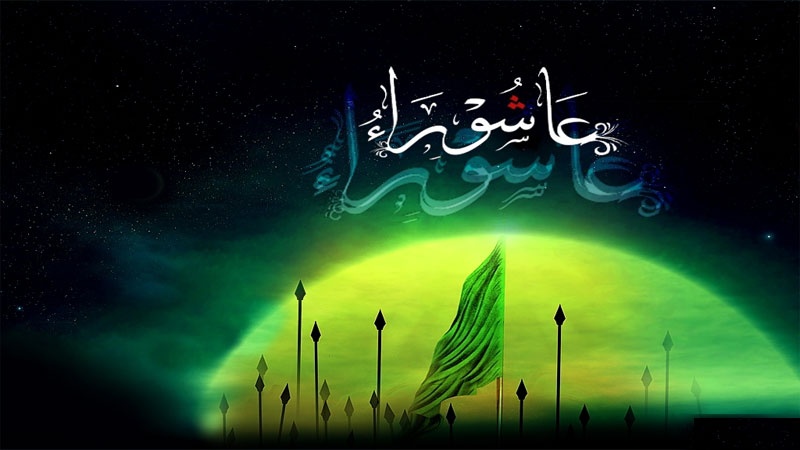
Today is the anniversary of the most tragic day in world history.
It is Ashura or the 10th of Muharram, the day on which most heartrending tragedy took place when in order to save the honour, dignity, and freedom of mankind, and in defence of all humanitarian values, Imam Husain (AS) spurned the demand to give pledge of allegiance to a Godless, tyrannical and libertine ruler, and instead court death in chivalrous martyrdom on the plain of Karbala, in Iraq in the year 61 AH (corresponding to 680 AH). Every year the faithful commemorate the anniversary of this immortal day to strengthen their faith, their resolve, their steadfastness, their quest for justice, and the universalizing of the characteristics of love, affection, patience, piety, magnanimity, valour and all other virtues for which the elixir of martyrdom was quenched by the grandson of Prophet Mohammad (blessings of God upon him and his progeny).
"O Allah, exalted is Your station, great is Your power, and stupendous Your might! You have no need of the creatures, Your supremacy is all-embracing, and You have the power to do whatever You wish. Your mercy is near, Your promise is true, Your blessings are plenteous, and Your tests are beautiful…
"I call You in the hour of my need and beseech You in the moment of my destitution! … I turn to Your help in my weakness and put my trust in You as being sufficient for me.
"Judge between us and our people [with justice], for indeed they have dealt with us deceitfully and treacherously, forsaken us and betrayed us, and spilled our blood, though we are the progeny of Your Prophet and the offspring of Your beloved, Muhammad ibn Abdullah, whom You chose for Your apostleship and trusted with Your revelation…!"
What we presented to you were excerpts from the famous supplication recited by Imam Husain (AS) on the day of his martyrdom in Karbala.
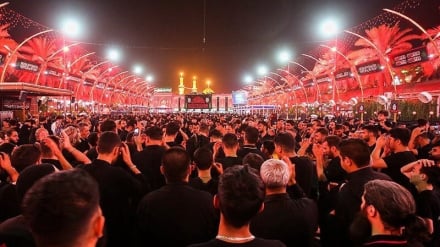
Today, a millennium, three centuries and seventy-eight years after history's most bloodcurdling tragedy the immortal saga of the grandson of the Seal of Divine Messengers, continues to be commemorated, not just in the land where he was treacherously martyred, but all over the world where his devout followers are present.
We use the term "devout followers", since devotion is the highest degree of love and affection for the person of the Prophet of the Islam and his God-given position, coupled with practical adherence to his way of life and teachings (i.e. Sunnah and Sirah).
Moreover, without devotion, the mere claim to be a follower could be dubious, as is clear from the words of Imam Husain (AS) in the above supplication that he and the other members of the Prophet's family were the victims of the treachery and deceit – not of adherents of other creeds but of those styling themselves as Muslims.
It is an irony of Muslim history that Imam Husain (AS) – as a member of the immaculate Ahl al-Bayt whose spotless purity God has vouched in the Holy Qur'an – ayah 33 of Surah al-Ahzaab – and decreed love and affection for them as token of a believer's gratitude to the Prophet for enlightening him/her with the message of Islam – ayah 23 of Surah Shura – was slain on the orders of the despicable Yazid, who falsely claimed to be the political heir of the Prophet.
Thus, although the Day of Ashura and the mourning ceremonies of Muharram and the subsequent month of Safar, might be expressions of devotional grief by the faithful and renewal of their allegiance to the ideals of justice of Imam Husain (AS) and refusal to bow to tyranny, this annual commemoration definitely raises questions in the minds of conscientious non-Muslim observers.
They ask: How Yazid and the Omayyad regime climbed to the apex of power of the Islamic realm, since as late as 8 AH and the fall of Mecca (two years before the Prophet's departure from the world), Yazid's father Mua'wiyah, and grandfather, Abu Sufyan, were hardcore heathens, never missing an opportunity to strike at Islam and Muslims?
And if it is claimed that Omayyad rule was legitimate and was on the basis of the commandments of God in the Holy Qur'an and the Sunnah of the Prophet of Islam, what unpardonable offence had Imam Husain (AS) committed to deserve such a tragic death along with 18 other male members of the Prophet's family including his 6-month old infant son?
Both Muslims and non-Muslims ought to ponder on these questions. If the verdict is in favour of the righteousness of the stand of Imam Husain (AS) and against Yazid and his Omayyad hordes, then they should be true to their conscience and probe in a diligently scientific manner as to what went wrong after the passing away of the Prophet that a tragedy of such a bestial magnitude occurred in Karbala, which did not even spare the womenfolk and children of the Prophet's Household from imprisonment.
A brief radio programme is not the place to delve into the dubious gathering of Saqifa Bani Sa'da in Medina while the Prophet's body lay unburied. Nor does time permit us to focus on the blasphemous attack by a mob of ruffians on the house of his daughter Fatema az-Zahra (peace upon her) with threats to burn down the entire household – with the then small boys Imam Hasan and Imam Husain (peace upon them) and their two sisters inside – if Imam Ali (AS) does not give oath of allegiance to the coup leaders in Medina.
To be frank and forthright, it were the neo-Muslim rulers of Medina, posing as caliphs or political heirs of the Prophet (despite the absence of any ayah of the Holy Qur'an or the Prophet's explicit instructions to support their claim), who in 19 AH (640 AD) gave to Mua'wiyah the governorship of the vast province of Shaam – made up of today's Syria, Lebanon, Jordan and Palestine including the illegal entity called Israel.
In the subsequent years, Mua'wiyah, who is on record as saying that every time the Muezzin recites the Prophet's name in the Azan, he feels intense hatred deep down in his heart, came out into open armed rebellion against Imam Ali (AS). He next intimidated and bribed the Iraqis to betray Imam Hasan (AS) so as to seize the caliphate in 41 AH (661 AD). Then in violation of the clauses of the treaty with the elder grandson of the Prophet – whom he martyred through a fatal dose of poison in 50 AH (670 AD) – he nominated the libertine Yazid as his successor in 60 AH.
These are the bitter realities of Muslim history that climaxed at Karbala 61 AH, where only the sacrifice on such a grand scale by the Prophet's younger grandson could salvage Islam. It ripped off the mask of hypocrisy from the face of Yazid, for the tyrant on seeing the head of Imam Husain (AS) in a tray before him, burst out saying that he had avenged his heathen ancestors killed in the battles of Badr and Ohad, which his grandfather Abu Sufyan had imposed on the Prophet and Muslims.
It should now be clear that the killers of Imam Husain (AS) were not Jews, not Christians, not Hindus, not Zoroastrians, not Buddhists, not Shamanists, not pagans, and not atheists, but people who called themselves Muslims, and knew him very well with full knowledge that he was a paragon of virtue.
Most of them had heard – either directly, or indirectly from their elders – the Prophet's immortal phrase "Inn al-Husain Misbah al-Huda wa Safinat an-Najah", whose English rendering is: "Indeed Husain is the Beacon of Guidance and the Ark of Salvation."
For the true believers, this wasn't the doting of a middle-aged grandfather, especially when God says that His Prophet neither errs nor speaks out of desire, and it is nothing but revelation revealed, as God says in opening ayahs of Surah Najm of the holy Qur'an.
Perhaps, some of the Prophet's companions, who before becoming Muslims had spent the greater part of their life worshipping idols and indulging in all sorts of cardinal sins, might not have properly gauged the words of the Seal of Divine Messengers regarding his grandson or the rest of his Immaculate Ahl al-Bayt, whose spotless purity the Holy Qur'an vouches.
If they had, Islamic history would have been spared of the greatest ever discord as a result of their violation of Divine Commandments by refusing to obey the Prophet's orders on his deathbed. If they had, they would not have called the Prophet (God forbid) 'delirious', and then after his passing away, usurped the rights of the Ahl al-Bayt and subjected them to tyranny, despite the clear wordings of the Hadith-Thaqalayn and the Prophet's proclamation of Imam Ali (AS) as his vicegerent, on God's explicit orders, at Ghadeer-Khom in 10 AH while returning from his Farewell Hajj pilgrimage. If they had, 50 years after the Prophet's departure, Imam Husain (AS) would not have been so tragically martyred along with 18 other members of the Hashemite clan in addition to over 50 other virtuously steadfast followers.
Now, we understand why the Prophet used to say in such explicit words: "Husainun minni wa ana min al-Husain" (Husain is from me and I am from Husain).
We also begin to comprehend his other immortal phrase regarding his two grandsons: "al-Hasan wa'l-Husain Seyyedai Shabab ahl al-Jannah" (Hasan and Husain are the Leaders of the Youth of Paradise).
Thus, it becomes obvious to us what Imam Husain (AS) means and to whom he refers in his supplication to God (cited at the beginning of this programme) when he speaks of the treachery, deceit and betrayal of the Ahl al-Bayt – that didn't start all of a sudden with Yazid in 60 AH, but were rooted in the scandalous events that had occurred in Medina half a century earlier following the departure of the Prophet of Islam from the mortal world.
Ashura and the ziyarat we recite on this day have thus drawn the clearest line between truth and falsehood for the guidance of human societies. For on this day blood triumphed over naked swords to jolt human conscience and present to mankind the most endurable barometer for ascertaining one's faith.
Thus, among the essons which we can learn from the tragedy of Karbala are:
- To be an open minded (thinking independently and being fair and just in one's judgments)
- Have a deeper understanding of death (death is for everyone and no soul can escape it. Death with dignity is preferable to a life of humiliation. Dying for the cause of Islam is martyrdom and a great honour).
- Always support the truth
- Never too late to repent
- Fidelity and loyalty
- Giving preference to the needs of others
- Patience in adversity
- Significance of Amr bil-Ma'roof and Nahi an-il-Munkar (that is, enjoining good and forbidding evil)
- Chastity and hijab, etc…
Imam Husain (AS) and his message of faith, freedom, human rights, justice, refusal to be bow before illegitimate power, continues to reverberate all over the Planet Earth, inspiring tens of millions including the non-Muslims.
AS/MG
Tags