America's new world order is officially dead
Jul 24, 2018 10:10 UTC
Hal Brands – a Professor at Johns Hopkins University – opines of waning American hegemony in his op-ed in Bloomberg titled, “America’s new world order is officially dead.”
While Brands blames Russia and China for America’s decline – it should be noted that the “US-led global integration” Brands and others within the halls of corporate-financier funded policy think tanks promote, was little more than modern day empire.
Post-Cold War, the US abused and squandered its monopoly over military and economic power. It led serial wars of aggression across the globe, destroying entire regions of the planet. It proved that whatever the rhetoric was used to sell its unipolar world order to rest of the world, it was in practice an order that ultimately served Wall Street and Washington at the expense of everyone else on the planet.
Russia and China’s vision of a multipolar world order is not predicated on institutions the world must surrender its sovereignty, trust, and future to. It is an order built on a much more realist balance of power – where national sovereignty holds primacy and a balance of economic and military power defines and protects the boundaries of international norms. This is in stark contrast to America’s vision in which an easily co-opted and manipulated UN made it easy for the largest, most powerful nations to sidestep national sovereignty and even international law, and expand wealth and power through sanctions, invasions, perpetual military occupations, and the creation of subordinate client states.
Brands mourns that the international order began with the immediate betrayal of western promises not to expand its NATO military alliance eastward toward Russia’s borders. At the time of the Soviet Union’s collapse, a buffer zone existed between Russia’s borders and NATO member states – many of these states choosing to benefit from the best of both Eastern and Western relations.
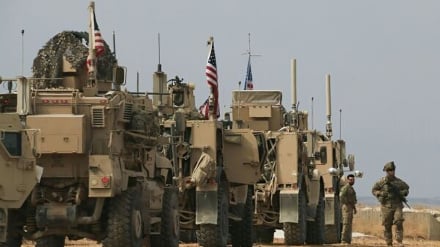
Today, NATO sits on Russia’s borders, particularly in the Baltic states where US troops train just shy of the Russian border – in Lithuania which surrounds Russia’s Kaliningrad oblast, and in Ukraine where US and NATO members have installed a regime in power dependent on literal Neo-Nazi militants and their respective political wings.
It is also an international order which saw in Russia’s moment of weakness, an opportunity to impose its order by force on former Soviet client states. This not only included NATO’s process of expansion in Eastern Europe through sanctions, subversion, and all-out war, but also in West Asia and Central Asia.
American post-Cold War foreign policy is an expression of modern day hegemony. The US has placed its armies on Russia’s borders in Eastern Europe, ravaged West Asia, and has attempted to encircle China through meddling and a military presence extending from Afghanistan in Central Asia to South Korea and Japan in far East Asia. It was a race against the proverbial clock to achieve global conquest before competitors could reestablish and protect the notion of national sovereignty.
Everywhere in between, the US has used economic pressure, political subversion, military threats, and covert terrorism as means to coerce and co-opt sovereign governments and overwrite the independent institutions of targeted nations that refuse to subordinate themselves to both Washington and Wall Street directly, and who refused to play an obedient role in America’s “international order.”
Throughout America’s post-Cold War attempt to establish itself as sole hegemon, it has repeatedly subordinated national sovereignty to what it calls “international laws and norms.” These laws and norms are expressed through the UN, a supposed international organization that in reality is little more than the sum of its parts. The US is the most powerful economic and military power in the UN, thus commands the greatest ability to bend this organization to its will.
In each instance of military aggression and political subversion the United States has engaged in, the notion of national sovereignty has been sidestepped by US claims of its own exceptionalism. This is most apparent when examining the US National Endowment for Democracy, engaged in an industrialized process of political meddling and election rigging operating in virtually every nation on Earth. It creates and supports pro-Washington and Wall Street opposition groups in their bid to both create parallel institutions in their respective nations, and eventually displace or overthrow existing, sovereign and independent institutions and governments when the opportunity presents itself.
American exceptionalism comes into play when considering recent US accusations against Russia and China of interfering in America’s own internal political affairs. Claims of hacking e-mail servers and posting messages on social media pale in comparison to entire media organizations created and operated in both Russia and China by the US regime either under the auspices of the US State Department’s Voice of America and the Broadcasting Board of Governors (BBG) or more clandestinely through NED funding, often not disclosed on NED recipient websites posing as “independent media platforms.”
The NED also stands up entire opposition groups who organize and execute physical protests in the streets of targeted nations. In Thailand for example, US, British and European embassy staff can be seen often accompanying US-funded agitators to police stations to face sedition charges – a clear threat to the Thai government that it must suffer sedition, or suffer greater penalties still. One could only imagine if the “meddling” the US accused Russia or China of even remotely approached such levels.
But because America sees itself as “exceptional” – it’s meddling and interference is “acceptable” – whereas any nation attempting to so much as defend against US influence and interference is “unacceptable” – saying nothing of attempts by other nations to seek equal but opposing influence within the US itself.
American exceptionalism thus is but a poorly disguised synonym for hypocrisy. An international order built on hypocrisy benefits only those who lead it. Virtually any alternative would appear more palatable, dooming any such order to inevitable failure.
Even America’s own allies and partners may realize this. In the long run what the US has attempted to create is unsustainable and as it begins to crumble, Washington and Wall Street are already shifting the weight of its collapsing order onto its allies and partners first, before bearing any of the consequences itself.
Brands in his Bloomberg op-ed claims of Russia that:
…China and Russia were indeed moving inexorably toward Western-style economic and political liberalism. Russian reform ground to a halt in the late 1990s, amid economic crisis and political chaos. Over the next 15 years, Vladimir Putin gradually re-established a governing model of increasingly undisguised political authoritarianism and ever-closer collusion between the state and major business interests.
And of China, Brands claims:
China, for its part, has been happy to reap the benefits of inclusion in the global economy, even as it has increasingly sought to dominate its maritime periphery, coerce and intimidate neighbors from Vietnam to Japan, and weaken U.S. alliances in the Asia-Pacific.
Brands uses “moving toward Western-style economic and political liberalism” as a euphemism for domination by western institutions and the corporate-financier interests that control them. He does however obliquely admit both Russia and China’s policies reflect a response to NATO’s expansion toward Russia’s borders and the extensive US military presence in Asia Pacific – thousands of miles from America’s own shores.
He claims:
The trouble here was that Russia and China were never willing fully to embrace the U.S.-led liberal order, which emphasized liberal ideas that were bound to seem threatening to dictatorial regimes. And so, as Beijing and Moscow obtained, or regained, the power to contest that order, they increasingly did so.
One must wonder though, what sort of “liberal ideas” are actually expressed by NATO’s aggressive eastward expansion or America’s military occupation of Asia Pacific. It is oblique admissions like this that reveal just what Brands and others mean by “Western-style liberalism.”
Brands inadvertently reveals that US-led “global integration” was little more than American hegemony, pursued through transparently hypocritical and lopsided policies that only ever could have elicited resistance from not only larger players like Russia and China, but also every other nation in between – including Washington’s own allies.
And Brands admits this. He claims:
…the U.S. needs to become both tougher and less ambitious in its approach to great-power relations and the international system. Less ambitious in the sense that it needs to set aside the notion that the liberal order will become truly global or encompass all the major powers anytime soon. And tougher in the sense of understanding that more strenuous efforts will be required to defend the existing order against the challenges that revisionist powers represent.
By “revisionists” Brands is referring to nations that refuse to subordinate themselves to “US-led global integration.” It is interesting to note that while the US seems to view Russia and China’s refusal to subordinate themselves to a US-led international order, the US itself refuses to participate in a multipolar alternative even as an equal.
Brands concludes by prescribing a series of US actions to help cling to what remains of its global hegemony, claiming:
This will require taking difficult but necessary steps, such as making the military investments needed to shore up U.S. power and deterrence in Eastern Europe and the Western Pacific, and developing capabilities needed to oppose Chinese coercion and Russian political subversion of their neighbors. It will require rallying old and new partners against the threat posed by Russian and Chinese expansionism.
What Brands refers to as “Russian and Chinese expansionism” is in reality simply Russia and China reclaiming territory and spheres of influence they possessed both before the post-Cold War period, or before western colonialism. This includes territory and spheres of influence in which populations speak Russian or Chinese, are within geographical proximity of Russia and China’s borders, and at one time actually existed within their borders.
Thus, Brands’ prescription is merely for the self-preservation of Washington and Wall Street’s own expansionism – expansionism that in no rational way can be justified by either geographical proximity or historical and cultural claims. The notion of the US investing in the defense of Taiwan – for instance – thousands of miles from American shores, speaking Mandarin and populated by ethnic Chinese – is another transparent example of American exceptionalism and hypocrisy.
While Brands hides behind phrases like “Western liberalism,” he and others within the halls of corporate-financier funded policy think tanks are in fact describing a world order built on “might makes right.” This is what allows the US to encroach on Russia’s borders, but prevents Russia from defending itself and its allies. This is what makes US fleets plying the waters of the South China Sea “right” and China building up its own military presence along its own shores, “wrong.”
But as technology and economics shift the balance of power, enabling not only Russia and China to emerge out from under the shadow of decades of American global primacy – but other nations across the developing world as well – Washington is finding that it is no longer the “mightiest.” The prescription of Brands and others to invest more militarily and continue coercing nations whenever and wherever Washington can, is really just a prescription to go kicking and screaming from its failed “global integration.”
Sound leadership grounded in reason would invest instead in preparing the US to play an equal partner to the emerging multipolar world from the coercive, manipulative, subversive, and destructive policies that have defined the failed “post-Cold War movement toward US-led global integration.” In terms of international laws and norms, the US can set an example that will benefit it in the long run – by reducing its overseas military presence and eliminating its foreign interventions by dissolving organizations like NED and reforming USAID to carry out disaster relief operations only.
(By Tony Cartalucci. He is a Bangkok-based geopolitical researcher and writer)
RM/EA
Tags