Lauding ‘Khayyam’ satellite launch, Iran president vows acceleration of aerospace feats
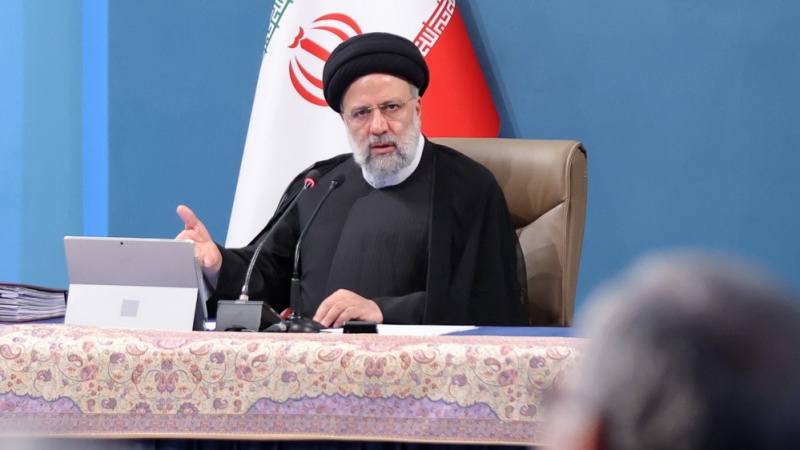
President Seyyed Ebrahim Raeisi hails earlier launch of Khayyam satellite on board a Russian rocket, pledging that the Islamic Republic would witness new achievements in the field of aerospace technology in the future.
According to reports, the chief executive made the remarks, addressing a cabinet meeting on Wednesday, a day after the remote-sensing satellite was launched into the orbit lying 500 kilometers above the Earth’s surface by a Soyuz-2.1b rocket, from the Russian-operated Baikonur Cosmodrome in neighboring Kazakhstan.
His government, Raeisi said, intended to make up for the areas in which the country was lagging behind in the field of aerospace.
“In the future, we are going to witness unveiling of new achievements in the field of the aerospace science that would render a remarkable service to [the areas of] environment, mineral explorations, natural disaster management, and border control,” he said.
Addressing a press conference, Hassan Salarieh, head of the Iranian Space Agency (ISA), shed more light on the process leading to the Khayyam satellite’s manufacturing and launch process.
The orbiter was produced based on an order placed by Iran with a Russian company, he said, noting, “The satellite reached the manufacturing stage based on parameters determined by Iran and also under the Islamic Republic’s [own] supervision.”
The official described Khayyam as a satellite with such imaging accuracy that has had made it capable of shooting images with a resolution of one meter.
The Islamic Republic intends to continue the aerospace cooperation with Russia, he said, announcing that more satellites would be manufactured with higher imaging accuracy in the coming years so the country’s needs in the area are taken care of.
The satellite’s data are captured via the north-central Iranian Mahdasht space base, Salarieh said, noting that the space agency was both equipping other available bases and also launching more, including mobile ones, that could receive the satellite’s data.
Salarieh countered claims that the orbiter served espionage purposes, saying spying satellites were of different sizes and weights than Khayyam—which weighs 600 kilograms—and were placed in different orbits.
According to the official, the Islamic Republic chose Russia for the cooperation due to Moscow’s status as a pioneering country in the field of aerospace.
Also on Wednesday, Minister of Information and Communications Technology of Iran Issa Zarepour said the Islamic Republic was currently capable of launching satellites into space that weighed under 50 kilograms, announcing that in the coming weeks, the country was about to test a new satellite launcher that could carry satellites weighing as much as 100 kilograms.
He said the country planned on developing indigenous launchers during the rest of the current Iranian administration’s tenure that could launch satellites weighing more than 500 kilograms.
SS