Has China–U.S. tension entered new phase over Cuba’s oil case?
-
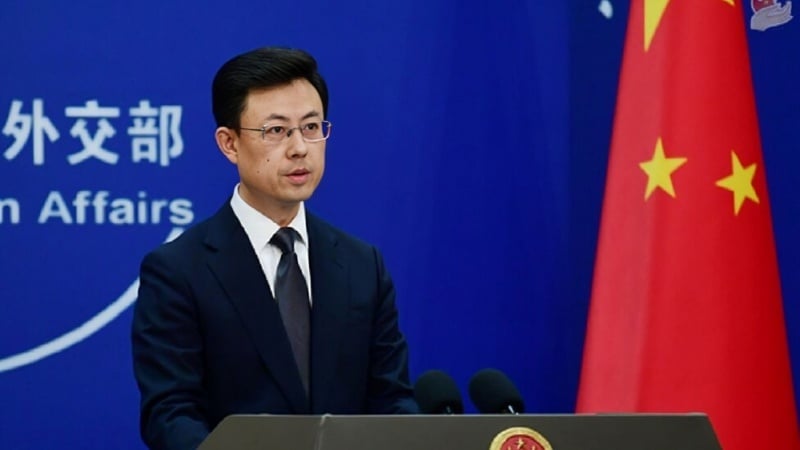
Guo Jiakun, spokesperson for China’s Ministry of Foreign Affairs
Pars Today — China has announced its support for Cuba in the face of U.S. pressure.
According to Pars Today, China rejected the recent move by the U.S. president to impose tariffs on any country engaged in oil trade with Cuba, and declared its support for the Latin American country.
On Friday, January 30, Guo Jiakun, spokesperson for China’s Ministry of Foreign Affairs, stated that China firmly opposes any actions that deprive the Cuban people of their rights. He emphasized that Beijing supports Cuba in defending its sovereignty and national security and in countering foreign interference.
These remarks by the Chinese government came in response to the latest executive order by former U.S. President Trump, which declared a national emergency and established a process to impose tariffs on countries that sell oil to Cuba or otherwise supply oil to the island. According to the White House, this measure is intended to protect U.S. national security and foreign policy interests by pressuring Cuba over what the U.S. government calls its “malicious actions and policies.”
The executive order authorizes U.S. Secretary of State Marco Rubio and Secretary of Commerce Howard Lutnick to take “all necessary measures” to impose tariffs and related actions.
In response, Bruno Rodríguez Parrilla, Cuba’s Foreign Minister, strongly condemned the recent actions of U.S. President Donald Trump against the island nation and Washington’s oil blockade. He emphasized that the U.S. is attempting to impose harsh living conditions on the Cuban people through an energy blockade.
It appears that tensions between China and the United States in January 2026 entered a new and more complex phase with the issuance of a U.S. presidential executive order imposing tariffs on countries that sell oil to Cuba. In the order, the U.S. government described Cuba as an “unusual and extraordinary threat” to U.S. national security, effectively extending Washington’s pressure beyond Cuba itself to countries such as China, Russia, Mexico, and other Havana trade partners.
Many analysts view this move as a form of “secondary sanctions,” a strategy the U.S. previously applied to Iran and Venezuela, and which the Trump administration has now implemented against Cuba.
China, one of Cuba’s most important trading partners and a long-standing critic of U.S. sanctions policies, has condemned the measure as interference in the legitimate economic relations of countries and a violation of the principles of free trade. In recent years, Beijing has strengthened its economic and energy ties with Cuba, considering the island nation one of its key partners in Latin America.
As a result, the U.S. punitive tariffs on countries that sell oil to Cuba directly target China’s interests and could escalate the geopolitical rivalry between the two powers.
The U.S. decision comes at a time when Washington–Beijing relations were already fragile due to trade disputes, technology issues, Taiwan, and the South China Sea. The inclusion of the Cuba issue now opens a new front of tension.
China is likely to respond by using its diplomatic and economic tools to counter U.S. pressure, including strengthening cooperation with Cuba, increasing investment in the country’s energy sector, and possibly filing protests in international forums. Beijing may also leverage reciprocal measures in its trade relations with the U.S., although such responses are unlikely to escalate into a full-blown trade crisis.
It is expected that this U.S. action will heighten tensions in the short term between Washington and Beijing and further deepen mutual distrust. China views the move as part of a broader strategy to contain it, while the U.S. sees it as a tool to pressure governments that cooperate with its geopolitical rivals.
In the long term, if Washington insists on strictly enforcing these tariffs, the likelihood of new economic and energy blocs forming among China, Russia, and Latin American countries will increase. Overall, the Cuba oil issue is not merely a bilateral matter between the U.S. and Havana; it has become a new arena for strategic competition between China and the United States, a rivalry that appears likely to continue in the coming years.