Negative public reaction in U.S. to Trump’s war rhetoric
-
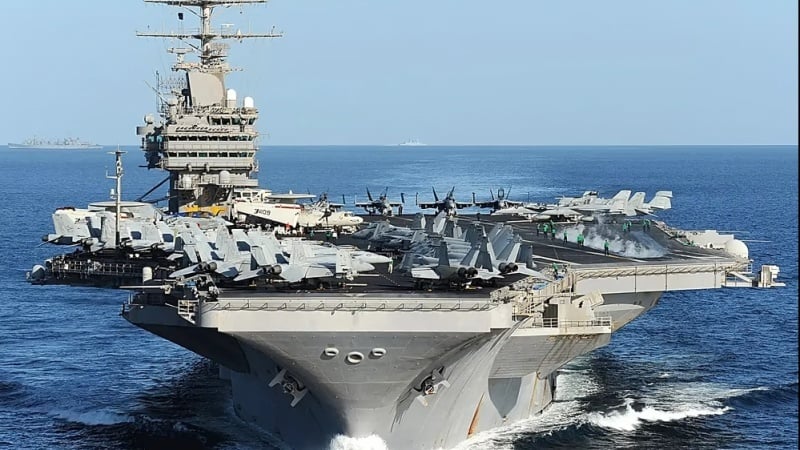
USS Abraham Lincoln aircraft carrier
Pars Today – In 2026, U.S. public opinion has shown unprecedented opposition to any new military adventure against Iran, reflecting a negative reaction to what is described as Donald Trump’s war-oriented stance.
According to Pars Today, while Donald Trump and some hardline figures in Washington continue to push war rhetoric against Iran, the latest U.S. polls present a very different picture of American public opinion.
Unlike March 2003, when the Iraq invasion received 72 percent public support in the United States according to Gallup, current public sentiment shows widespread opposition to launching another war in West Asia, with the majority of Americans responding “no” to the prospect of a new military conflict.
According to a joint poll conducted by the University of Maryland and SSRS in early February 2026, only 21 percent of Americans support a military strike against Iran.
The survey shows that 49 percent openly oppose any military action, while 30 percent remain undecided. Compared with post-June 2025 surveys — which showed 85 percent opposition to war with Iran — these figures indicate the continuation of strong public resistance to a new conflict.
Notably, even within the Republican camp there is no consensus on war. Although the party shows the highest tendency toward a military option at 40 percent, 25 percent of Republican voters oppose war, while 35 percent hold no clear position.
These findings have also been confirmed in several other U.S. opinion surveys in recent months, indicating that efforts toward U.S. military intervention have faced strong public resistance.
In a The Economist / YouGov poll conducted in late January 2026, 48 percent of Americans opposed military action against Iran, while 28 percent supported it.
When the question was framed around a scenario of “supporting protesters,” opposition rose to 52 percent, further reflecting public reluctance toward military involvement.
In addition, according to a survey conducted by Quinnipiac University in early January 2026, one week after threats in which U.S. leaders said they were “ready and armed,” 70 percent of respondents said the United States should not intervene in Iran’s affairs, while only 18 percent supported intervention.
Analysts say the bitter memory of the Iraq War continues to cast a long shadow over current American public attitudes. On the 20th anniversary of the Iraq invasion, 61 percent of Americans described that war as a major mistake.
Some analysts argue that the reason Donald Trump has so far refrained from launching a strike against Iran is that, unlike the 2003 administration of George W Bush, no large-scale media campaign has successfully generated public support. They also note divisions within the Republican Party, along with the likelihood that public polling trends are influencing decision-making on this issue.
Overall, widespread American opposition to war appears rooted in historical experience and cautious public sentiment shaped by past conflicts.
One of the reasons for this is deep fatigue from America’s “endless wars” in the 21st century. The main driver of public opposition is the bitter memory of two decades of exhausting conflict in Afghanistan and Iraq.
Many Americans believe these wars not only failed to improve security in United States but also imposed trillions of dollars in costs and caused thousands of deaths and injuries.
Unlike 2003, when 72 percent of Americans supported the invasion of Iraq, today only about 21 percent would support repeating such a mistake. Public trust has also been shaken toward politicians who promised to end these wars but are now considered by many voters to be contemplating the start of another conflict.
Another reason is the fear of retaliation by Iran and the risk of regional escalation. Contrary to common perceptions, many Americans take Iran’s military capabilities and potential response seriously.
Polls indicate that about 80 percent of Americans are concerned about the possibility of a wider regional war and an Iranian counterstrike. The presence of dozens of U.S. military bases near Iran and the country’s missile capabilities have intensified worries that any attack could come at the cost of American soldiers’ lives and the security of regional allies of United States.
The third reason relates to growing distrust of the U.S. government and concerns over lack of transparency.
The administration of Donald Trump has failed to provide a convincing justification for a potential strike. On one hand, it claims to have achieved the “complete destruction” of Iran’s nuclear program in last year’s attacks, while on the other hand, the same program is being used as a pretext for a new war.
This contradiction, along with the absence of serious debate or voting within the United States Congress, has reinforced suspicions that the White House is pursuing an unnecessary war without legal authorization.
The next reason is the need to prioritize domestic concerns over foreign adventurism. U.S. voters, especially under current economic conditions, want the government to focus on internal issues such as inflation and the cost of living, and they view spending billions of dollars on a new war as contrary to national interests.
Even within the support base of the Republican Party and the “America First” political narrative, there is a strong belief that a war with Iran would not advance the “America First” agenda and could instead drag the country into a new strategic quagmire.