UK must withdraw support for Trump's Mideast policy: MPs
-
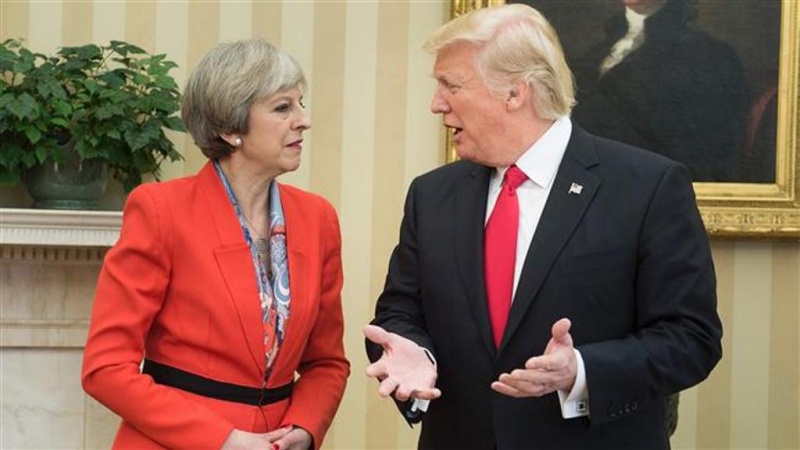
British Prime Minister Theresa May (L) and US President Donald Trump speak in the Oval Office of the White House, in Washington, DC
A UK parliamentary committee has called on the government of Prime Minister Theresa May to stop pursuing US President Donald Trump’s policy in the Middle East and devise its own alternative approach.
The House of Lords International Relations Committee released a much-anticipated report after six month on Tuesday, concluding that Trump’s unpredictable approach to the Middle East risked more instability in the region.
The MPs also warned that Washington’s current policy shows that it would no longer “set the tone” for the West's relationship with the region.
“The mercurial and unpredictable nature of policy-making by President Trump has made it challenging for the UK government to influence US foreign policy so far, a challenge that is not likely to ease,” the report said.
The peers cited Trump’s aggressive rhetoric against the Iran nuclear deal as an example of his unreliable approach.
The committee said London should do more to support the Iran deal, which was signed between Iran and the P5+1 group of countries —the US, the UK, France, China, Russia and Germany—in 2015 and removed all sanctions against the Islamic Republic in exchange for voluntary limitations to its peaceful nuclear program.
The report suggested that the UK and other European Union countries should ease banking regulations with Iran to create new financial opportunities, even if that contrasts America's plans.
Led by Conservative former Foreign Office minister David Howell, the committee admitted that removing Syrian President Bashar al-Assad was not possible in the foreseeable future and the UK should instead push for a more realistic solution to the years-long conflict.
“The objective of displacing Assad, as a prerequisite of any settlement, with the current means and policy, has proved unachievable,” the report said.
The Trump administration has sent mixed messages with regards to Assad’s future.
The committee also urged the government to take a tougher line with Saudi Arabia over its ongoing aggression against Yemen and reconsider weapons deals with Riyadh regime.
“We recognize the importance of arms sales to the UK economy and the Persian Gulf. Arms sales, however, must take place with regard for international obligations,” the report read.
“The government must demonstrate that its private diplomacy is working. If not, it should speak out clearly at the UN, within the Human Rights Council, condemning violations, intentional or not, in clear terms,” it added.
"Finally, as a last resort, we recommend that the UK should send a political signal, for instance, by suspending some key export licenses, where there is a risk that they could be used in violation of international humanitarian law in Yemen," the further noted.
EA