Sacred Defense era (1)
Sep 25, 2019 05:27 UTC
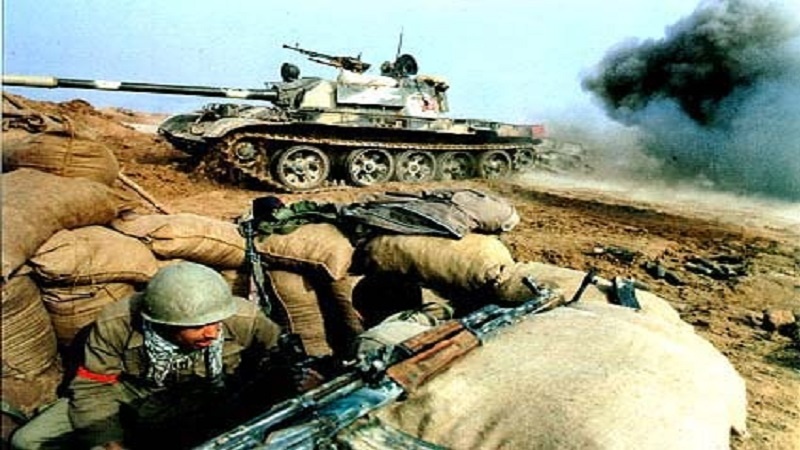
The Iraqi Ba'th minority regime troops slipped across Iranian borders on September 21, 1980, waging an invasive war against Islamic Iran.
The Iraqi imposed war maintained a set of specific goals, including a futile bid to somehow topple the sacred Islamic system and to occupy swathes of Iran's soil, but to no avail.
Throughout the 8-year Sacred Defense, the elevated Islamic and national spirit motivated Iranian youths to powerfully and courageously stand up against enemies.
Saddam's repressive regime was supported by the East and the West in his invasive war against Islamic Iran, and possessed an arsenal of weapons of mass destruction and chemical weapons. Many Iranian cities were hit by the former Iraqi regime's missiles, leading to the martyrdom of thousands of innocent people. However, ultimately, the invasive enemy forces were driven out of Iran's soil.
The people of Iran unanimously stood firm against the troops of Saddam's regime, in a highly courageous and selfless manner.
The presence of popular resistance at the warfronts during the 8-year Sacred Defense, and the Iranian nation's relentless support for the brave Iranian combatants and sacred Islamic establishment behind the warfronts, played key roles in the victory of Islamic Iran in the imposed war, leading to major epics, such as the liberation of the southern Iranian city of Khoramshahr from the yoke of Saddam's troops.
According to French daily, Liberation: After the liberation of Khoramshahr by the Iranian troops; the US, Europe, and even some of the Persian Gulf littoral states immediately made strenuous efforts to end the Iraqi imposed war in order to obstruct the fall of Saddam's regime.
The utter failure of Saddam's forces diminished all of the calculations of Saddam's regime and its supporters.
The supporters of the Iraqi Ba'th minority regime; namely US, Saudi regime, and Kuwait, provided arms and financial help for the former Iraqi regime, turning Saddam Hussein's regime into the first regional power. The US, under the pretext of endangerment of shipping in Persian Gulf, and ostensibly upon the call of Kuwait on the US to protect Kuwaiti oil tankers, justified US presence in the region, stationing its largest fleet of warships in the Persian Gulf waters. Additionally; the US encouraged the involvement of other major powers, such as the permanent member states of the UN Security Council, in the Iraqi imposed war against Islamic Iran to somehow form a global consensus for piling up pressure on Iran, and for somehow terminating the Iraqi imposed war in favor of Saddam's regime. However, these sinister efforts failed.
The Sacred Defense era provided valuable and everlasting experience for the current and future generations of Islamic Iran.
The Leader of Islamic Revolution and Islamic Republic of Iran's Armed Forces Commander-in-Chief, Ayatollah Seyed Ali Khamenei, in his keynote remarks in an address to the senior commanders of Iran's Armed Forces, noted: "Iranian Armed Forces need the best human resources in order to safeguard the Iranian nation's invincibility in the face of enmities and hostilities."
Islamic Republic of Iran's Minister of Defense, Brigadier General Amir Hatami, noted: "As long as some use the language of threats against Islamic Iran, the reinforcement of Iran's defense capacity will continue with power and strength."
The defense capacity of any given nation is one of the main factors in countering foes' military threats.
As the Leader of Islamic Revolution has pointed out: The Sacred Defense era is a valuable asset, which should be reminded and praised for the development of the country, national growth, and for preparedness of people and youths in all arenas.
Islamic Republic of Iran's policy is based on avoidance of tension and military confrontations. However, Iran has always conveyed this message to its enemies and invaders that in necessary cases Islamic Iran defends its security, and maintains the capacity to stand up against elements who destabilize and undermine security in the region.
The Commander of Quds Forces of Islamic Revolution Guards Corps, Major General Qasem Solaymani, in reference to threats leveled by the US president, Donald Trump, against Islamic Republic of Iran, notes waging war against Iran is tantamount to destruction of all US facilities.
Major General Solaymani, referring to heinous crimes committed by US terrorist forces in Afghanistan, and stating facts about US deteriorating power, reminds that US, despite deploying 110,000 American terrorist troops, thousands of tanks and personnel carriers, military facilities, hundreds of advanced warplanes and choppers, failed to defeat the weak Taliban forces.
Major General Solaymani addressed US president, Donald Trump, noting: " the Quds Forces of Islamic Revolution Guards Corps can single-handedly crush you and there is no need for the Islamic Republic of Iran's Armed Forces to enter the scene."
Iran's Defense Minister, Brigadier General Amir Hatami, in an address to the enemies of Islamic Iran, notes: "Be assured that the further the sanctions, pressures, propaganda campaign, and psychological warfare against the grand Iranian nation; the further will be our resolve for development and growth of defense power in all fields. Iran's defense doctrine is based on effective and active deterrence, and Iran will crush any given threat."
The Leader of Islamic Revolution has on several occasions underscored that the goal behind the policy of deterrence power of sacred Islamic system is prevention of any aggression against Iran by global bullying powers.
Based on these realities, the Sacred Defense era should be considered as the era of manifestation of true capacities and power of the Iranian nation in the face of threats.
Iran has currently stood firm against the foes with the same spirit and with full power and preparedness, and is determined to continue this honorable path with the same motivations of the Sacred Defense era.
MR/ME
Tags