Nowruz, Festivity of Creation (2)
Mar 22, 2017 05:53 UTC
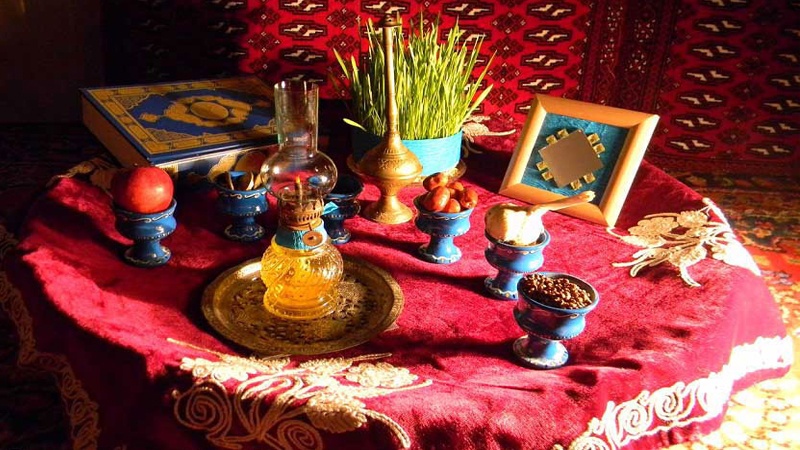
Welcome to the second episode of this series. In our previous episode we talked about the Nowruz ceremonies in the beginning of the year. It was said that, as the year nears its last hours, the family members take bath and wear new and clean clothes and sit at the table cloth called “HaftSin”. In this episode you are going to get familiar with other traditions of Nowruz.
Interestingly, many of the Iranian families try to be at Imamzadehs or the shrines of the descendants of the Prophet and mosques to benefit from the spiritual atmosphere of these places. Being at these holy sites purifies hearts and illuminates minds. The most crowded religious sites at the time of Nowruz are the holy Shrine of Imam Reza (AS) in Mashhad, the holy shrine of Lady Ma’suma (Peace upon her) in Qom and the holy shrine of Shah Cheragh (AS) in Shiraz.
After the change of the year, the mutual visits start which continue till the 13th of Nowruz and even beyond that. Since the elderly enjoy high respect and status in the Iranian Islamic tradition the young ones first go their houses of their grandparents. Every visit is usually followed by the visited. During these visits the elderly often give money or gifts called “Eidi” to the young ones. This is also done among siblings, i.e. brothers usually give gifts to their sisters and the elder siblings give gifts to the younger ones. In the course of visiting, families sit enjoy conversing with each other while they eat nuts, pastries and fruits. Another tradition which is usually observed during the Nowruz visits is to go to the house of the relatives and friends who have lost their loved ones in the past year. Iranians also visit the families of the martyrs as a sign of veneration of the status of struggle in the way of God and training such lofty souls. Some people also go to hospitals and asylum houses to pay visits to the sick persons and old people who are being cared for far from their families.
The moment of changing the year in Iran is exactly the time of Vernal Equinox. Research has shown that chronicling has enjoyed especial status in various civilizations. The civilizations of ancient Iran, Greece and Egypt and so on had calendars and chronicled events via painstaking calculations. The current Iranian calendar is no doubt one of the most precise calendars in the world. The usage of calendar and chronicle in Iran dates back to at least 2000 years BC. Ancient documents prove that the Iranian calendar has its roots in the Babylonian calendar. Approximately 2500 years ago, i.e. after the formation of the Achaemenian dynasty and then during the Sassanid dynasty this calendar went through changes but the major change occurred after the emergence of Islam and acceptance of Islam by the Iranian people.
The solar Hijri calendar originates from the Jalali calendar. The solar Hijri calendar is used in Iran and Afghanistan. It is based on the migration of the Prophet of Islam from Mecca to Medina on 1 of Rabi-ul Awwal, 1 AH corresponding with 16 September, 622 AD. This calendar is composed of 365 days in 12 months. Every 5 years one day is added to it which is called leap year. The first half of this calendar contains of 6 months with 31 days and the second half contains of other six months which have 30 days in the leap year but in non-leap years the last month has 29 days. The devisers of Jalali calendar were a group of scientists especially the Iranian mathematician and astronomer Omar Khayyam. These people designed the calendar upon the order of Malek Shah, the Saljuq king. According to the strenuous efforts the Jalali calendar has been calculated in a way that it has one second mistake within 10,000 years.
Nowruz (new day) is not just the renewal of year, season and day but the renewal of human beings and their behavior. The spiritual joy and freshness is one of the most important impacts of this great change. Research has shown that happiness increases efficacy. From the sociological point of view happiness will not only affect economics it will also affect politics, culture and training in a society. Happiness has a positive impact on the mind and psyche of the individual.
God says in ayah 58 of surah Yunus of the holy Qur’an, “Say, ‘In Allah’s grace and His mercy- let them rejoice in that! It is better that what they amass.’
According to this ayah, communication with God and having trust in his grace and mercy provide the ground for happiness of the spirit and the psyche. That’s why many Iranian people read Qur’an and pray at the time of the change of year. Prayer and supplication bring the individual to the proximity of God and instill the hope of God in him. Besides, the individual trusts in God and asks God to fulfill his demands. Elsewhere in the holy Qur’an God says, “Those who have faith and do not taint their faith with wrongdoing – for such there is safety and they are the guided.”
Those who have deeper communication with the Source of all perfections, beauties, goodness and power will naturally be less sad. Those who have more access to power and wealth will enjoy an ostensibly happier and more satisfactory life. But the eternal and stable joy and solace will be gained only through communion and communication with God. Prophet Mohammad (SAWA) says, “He who seeks forgiveness a lot, God will relieve him from every grief, and salvage him from every tight place.”
The greenery of spring and flourishing of the nature causes human being to remember and pay more attention to the Creator. This remembrance leads him to gratitude and ultimately solace. This will result in the tranquility and comfort of the heart and mind. God says in the holy Qur’an, “Look! The hearts find rest in Allah’s remembrance!” For sure, this state will lead to refraining from sin. We end this program with a brilliant saying from the Commander of the Faithful, Imam Ali (AS), “Every day on which God is not disobeyed is Eid.”
RM/MG
Tags