Tehran Trilateral Meetings
Nov 05, 2017 07:01 UTC
Islamic Republic of Iran's Capital, Tehran, was host to a round of consultations between the leading figures of Iran, Russia, and Azerbaijan Republic on Wednesday.
Throughout these one-day meetings, a number of topics were discussed such as bilateral, regional, and international topics of importance; the latest interactions in relation to Iran, Russia, and Azerbaijan Republic, and mutual cooperation in the campaign against terrorism.
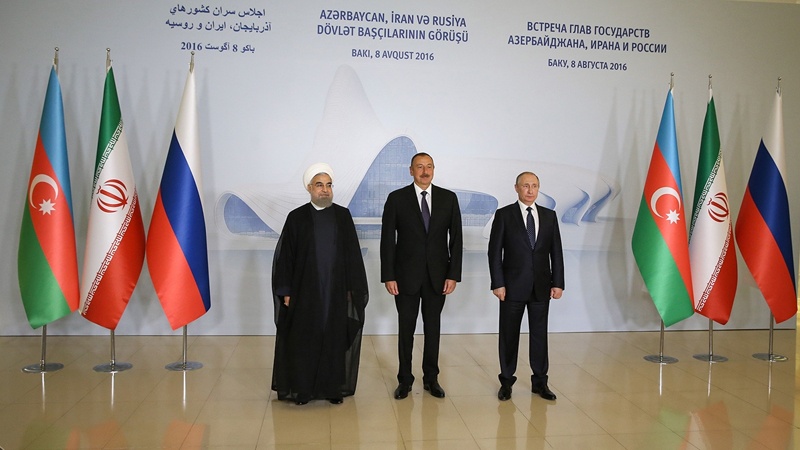
In the view of many media and political circles, these meetings maintained strategic goals. Tehran meetings were the second joint meetings of the heads of state of these three countries; the first one of which was convened in Baku, last August.
In the time-gap between these two rounds of meetings, a number of important developments have taken place in the region, and many of the security equations in the campaign against Daesh in Iraq and Syria have changed.
In the meantime, tensions have been running high in international relations in the aftermath of instatement of Donald Trump as the US president; and the positive atmosphere which emerged after the conclusion of Joint Comprehensive Plan of Action has been threatened by Washington, in the wake of US refusal to comply with its pledges.
However, despite of this tense atmosphere, Iran's role in establishment of stability and security in the region has been highlighted and the seventh round of Astana talks for assistance to restoration of peace in Syria has brought about promising outcomes. Currently, the joint efforts of Iran and Russia, as the most important means for restoration of peace, have won regional and international support.
Russia's resolute support for Joint Comprehensive Plan of Action and confirmation of Iran's full commitment to its obligations is another topic of importance which captured the attention of observers concurrent with Tehran meetings.
The Russian President, Vladimir Putin, in a meeting with the Leader of Islamic Revolution, Ayatollah Seyed Ali Khamenei, once again voiced Russia's support for the Joint Comprehensive Plan of Action, noting: Moscow finds a change in the main principles of the International Atomic Energy Agency as a wrong measure, and is opposed to relating Iran's nuclear plan to other topics, such as the topics related to the domain of defense.
In this meeting, the Leader of Islamic Revolution referred to the cooperation for steadfastness against US sanctions on Iran and Russia as "beneficial", while terming the remarks of the Russian president in this meeting about the Joint Comprehensive Plan of Action and the necessity to abide by multilateral treaties as "appropriate", adding that unfortunately the US officials continue their rebellions, and they should be dealt with via reliance upon wisdom and usage of appropriate avenues.
In further remarks, the Leader of Islamic Revolution underlined that the joint steadfastness of Tehran and Moscow against Takfiri terrorists, which are supported by a number of states, has brought about a number of important outcomes, while noting that the failure of US-led Coalition, which backed terrorists in Syria, is an irrefutable fact. But, they continue to hatch plots and conspiracies. Therefore, the complete resolution of the Syrian issue is tied to continuation of solid cooperation.
The Iranian President, Hassan Rohani, in meeting with his Russian counterpart, attached significant importance to the multilateral, regional, and international cooperation between Tehran and Moscow in resolution of crises, while underscoring that Iran considers instability in the region as a detriment to all countries, and supports the development of stability and security in the region.
Given these parameters, the importance of Tehran's trilateral meetings should be analyzed, based on three aspects.
Firstly, in a glance at Tehran meetings, one realizes the prominent and decisive role of Islamic Republic of Iran in development of strategic and beneficial ties with neighboring countries. Focus on mutual and multilateral interests with northern neighboring countries and the Azerbaijan Republic, once again showed that Tehran practically seeks interactions which expand and broaden regional cooperation, in line with the realities.
Secondly, Tehran meetings maintained a realistic outlook toward security challenges and terms of handling common threats. In this realm, Islamic Republic of Iran maintained positive credentials in transference of its abilities to regional countries for resolution of crises and threats, while hosting Tehran trilateral meetings.
Thirdly, Tehran meetings put emphasis on the common interests of the three countries within the framework of regional cooperation revolving round North-South Corridor Plan.
These three countries consider this transit corridor important as a means that bonds East and West. North-South transit route makes it possible to connect Persian Gulf littoral states and the Indian Subcontinent to Azerbaijan Republic via Iran, and from there to Russia, Northern and Eastern Europe. In fact, this transit route grants a pivotal commercial role to this connection loop. Within the framework of this project, a number of other goals are also pursued, including projects in the domain of economy, such as the Euro-Asia economic union. This project also expands the ties of Central Asian countries and Caucasus with Iran, and reinforces and cements regional relations.
Tehran meetings also raised an opportunity for reinforcement of Iran's relations with South Caucasus countries and Russia.
It can be said that a significant part of Tehran-Moscow relations in recent years have been focused on the resolution of Iran's peaceful nuclear activities case. However, currently, the two countries' ties have entered a new phase. This phase has been shaped under the impact of common threats, and in line with regional conditions and crises.
The contemporary researcher, Dr. Mahmoud Shouri, believes that given the infrastructures which have been established in Iran-Russia ties in the recent three years, if a number of capacities are formed domestically, one would be able to observe stronger ties between the two countries in the future.
The remarks of the Russian president, in his meeting with the Leader of Islamic Revolution also reflect this fact. Furthermore, in this meeting, the Russian president pointed out that his country considers Iran as a strategic partner and a large neighboring country, while making the best of every opportunity to cement and reinforce mutual ties between the two nations.
Meanwhile, Tehran-Baku ties have significantly improved in recent years.
The Azeri President, Ilham Alyov, has visited Iran three times in the past three years. During his visit to Iran, last March, more than 120 important cooperation documents were signed and concluded between the two countries.
The Azerbaijan Republic president, in a meeting with the Leader of Islamic Revolution pointed out that his country is cementing economic and cultural ties with Iran and is indomitably resolved to sustain these mutual ties.
In this meeting, the Leader of Islamic Revolution, Ayatollah Seyed Ali Khamenei, mentioned the deep-rooted ties between the two countries, while adding that the majority of the population of Azerbaijan Republic, like Iran and Iraq, are the followers of the Prophet of Islam's Infallible Household School of Thought. One should be grateful for this opportunity and the glorious mourning ceremonies of Shias in Azerbaijan Republic, given that these cases reinforce the identity of the nation and country of Azerbaijan Republic.
Meanwhile, the Iranian president in a meeting with his Azeri counterpart, named the construction of Rasht-Astra Railroad as the two countries' joint project, an important step in development of transit relations in North-South Corridor. The Iranian president added that in order to meet the needs of Iran and Azerbaijan Republic, the existing capacities of the two countries should be put to use, more than ever.
The negotiations of the presidents of Iran, Russia, and Azerbaijan Republic, and the important and strategic remarks of the Leader of Islamic Revolution in this regard, show the indomitable resolve of the three counties for development of the multilateral relations between the three neighbors. These relations are in line with the interests of regional nations and collective peace and security.
MR/MG
Tags