Glimpses of Epic of 8-Year Holy Defense (34)
Aug 07, 2018 15:16 UTC
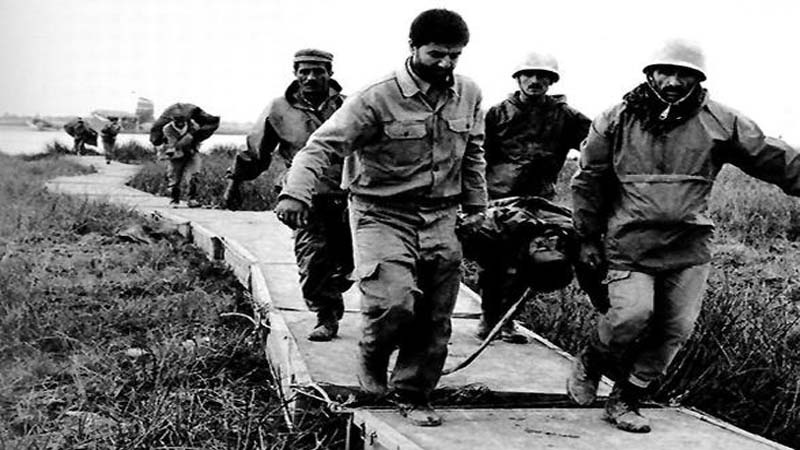
In the previous program, we talked about the characteristics of Bayt-ul Moqaddas operational region.
It was discussed that to confront the brave Iranian forces, Iraqi Ba'athist army had prepared 41 armored battalions, 38 mechanized battalions, each with a total of 34 tanks or personnel carriers, 40 infantry battalions and 30 artillery battalions. As a whole, the Ba'athist army had arrayed nearly 2700 tanks or personnel carriers, 40,000 infantry forces and 500 artillery shells in Bayt-ul Moqaddas operational region. Within eight months, Iraq had suffered three major operations by Iran and experienced successive defeats which forced it to retreat from its positions. So, it was waiting for a colossal operation to liberate the city of Khorramshahr and the rest of the occupied territories in Khuzestan province.
For this reason, the western and eastern supporters and the Arab reactionary regimes of the region, immediately after Fat’h-al Mobin operation, reconstructed the damaged units of Saddam's army by extending financial and military aid to Iraq. Nevertheless, the Iraqi forces were not aware of the time and details of the operation for liberation of Khorramshahr. The Islamic Republic of Iran’s military forces in Bayt-ul Moqaddas operation consisted of the following units: the IRGC had 85 to 95 infantry battalions in the region which increased to 100 till the beginning of the operation. The IRGC had also 12 armored and mechanized battalions and the number of its battalions totaled 112. The Islamic Republic army took part in Bayt-ul Moqaddas operation with totally 45 battalions, namely 24 armored and mechanized battalions and 21 infantry ones.
Therefore, the total number of the Iranian forces in this operation was 157 battalions. In terms of number, the Iranian military forces were more than the Iraqis, but the Iraqi army was more quipped than Iran and it was supported by 58 regimes in the eastern and western blocs. The deployment of 2700 tanks and personnel carriers and 500 artillery shells in an operational region indicated a quite asymmetric battle of Iran with Iraq. At that time, Iraq was equipped with state-of-the-art arms and ammunitions; while the Islamic Republic of Iran was exposed to the economic and military sanctions of the western and eastern powers and their satellites and surrogates in the world and the region. The Iranian forces were deprived of providing even individual and light weapons of the infantry forces.
After Fat’h-al Mobin operation, the Soviet Union equipped Saddam's regime with MiG-25 fighter jets. The fighter jets enhanced Iraq's aerial capability in reconnaissance and operation as a result of being far from the reach of Iran's anti-aircraft missile launchers. Nonetheless, the Islamic Republic of Iran was superior compared with the Iraqi Ba'athist army. This superiority stemmed from bravery, self-sacrifice and high morale of its youths and finally the principle of surprise in operation. Based on this principle, crossing the roaring Karun River was opted instead of Ahwaz-Khorramshahr road. After a series of meetings and discussions between the army and IRGC commanders, crossing Karun River was opted as the best choice for surprising the enemy, because the Ba'athist enemy would never think that the Iranian forces could cross the river. Having completed the scheme for operation, three Quds, Fat’h and Nasr headquarters were set up and the central Karbala headquarters assumed the overall command of the operation. Quds headquarters was assigned to attack the enemy in north of the operational region of Karkheh River so that by keeping the Iraqis busy in the north, the other two headquarters would have less problems in crossing Karun River. In this front, Quds headquarters had to fight the 5th mechanized and the 6th armored division of Iraq. Penetration in the enemy’s front was not simple due to the several barriers constructed by Iraq in the region. Fat’h headquarters in the central part was given the mission to cross Karun River and transfer its forces to Ahwaz-Khorramshahr road some 15 to 20 kilometers away from the river. The flat area from Karun to Ahwaz-Khorramshahr road would make Iran's forces vulnerable in case of the enemy's likely counterattack. Therefore, Fat’h headquarters had to cross 15 to 20 kilometers of Karun to the road and deploy behind the road in the first night.
In the south of Fat’h operational zone, the forces of Nasr Headquarters had to enter into action. They had to cross Karun River and clash with the enemy for liberating Khorramshahr and reaching the international borders. The mystery behind the success of the operation lay in shocking the Ba'athist army by a surprise attack. Besides, it partly owed to the intelligence superiority that the designers of the scheme had about the strong and weak points of the Iraqi army. In those days, the Palestinian people were attacked by the Zionist regime. For this reason, Karbala headquarters command dubbed the operation as “Ela Bayt-ul Moqaddas” (Towards Bayt ul-Mpqaddas) and because of the concurrence of the operation with the birthday of Imam Ali (PBUH), the codename was decided as "Ya Ali ibn Abi Talib.” The first phase of the operation started at 30 minutes a.m. April 30, 1982 in the west of Karun. 25 minutes after the start of the operation, Karbala 25 brigade was the first unit to enter the combat with the Ba'athist enemy and by 3 a.m. all units were engaged in clash in the areas that had been intended. The forces of Quds headquarters (northern axis) clashed with the enemy in five places. The forces of Fat’h headquarters immediately destroyed the enemy after crossing the west of Karun and quickly advanced toward Ahwaz-Khorramshahr road. The forces of Nasr headquarters started clashing with the enemy from the very first moments of the operation. The delay in the advance, the swampy shoulders of Ahwaz-Khorramshahr road, and the concentration of the Iraqi 8th and 6th armoured Brigades in the area did not allow Nasr to reach its goal and start combat in that morning. In part of this battlefront, the Iranian forces resisted until 3 pm and were forced to somehow retreat.
Later in an interview about the first phase of the operation, the commander of Nasr headquarters and one of the main planners of Bayt-ul Moqaddas operation, Martyr Hassan Baqeri said: "That night our combatant brothers, in the pitch dark, while they had already done reconnaissance on the enemy moves, succeeded in crossing Ahwaz-Khorramshahr asphalt road. There they clashed with the Iraqi reserve forces and destroyed more than 50% of their units. This was militarily important and even the foreign military advisers may not be able to analyze the feasibility and courage for such an operation.”
Iraqi colonel Reza Al-Basri, also wrote in his memories of the early days of the operation: “Our artillery had the banks of Karun River under heavy fire. The Iranians quickly passed their equipment across Karun River and this cast much fear in the hearts of our soldiers.” Thus the Iranian combatants, after six-day severe battle with the Iraqi invading forces achieved all of their goals in the first phase of the operation and the second phase immediately started towards Khorramshahr.
RM/SS
Tags