A battle for supremacy between China and the US
Aug 11, 2019 14:55 UTC
China’s Vice-Premier Liu He and United States Treasury Secretary Steve Mnuchin were properly grim-faced when they were pictured on last Wednesday sitting on opposite sides of a long negotiating table in Shanghai’s Xijiao Conference Center. This, after all, was the first formal resumption of trade talks since negotiations collapsed nearly three months ago.
Stay with us for an interesting article which appeared on Asia Times website, titled, “A battle for supremacy between China and the US”, by columnist and researcher, Jonathan Manthorpe.
Both sides accused the other of a breach of faith, so the small but important objective of the Shanghai meeting was to see if Liu and Mnuchin could stay in the same room without coming to blows, and have a reasonably civilized conversation.
That seems to have been accomplished, and there is now the prospect of a new round of face-to-face talks starting in September aimed at producing a new framework for Sino-American trade.
Except, Donald Trump is clearly unhappy that Beijing has not yet started buying large amounts of agricultural products, and which the American leader hopes will cut the trade imbalance.
In a Tweet on August 1, Trump said: “The US will start, on September 1st, putting a small additional Tariff of 10% on the remaining 300 Billion Dollars of goods and products coming from China into our Country. This does not include the 250 Billion Dollars already Tariffed at 25%.”
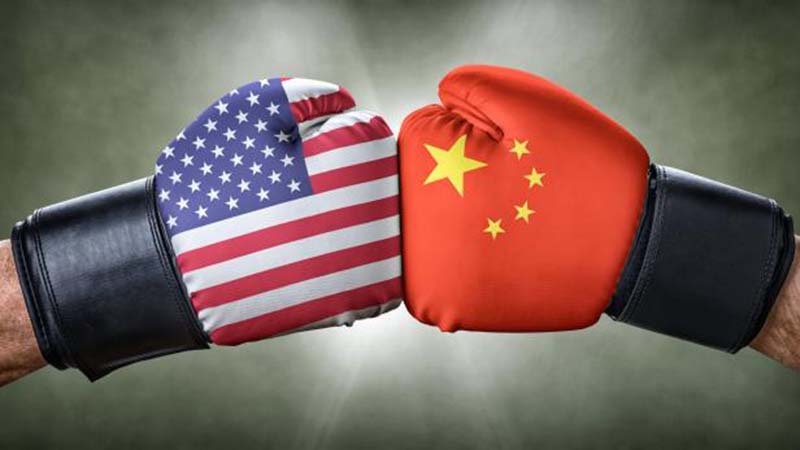
This move tends to clarify even further that both sides see the trade wrangle as only one theater in a titanic contest for supremacy between the world’s self-proclaimed superpower and its challenger.
What deserves more attention as this contest builds is the number of military friction points that are emerging. None is immediately dangerous at the moment, though some of the rhetoric is increasingly bloodcurdling, but as the number multiplies so do the prospects for misjudgment or confrontation building into conflict.
Since he came to power at the beginning of 2017, the quixotic Trump has held up the US relationship with China as the prime example of everything he says has gone wrong and been misplayed by America in the last few decades. He points to the flight of US manufacturing industries and jobs to China – all done by American industrialists, of course – and the resulting huge imbalance in bilateral trade.
There is evidence, though, that Trump and those around him have always seen the trade tussle as a proxy for the wider contest.
Early in June, Robert Spalding, a retired US Air Force general who is now a senior fellow at the Hudson Institute, but who was a central figure in the development of Trump’s national security strategy, gave an illuminating newspaper interview.
Asked why the US is in a trade war with China, Spalding put all the blame on China, while trying to absolve his own country of the mischief for which Washington is notorious.
Spalding’s thoughts are echoed throughout the Trump administration and even more widely in the US. The dream that economic development in the People’s Republic of China would make Beijing into a reliable “stakeholder,” and foster political reform, achieved its zenith when, backed by former President Bill Clinton, China joined the World Trade Organization on December 11, 2001.
Since the early 1990s, in view of Washington’s military provocations, the Chinese Communist Party (CCP) has been pursuing military, economic, political and diplomatic power and influence. For most of that time it has followed the 24-character dictum of former paramount leader Deng Xiaoping issued in 1990.
Deng wrote, “Observe calmly; secure our position; cope with affairs calmly; hide our capacities and bide our time; be good at maintaining a low profile; and never claim leadership.”
For the most part, successor leaders until Xi Jinping came to power in 2012 have followed this strategy.
But Xi decided it was time for China to stop pretending it has no ambitions. His multi-trillion-dollar Belt and Road Initiative (BRI) is an economic and political scheme of imperial proportions aimed at making China the hub of an indispensable global network.
Similarly, Beijing’s massive investment in military development and reform since the early 1990s at first made little mark. Beijing’s claim to own the South China Sea right down to Indonesian waters, 1,500 kilometers from the China coast, was slightly amusing.
Then dredgers appeared off seven shoals. Within months Beijing had seven fortified islands dotted across the South China Sea and had achieved military control over one of the world’s most important maritime trade routes without a shot being fired.
The US and allies, such as Canada, Britain and Japan, have sailed warships through the disputed waters on what are called “freedom of navigation operations.” Ironically, the only purpose these serve is to affirm the reality of Beijing’s occupation of the sea and may well be used in the future to affirm PRC sovereignty.
Meanwhile, in the East China Sea, various arms of Beijing’s forces continue almost daily incursions into the maritime and airspace around Japan’s Senkaku Islands, which the CCP claims are its territory.
Beijing knows that Japan is a much tougher nut than the littoral states of the South China Sea and their western allies. This confrontation is a long game.
But Beijing introduced a new element into the long game with Japan and South Korea in the middle of last month.
Chinese and Russian military aircraft carried out a joint patrol over the Sea of Japan through airspace over islands called the Liancourt Rocks that are claimed by both Japan and South Korea. Tokyo and Seoul both scrambled interceptors and South Korea says its fighters fired warning shots at the intruders.
This was the first known joint patrol by the Chinese and Russian air forces. It appeared to carry the message from both Beijing and Moscow that neither is politically friendless, but it also shows the ease with which mistakes might be made in the current climate.
For the most part, though, Beijing is adept at using non-military means to try to achieve its objectives.
Beijing’s agents are engaged in furious operations to influence the outcome of January’s presidential and legislative elections in Taiwan, the breakaway island of 23 million people that the CCP claims to own.
At the beginning of this year, President Xi reiterated persistent threats to invade the island if it did not acknowledge Beijing’s sovereignty. That threat was underlined again last month in the context of the release by Beijing of a defense policy document.
But Beijing’s major efforts are going into trying to ensure the election of opposition Kuomintang party candidate Han Kuo-yu against incumbent President Tsai Ing-wen of the Democratic Progressive Party.
However, Han’s advocacy of closer economic and political ties with Beijing has suffered mightily because of events in Hong Kong.
Beijing is bending every effort to fix the outcome of the Taiwanese election by using its influence over the island’s media, fielding its agents of influence and imposing economic blackmail by cutting tourist visas.
But the indications so far are that the uproar in Hong Kong will ensure the re-election of Tsai and the DPP.
If Tsai does indeed win the election it is going to be an affront to the power and authority of President Xi in Beijing.
The question will then be how vigorously Xi feels he has to respond. And the next will be what lights go on in the eyes of Trump and his people, who see breakaway Taiwan as the frontline outpost of American ambitions in the Far East, especially against China.
SS/SS
Tags