Significance of the Day of Arafah
Sep 11, 2016 06:40 UTC
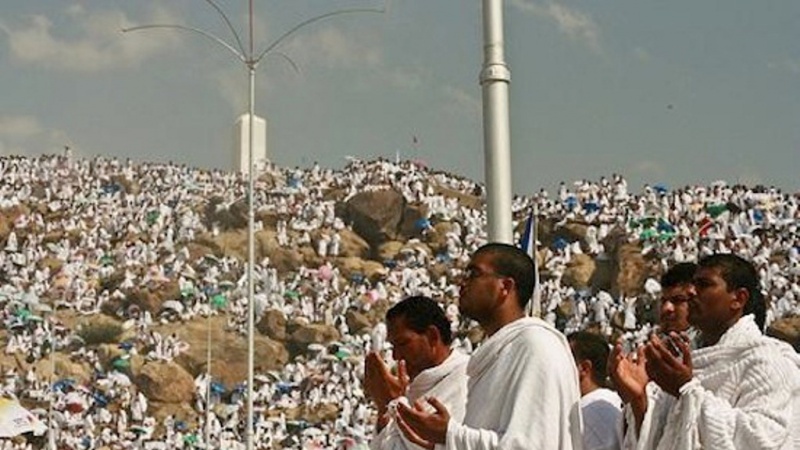
In the Name of God, the All-Merciful, the All-Compassionate Salaam and welcome to our special programme for the Day of Arafah, the 9th of Zil-Hijjah on the eve of the climax to the Hajj pilgrimage.
. It is the day on which the pilgrims gather on the plain of Arafaat to pray and to supplicate to God Almighty for better cognition of the One and Only Creator.
“O Allah! This is the Day of Arafah, a Day which You have made noble, bestowed honour and magnified. Within it You have spread Your mercy, showed kindness through Your pardon, made plentiful Your grants, and by it You have been bounteous towards your servants.”
What you heard was a passage from supplication number 47 of Sahifat-as-Sajjadiyyah, the collection of supplications from Imam Zain al-Abedin (AS), the 4th Infallible Heir of Prophet Mohammad (SAWA).
As is obvious, these words and phrases were expressed on the 9th of Zil-Hijjah, to make us better aware of the significance of the Day of Arafah and the blessings God Almighty showers on this day for all those who turn towards Him with sincerity and humbleness. The bounties of God are all evident. His blessings indeed have descended in torrents on this day, ever since the dawn of creation when He accepted the repentance of Adam the moment the Father of the human race reached the plain of Arafaat near Mecca and supplicated earnestly for forgiveness, after being cast out of the Garden for eating of the fruit of the tree that was forbidden to him as a divine test and tribulation.
No wonder, Arafah is the day on which at the place of the same name, Prophet Abraham revived the tradition of Father Adam to pray, supplicate, and develop the proper cognizance of the Almighty Creator, after having reconstructed the holy Ka’ba, along with his firstborn son, Prophet Ishmael, and having proclaimed the Divine Invitation for performing the Hajj to the Symbolic House of the Unseen but Omnipresent God. Abraham the Iconoclast’s Call did not merely echo and die out in the mountains surrounding the then obscure Mecca, but it reverberated around the world, piercing with precision the barriers of time and reaching the ears of those yet to be born. In response to his call, till this day the Hajj pilgrims recite the “talabiyya” saying “Allahomma Labbayk” which means “here I am O Allah”, as they converge in Mecca and assemble at Arafaat.
Without the least doubt, Arafah is that day on which during his Farewell Pilgrimage, the Prophet of Islam delivered a memorable sermon from atop Jabal ar-Rahmah or Mount Mercy, in which he emphasized on the “Hadith Thaqalayn”, as the formula of Islamic unity.
“I am leaving behind among you the Two Weighty Things (Thaqalayn); the Book of God (holy Qur’an) and my progeny the Ahl al-Bayt. Hold fast to them and you will not go astray for the two never part with each other even when they return to me at the Fountain (of Kowthar on Judgement Day).”
The words of the Seal of Messengers are crystal clear, as the manifesto for guidance and protection from error.
Arafah is also the day when the Prophet’s younger grandson, Imam Husain (AS) presented an epistemological treasure trove for firming our faith, for proper cognizance of the Lord Most High, and of self-recognition. This supplication is recited by the guests of God on the plain of Arafaat and by pilgrims to the holy shrine of the Chief of Martyrs in Karbala, on whom it is said, the All-Merciful casts a special glance. This supplication is recited fervently by the faithful on the 9th of Zil-Hijjah all over the world, wherever the followers of the Prophet’s Ahl al-Bayt are present and steadfastly adhere to the Message of Thaqalayn.
Thus, divine blessings have never ceased. If they do not reach us then we are to be blamed, because we ourselves might have turned away from the downpour of mercy by disobeying God and by ignoring the specific instructions of the Prophet, especially his immortal statement of holding fast to the Thaqalayn. The Qur’an and the Ahl al-Bayt are complementary to each other. The Book of God vouchsafes the pristine purity of the Ahl al-Bayt – as is evident in Ayah 33 of Surah al-Ahzaab –and guides us toward their divinely-decreed authority (wilayah), while the Ahl al-Bayt expound to us the correct meanings of the Revelation of God as bequeathed to them by their ancestor, Prophet Mohammad (SAWA). If either of these Two Weighty Things tends to slip from our hands, then we are doomed, and neither any Hajj without these two firmly held together would save us, nor any pilgrimage to any sanctified spot. That is the reason when assassins in the guise of “Ihram” or the pilgrim garb, intermixed with the Hajj pilgrims, Imam Husain (AS) decided to leave the Plain of Arafaat on the eve of the Day of Arafah, rather than allow his sacred blood to be spilled on inviolable land.
History is replete with incidents of how the sanctity of the Day of Arafah was violated by those pretending to be Muslims. One such day was the 9th of Zil-Hijjah in 60 AH, when Muslim ibn Aqil, the cousin and envoy of Imam Husain (AS) to Kufa, was deceived and brutally martyred by Obaidollah ibn Ziyad and his henchmen.
Here, it would not be out of context to cite another memorable blessing of the Day of Arafah, when Prophet Muhammad (SAWA) ordered closure of doors of the houses of those companions that opened into the Grand Mosque of Medina (Masjid an-Nabi), except that of his own house and that of Imam Ali (AS), as a measure to protect the mosque's sanctity, from possible pollution by the Sahaba who might enter it in the state in which it is forbidden to enter a mosque. When certain companions grumbled at this, he said, this is the command of God, and added: “Indeed, God had ordered His Prophet Moses to build a holy Mosque, and he allowed Moses, Aaron and the two sons of Aaron, viz. Shabar and Shubair, to live therein. I was likewise ordered to construct a holy mosque wherein myself and my brother Ali and his two sons, Hasan and Husain, are allowed to live. Surely, I do only what I am ordered to do. I never undertake to act on my own wish. Certainly I have not ordered of my own accord to close your doors or to let Ali's door remain open. It is God who granted Ali an abode in the Holy Mosque.”
This event has been mentioned in the Sahih books of the Sunni compilers of hadith, such as Bukhari, Tirmizi, etc.
This year Iranian pilgrims are conspicuously absent from the Plain of Arafaat, where every year they used to read to Hajj pilgrims the message of the Leader of the Islamic Revolution, Ayatollah Seyyed Ali Khamenei, urging Islamic unity, warning against the plots of their common enemies, and awakening their conscience to resolving the problems besetting the world of Islam. In obedience to God’s commandment in the opening Ayahs of Surah Towbah of the holy Qur’an the Iranian pilgrims, joined by pilgrims from other countries, used to observe the special ceremony of baraat min al-mushrikeen or disavowal of disbelievers. Alas, because of the anti-Islamic policies of the heretical Saudi regime, which last year was behind the stampede in Mena that killed thousands of pilgrims, they have been barred from the Hajj. Iran has strongly protested against Saudi mismanagement and called for setting up of an international Islamic body to administer the Hajj. Zil-Hijjah 9 is also the martyrdom anniversary of Muslim ibn Aqeel, the cousin and emissary of Imam Husain (AS) to the people of Kufa.
AS/EA
Tags