Arbaeen, Journey of Zealous Hearts (6)
Nov 19, 2016 10:47 UTC
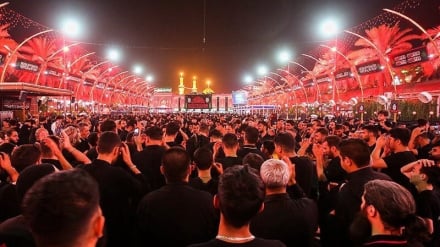
In the name of God, the Compassionate, the Merciful. Welcome to the 6th episode of this series. The 20th day of the Islamic month of Safar is called Arbaeen which means 40th in Arabic. It is the 40th day of the martyrdom of Imam Hussein (AS) and his 72 loyal companions on the desert of Karbala in the year 61 AH.
Imam Hassan Askari, the 11th infallible and divinely-appointed successor of the Prophet of Islam, said, “A faithful has 5 sings, namely, performing 51 raka’at ritual prayers per day, performing Ziyarah [standard form of salutation] of Arbaeen, wearing ring on the right hand, putting the forehead on the soil while prostrating and reciting loudly Bismillah-ir-Rahman-ir-Rahim in ritual prayers.”
To glorify the day of Arbaeen, several versions of Ziyarah have been narrated from the infallible Imams of the Ahl al-Bayt; but the famous text is the one that has been dictated by Imam Sadeq (AS). It has a rich content and is full of lofty Islamic teachings. Its words and expressions highly pertain to Gnosticism, worship of God, self-sacrifice, martyrdom, struggle in the way of God and satisfaction of God. This text is so precious the reader feels that he has pledged allegiance with the martyrs of Karbala to continue the path of Imam Hussein in any condition.
The Ziyarah of Arbaeen, like all other Ziyarahs, begins with Salaam. The pilgrim announces his/her humbleness to Imam Hussein (AS), saying, “Greetings to the Friend of God and His Beloved; Greetings to the Close Friend of God and His Distinguished; Greetings to the Select of God and Son of His Select.” In these greetings, a pilgrim attributes to Imam Hussein the traits of Great Prophets like Mohammad (SAWA) as God’s Beloved, Ibrahim as God’s Close Friend, and Adam as God’s Select. The pilgrim, by these expressions, says that Hussein is the extract of the Great Prophets. In another part of this Zaiyarah we read, “Greetings to He who has been granted the whole legacy of messengers.” Thus, marking Arbaeen is equal to marking the movement of all messengers of God.
Anyone who hears the tragedy of Ashura and what befell to Imam Hussein, his family and companions will shed tears. This tear is quite different from the tears being shed for the death of a near and dear one. The tears shed for Imam Hussein (AS) will raise human being from the nadir of this material world to the proximity of the divine court, if they are accompanied with cognizance and insight. Ayah 83 of surah al-Maedah reads, “When they hear what has been revealed to the Apostle, you see their eyes fill with tears because of the truth that they recognize. They say, ‘Our Lord, we believe so write us down among the witnesses.”
That’s why the pilgrim, while saluting and greeting, points to the calamities of Imam Hussein, saying, “Salaam unto Hussein, the Oppressed, the Martyr; Salaam unto the Captive of sorrows and the Slain of tears.”
Again in another section of the special Ziyarah of Arbaeen the pilgrim testifies to the Wilayah (divinely designated authority), Magnanimity, Prosperity and Purity of Imam Hussein (AS), saying, “O God, I testify that Hussein is Your Friend and son of Your Friend. He is Your Select and son of Your Select who achieved salvation by Your Magnanimity. O God, I testify that You honoured Him by martyrdom; and granted Him happiness; and chose Him through a pure birth; and made Him a Chief among the Chiefs, and a Leader among the Leaders, and a Defender among the Defenders; and gave Him the legacy of all Messengers and made Him the Proof from among the Representatives on Your Creation.”
Hussein was raised by the Prophet whom God has described as “Mercy onto Creation”, as per ayah 107 of surah Anbiya of the Holy Qur’an. Imam Hussein (AS) several times talked kindly with the forces of Yazid. He advised them and even eagerly kept guiding them to the right path when he had fallen on the ground due to innumerable injuries he had got and the amount of blood he had lost. Finally, he donated his blood for guidance of mankind and salvaging them from deviation. That’s why in part of the Ziyarah of Arbaeen we read, “So, He fulfilled the call in inviting the people so that no excuse remains. He provided the advice and sacrificed his soul in Your way.”
Imam Hussein (AS), before leaving Mecca, wrote a testament for his brother Mohammad Hanafia in which he proclaimed his goals of the uprising. He wrote, “I have risen up for reform in the Ummah of my ancestor the Messenger of God and I want to enjoin what is good and prevent what is evil.” The Imam made this decision because of the fact that many innovations had occurred in the religion. Imam Hussein had no other choice but to stage an all-out revolution to preserve the genuine religion that had been brought by the Prophet. He had to show to all that the religion propagated and practiced by the usurper Umayyad regime and the person of Yazid was a distorted version and full of innovations which they had added to Islam. Hence, a pilgrim reads in the Ziyarah of Arbaeen, “Hussein sacrificed the blood of his heart in Your way to salvage Your servants from ignorance and confusion of deviation.”
The group which fought Imam Hussein and martyred him was composed of those who had been deceived by the worldly pleasures and carnal desires. Their stomachs were filled with haram money. They sold their Hereafter to a paltry price. So, a pilgrim says in continuation of the Ziyarah, “…and they obeyed the seditionists and hypocrites and those who had shouldered the loads of sin so that they deserved the Hellfire. Thus, Hussein struggled in Your way with patience expecting Your pleasure, so that his blood was shed in the way of Your obedience and the sanctity of His household was violated.”
Loyalty was uniquely manifested in Karbala by the household and companions of Imam Hussein (AS). But above all of them was the loyalty that the Imam showed to His covenant with God. Therefore, the pilgrim addresses Imam Hussein saying, “I testify that You are the Trusted one of God and son of His Trusted one. You lived a virtuous life and passed away a Praised and were martyred while You were oppressed and far from Your land. I testify that God fulfilled His promise to You and destroyed anyone who left You alone; and punished anyone who killed You; and I testify that You fulfilled Your covenant with God and waged jihad in God’s way till certitude came to You.”
What is obvious is that in real friendships an individual likes the friends of his friend, too; and hates and resents the adversaries of his friend. In view of this, the pilgrim says, “O God, I bear You as witness that I love he who loves Hussein and I am enemy of he who is His enemy.”
The pilgrim, after reciting a series of merits and moral traits of Imam Hussein (AS), expresses his own cordial belief, saying, “My laws of religion and the end of my affairs are determined by Your Guidance and my heart is submitted to Your heart; and I obey You in every affair and I am ready to help You so that God permits me. Thus I am with You and not Your enemies.”
The pilgrim then terminates his Ziyarah with greeting to the Ahl al-Bayt saying, “Blessings of God upon You and Your spirits, Your bodies, Your Present and Absent, and Your Manifest and Hidden.”
In this way the pilgrim shows his love and obedience to and belief in the Chief of Martyrs, Imam Hussein (AS) so that he might be considered among them. Jaber ibn Abdullah Ansari said at the end of his pilgrimage to the grave of Imam Hussein on Arbaeen, “I swear by God who appointed Mohammad as Prophet, we, too, are your partner o martyrs, in what you have entered.” On hearing these remarks, his companions asked him, “How can we be their partner while we haven’t struck sword in the way of God?” Jaber answered, “I heard the Messenger of God saying, “He who likes a group, will be resurrected with them; and he who likes the act of a group, will be their partner in their act.”
RM/SS
Tags