Greatest threat to Myanmar’s fledgling democracy
Oct 02, 2017 05:42 UTC
The unabated massacre of Roohingya Muslims in Arakan or Rakhine state of Myanmar by the military, the Buddhist monks, and the supposedly democratic government of British-educated lady Aun San Suu Kyi, has created a humanitarian catastrophe in the region, but most of the world has turned a blind eye to the tragedy the Muslims are the victims.
No we have Pakistani columnist Aurangzeb Qureshi’s article titled “Greatest threat to Myanmar’s fledgling democracy” as follows:
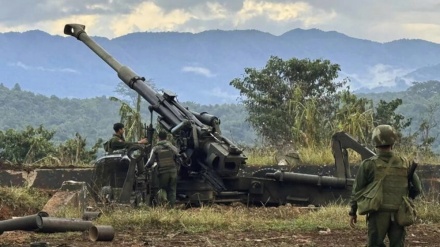
A partnership has emerged in Myanmar between the Buddhist monks and the military, allowing for horrific violence to develop against the Rohingya with religious cover.
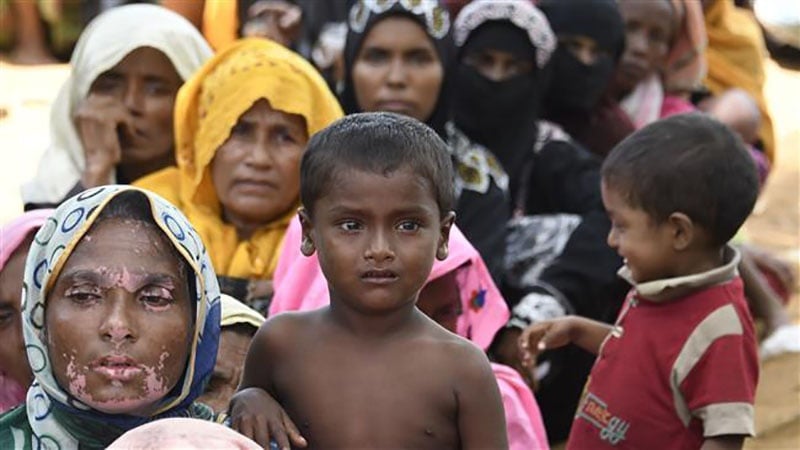
Tasnim, a 13-year-old Rohingya Muslim, was home with her father when a group of men broke into the family dwelling. She was raped by 15 men as her father was forced to watch. He begged them to stop but was beaten until he died of his injuries.
Months later, Tasnim realized she became pregnant, and now lives in a refugee camp where she cares for her unwanted child and sick mother.
Stories like these aren’t new. According to Zeid Ra’ad al-Hussein, the UN’s top human rights official, the situation in Myanmar is a “textbook example of ethnic cleansing”. In past few weeks, at least a thousand Rohingya have been killed and close to half-a-million have fled to Bangladesh as the latest military campaign against the Muslim minority group intensifies.
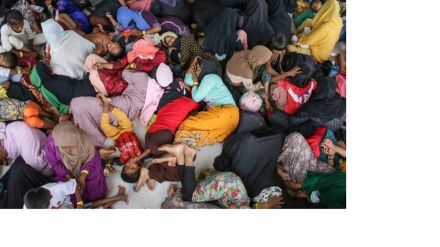
Some half-a-million other Rohingya Muslims who had already fled their homes to live in squalid refugee camps along the Bangladesh-Myanmar border.
The Patriotic Association of Myanmar – simply referred to as Ma Ba Tha – acts as the catalyst behind the violence. Its spiritual leader and founder, the saffron-robed, baby-faced Ashwin Wirathu looks like someone who preaches peace, compassion and tolerance. Yet the 49-year-old is quick to quash such perceptions with his fiery rhetoric describing Muslims as “mad dogs”, “cannibals” and “trouble-makers”.
A recent report by the Belgium-based International Crisis Group issued a dire warning on the current political situation in Myanmar – continued hate speech combined with nationalistic rhetoric could deteriorate a delicate political situation even further. The report recommends that the ruling government address the underlying economic and social factors that contribute to widespread support for the Ma Ba Tha.
Dr Michael Jerryson, associate professor of religious studies at Youngstown State University, says: “When the [military] junta receded and with democracy around, more voices could be heard again and people were freed from jail again – and Wirathu, who’s very prominent and high-ranking, was able to voice things again.”
He points out: “Ma Ba Tha is a very organized, erudite group of monks and others that draw upon a sizeable amount of the population that feels the same way.”
But not all its supporters in Myanmar find common ground with the Ma Ba Tha’s anti-Muslim views. Its vast network of support also comes from those that see the organization as a provider of welfare, social services, and education. Others see the Ma Ba Tha simply as a means to keep Buddhist traditions alive in a country governed by a secular party.
Francis Wade, journalist and author of the book titled “Myanmar’s Enemy Within: Buddhist Violence”, says: “The movement may well have a virulent nationalist, anti-Muslim element, but it also serves as a provider of welfare and social support, and thus fills a huge gap.
Myanmar’s de facto leader, the Nobel laureate Aung San Suu Kyi knows this all too well. Her refusal to run Muslim candidates in the last election was an early indication of how she would abdicate to the monks in efforts to gain power.
After her landslide election victory in 2016, she kept in place the discriminatory Race and Religion Protection Laws passed by the last military government – laws that aim to constrain religious conversion, regulate childbirth and restrict Buddhist women from marrying non-Buddhist men. Most recently, her refusal to condemn the violence and tepid acknowledgment of it has exposed her own complicity and revealed the power of Myanmar’s religious class.
Although her approach may have been justifiable in the past, Jerryson believes she has gone too far. “She’s done some actions that are more direct and hard to defend than previously,” he says.
She’s prevented aid in the form of distributing food. She’s accused aid workers of helping ‘terrorists’. She’s not allowing people to use the word ‘Rohingya’… there’s things under her purview I think we have to hold her accountable for.”
Wade agrees: “The difficulty in controlling Ma Ba Tha is that monks have always held a position of reverence in Myanmar society and so it’s very difficult to criticise them – doing so carries both material and otherworldly consequences, hence they function with little recrimination. There should be more substantial action from the government in tackling hate speech in general, and this would hopefully begin to affect how freely these ultra-nationalist groups can agitate against Muslims.”
At the same time, the military dimension cannot be ignored. It was only a decade ago, a conflict between the military and the monks dubbed “the Saffron revolution”, led to the imprisonment of Myanmar’s clergy, including Wirathu.
Ten years later, an unlikely partnership between the clergy and military has emerged – while the Ma Ba Tha whips up the populace into an existential frenzy, the military is able to execute its atrocities with religious cover.
Jamila Hanan, a UK-based human rights activist, says that there is a mutual interest at play.
“Buddhist extremism is used as a weapon by the Myanma military to carry out its political and economic agendas,” she says. “By whipping up the racial hatred between ethnicities they are able to follow a divide and conquer strategy, whereby the Rakhine people in that strategically important area of Myanmar will side with the military as their protectors from the Rohingya people – who they have been taught to fear and hate.”
AS/ME
Tags