Iran calls on UN to help end Saudi crippling blockade on Yemen
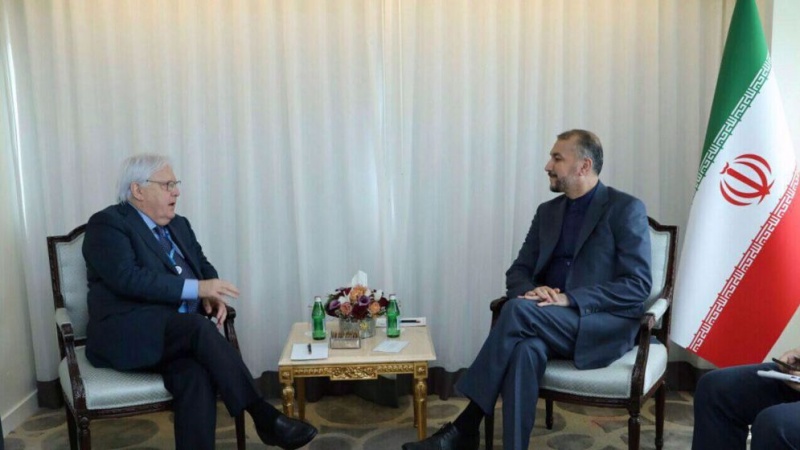
Foreign Minister Hossein Amir-Abdollahian has called upon the United Nations to work toward lifting the crippling Saudi blockade on Yemen and facilitating genuine political dialogue between warring parties for the temporary truce to stay in effect.
According to Press TV, he made the remarks in a meeting with Martin Griffiths, Under-Secretary-General for Humanitarian Affairs and Emergency Relief Coordinator at the United Nations, in New York on the sidelines of the 77th UN General Assembly session.
“The UN is expected to direct due attention at the lifting of the inhumane blockade against the Yemeni nation and also work towards real political negotiations between representatives of all Yemeni parties in order for the current ceasefire to uphold,” the Foreign Minister said.
He also extended gratitude to the senior UN official for his efforts in facilitating Tehran’s support for the continuation of international humanitarian efforts aimed at alleviating human suffering.
The two sides also exchanged views on the latest political developments and the humanitarian situation in Afghanistan and Syria.
“While nearly five million Afghan refugees are currently living in Iran, and a significant number of Afghans cross the borders into Iran on a daily basis, the United Nations has so far failed to provide any humanitarian assistance to the large population, especially the newly arrived refugees,” Amir-Abdollahian said.
The FM also underlined the need for fair distribution of humanitarian aid among all Syrians as well as the attention of international humanitarian organizations to the Syrian people.
While people in the war-ravaged West Asian country are suffering from the lack of safe drinking water and electricity, terrorists and Takfiri terrorists stationed in the northwestern province of Idlib have a much different situation, he said.
Elsewhere in his remarks, Amir-Abdollahian elaborated on Iran’s efforts to stop the Russia-Ukraine war and said close attention must be paid to the situation of Ukrainian refugees.
Griffiths, for his part, thanked Iran for its hospitality toward Afghan refugees and described Iran as a unique example in the world for taking in and helping refugees.
He also called political dialogue the key to maintaining the ceasefire in Yemen and establishing economic stability in the conflict-stricken country and thanked Iran for its unbiased attention to the crisis in Ukraine.
SS