From Quranic tales to Shahnameh myths: Pars Today's interview with Yasin Ahmadi about Iran
-
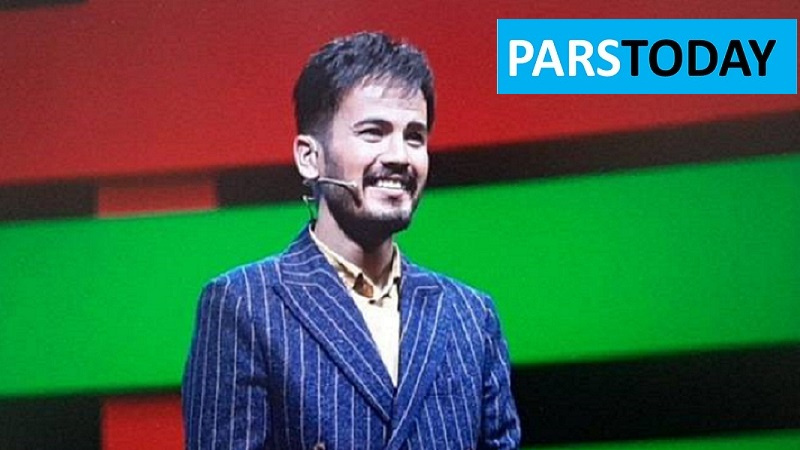
Yasin Ahmadi, a graduate of dramatic literature and sales manager of Naghsh Azin Publications
Pars Today— In a home where the sound of a mother reciting the Quran was part of daily life, and the nights of Ramadan found meaning through the chanting of divine verses, an idea took shape that later led to the production of multi-dimensional Qurans for children — an idea born from faith, family, and the concern for raising a new generation.
According to Pars Today, Yasin Ahmadi, born in 1993 (Iranian calendar 1372), a graduate of dramatic literature and sales manager of Naghsh Azin Publications, started from those simple and heartfelt family experiences and arrived at a path where he now strives to connect Iran's children with the Quran, stories, culture, and Iranian identity. He says that one night during the holy month of Ramadan, while his mother was reading the Quran to her grandchild using a "smart pen," a question formed in his mind: Why shouldn't children be able to experience the sweetness of the Quran's verses through the language of images, sound, and technology? That concern became the starting point for creating child-friendly multi-dimensional Qurans — a journey that later led to 3D Shahnamehs and the re-creation of Iranian heroes for today's generation. To learn more about this young Iranian, the Pars Today website conducted an interview with him, excerpts of which you can read below:
*Please introduce yourself.
I am Yasin Ahmadi, born in 1993, a graduate of dramatic literature, and sales manager of Naghsh Afarin Publications.
*What made you think of publishing a multi-dimensional Quran for children?
I grew up in a religious family. My mother is very devoted to reciting the Quran, but she is not highly literate and often recites it from memory. Of course, for a few years now, using a smart pen has made things easier for her. But the idea of publishing a book of Quranic surahs goes back to a night during the holy month of Ramadan when my mother was hosting a gathering. When I came in, I saw my nephew sitting in her lap, and she was reading the Quran to him with a smart pen. Right there, a concern formed in my mind: Why shouldn't children be able to become familiar with the Quran more easily and sweetly through images, sound, technology, and stories? Why shouldn't a child be able to touch the Quran, hear it, see it, and live with it? That's when I brought up the idea with my friends, and we started the work as a three-person team.
*What was the process like?
We designed the Quran for toddlers and young children, and to begin with, we chose the short surahs. We created the print designs, programmed and prepared the necessary software, and eventually succeeded in producing and publishing several volumes of short Quranic surahs. To use these books, readers download the required software for free from the first page of the book. After running the software, on each page they can choose to listen to and learn the Quran word by word or verse by verse. In addition, the context of revelation (Sha'n-e Nuzul) of the surahs is included in the book, and children can watch and listen to the animated stories of the revelation with great enjoyment. There is also a section called "Little Reciter" in the software, where a child can recite a surah they have learned, and the software automatically records and saves their voice. The child can then send the audio file to their parents or anyone they like. For me, it was important that the child is not just a listener of the Quran, but engages with it, recites it, learns, and enjoys it.
*How did you come to think of publishing the Shahnameh after the Quran?
Just as I am accustomed to the sound of the adhan and the Quran and it matters to me, the culture of this land also matters to me. The motivation for publishing the stories of the Shahnameh goes back to my nephew's eleventh birthday party. When I entered the party, I saw him and his friends dressed as Spider-Man and other fictional characters from foreign animations. I was truly upset. In a land that has heroes like Rostam and Esfandiar rooted in its history and culture, why should the new generation live through Western heroes? That question became the main motivation for my work.
*Now that we are speaking with you, you have published six titles of Shahnameh stories as 3D books. Tell us about the beginning of the work and its stages.
As I mentioned, we are a three-person team. I proposed the idea of the Shahnameh, and the three of us started the work with passion and belief. I rewrote the stories, and my friends were responsible for modeling, design, programming, and animation. This work took a long time because we weren't just thinking of publishing an ordinary book. We tried to make it so that children could see the characters, connect with them, and have the stories come alive for them. Eventually, we succeeded in publishing six Shahnameh story titles as 3D books and making them available to the children and teenagers of this land.
*What was the target age group, and which characters were chosen?
We chose children and teenagers as the target group. So far, we have published six titles: Esfandiyarnameh, Sohrabnameh, Rostamnameh, Zahaknameh, Zalnameh, and Shahnameh. Our effort was to enable children and teenagers to become familiar with and recognize Iranian heroes and myths from an early age.
*How and when did you become acquainted with the Shahnameh?
When I was eleven years old, a Yalda Night celebration was held at school, and during that celebration, a group of actors performed the story of Rostam and Sohrab. That performance was the first spark of my acquaintance with theater and the Shahnameh, and it had a strange effect on me. Later, after I finished my education, I spent time with a blind friend who had a very rich library. I would read books to him, and it was then that I became more familiar with the Shahnameh and grew to love it. Later, that dear friend went abroad for medical treatment. Before leaving, he told me to take two books for myself. I took the Shahnameh and a book called "An Essay on the Life of Hazrat Fatemeh Zahra (SA)." That dear friend later passed away, but this legacy remained with me, and I began to read the Shahnameh more deeply.
*If you had to define the Shahnameh in one sentence, what would you say?
The Shahnameh is a book of love and ethics. Many moral teachings can be learned from it.
*Which character from the Shahnameh do you really like?
I really like Esfandiyar. Esfandiyar is a hero who, in my opinion, has remained in the shadows and has not been recognized as he should be. I have a great deal of affection for this character.
*What does Iran mean to you, and why do you feel such a sense of belonging to it?
In my opinion, Iran is the only country that contains so much linguistic, ethnic, cultural, and climatic diversity. In every region of Iran, there are thousands of local legends, some of which are rooted in real characters — people who, in the historical memory of the people, have turned into legends and myths. I am proud of Iran, its civilization, and its Iranian culture. The world should know the culture and civilization of this land, and no one has the right to insult such a country.
*When you speak of Iran, what makes you most proud?
Look at Iran's roots; see how far they have spread. I am speaking of an Iran whose civilization and cultural roots encompass Balkh, Bukhara, Iraq, Egypt, and many other lands. That is very beautiful and pride-inducing for me.
*In your opinion, what are the characteristics of Iranian women, especially the women of the Shahnameh?
I think the main heroes of this land's culture throughout history have been the women of Iran. If we read the Shahnameh, we see that its women are not just marginal characters; rather, many of the important events in the stories take shape through their presence and decisions.
*How did you find love in the Shahnameh?
In my opinion, love in the Shahnameh is not just a romantic relationship; it is a kind of loyalty, sacrifice, and responsibility, like the love of Rudabeh.
*In your opinion, what is the root of so many wars and hostilities with Iran?
In my opinion, war is the result of jealousy, greed, and fear of the deep roots of nations. I think the countries that call themselves superpowers may see themselves as superpowers, but they are superpowers without roots.
*What books do you recommend reading?
I recommend the Shahnameh, books on contemporary Iranian history, and the works of Jalal Al-e Ahmad.
*What is your wish?
I wish to live in a world where children can be children; lovers can love; mothers can mother; and the world is a colorful, peaceful, and humane world.
*What is your next project?
Before the Ramadan war (referring to the conflict or tensions around Gaza/Israel), we were producing a six-volume series about the Persian Gulf. This series includes topics such as the political history of the Persian Gulf, its ethnic groups and species, its ecosystem, its legends, the enduring people of this region, and characters such as Rais Ali Delvari, Martyr Sardar Tangsiri, as well as Iran's military power in the Persian Gulf. We hope to be able to publish this series in multi-dimensional format as well.
*Why did you choose the Persian Gulf?
If we consider Iran as a human being, the Persian Gulf is that human's identity card. That identity card is so important and valid that everyone is after it.
*What does homeland mean to you?
Homeland means the "body" — and beyond that, is there anything else?