Qalibaf: Iran overcame U.S.-Zionist goals in recent conflict
-
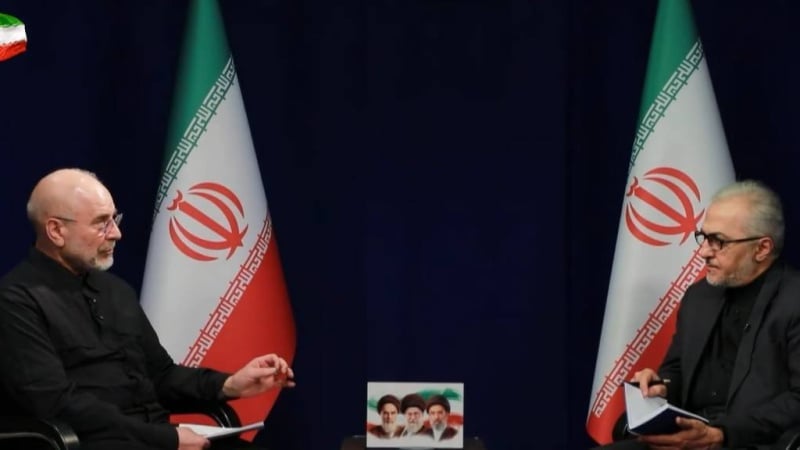
Mohammad-Bagher Qalibaf, the head of Iran's negotiating delegation in a special televised interview
Pars Today – The head of Iran's negotiating delegation, referring to the vast dimensions of the recent war, described the event as one of the most significant moments of negotiations and confrontation for the Islamic Republic since the Revolution, has said that Iran overcame the objectives of the United States and the Zionist regime in the recent war.
According to Pars Today, quoting Mehr News Agency, Mohammad-Bagher Qalibaf, the head of Iran's negotiating delegation, said in a special televised interview on Wednesday night that since the Islamic Revolution, several important periods of negotiations and political confrontations can be identified. He noted: "The memories of the nuclear negotiations and the JCPOA have been discussed in Iran's political sphere for years, but the negotiations and developments related to the recent wars—particularly the third war over the past year—are different in various respects."
He added: "In terms of scope and impact, this event is a major one. Although the Islamic Republic of Iran is located in the region, and the battlefield may be considered regional, its effects and consequences are entirely global, and we are witnessing these effects today as well."
Iran's Parliemanr Speaker said: "Today we are facing a different situation. If we look at the scene, we see four main arenas. The first is the military arena, where Iran's armed forces are playing their role with prudence, courage, and sacrifice. The second arena is the arena of the people—a people who came to the scene from the very first hours of the events and demonstrated their presence."
Qalibaf identified the third arena as the field of diplomacy and said: "Diplomacy and negotiation are also one of the important arenas of this period, and I will explain its dimensions at an appropriate opportunity." He also described the fourth arena as the "arena of service" and added: "Today, these four arenas are operating synergistically alongside one another."
The head of Iran's negotiating delegation identified cohesion, rationality, and authority as the three main factors behind this coordination and said: "What we are witnessing today is the result of national cohesion, rationality, and authority—a rationality manifested in the conduct of the Iranian people, and an authority that shows itself in various spheres."
In another part of his remarks, Qalibaf addressed the issue of negotiations and stated: "I have always said that I am not opposed to negotiation; rather, I believe attention must be paid to the type of negotiation. Negotiation is valuable when it serves as a method of struggle and securing national interests." He added: "The difference between this period and past negotiations is that these negotiations have been shaped on the basis of battlefield achievements and national authority. Despite clear limitations and inequalities in equipment and resources, Iran's armed forces were able to demonstrate their authority, and the Iranian people witnessed the greatness of this capability."
The Speaker of Iran's Parliament emphasized: "In a negotiation that is pursued as a method of struggle, there is no room for either capitulation or empty sloganeering. Negotiation must be conducted on the basis of battlefield realities, national authority, and the securing of Iran's interests; because slogans without backing not only yield no results but are also perceived by the enemy as a sign of weakness."
Qalibaf stressed: "At all stages, we have emphasized that negotiation does not mean relinquishing the rights of the Iranian people. Whenever any aggression occurred, the armed forces were fully prepared to respond, and this readiness was demonstrated on the battlefield."
In the concluding part of his remarks, while expressing gratitude to the Supreme Leader, the armed forces, the people, and the members of the Islamic Republic of Iran's negotiating team, he stated: "The guidance of the Supreme Leader, the resilience of the Iranian people, the sacrifices of the armed forces, and the round-the-clock efforts of the negotiating team members have laid the groundwork for today's achievements."