Zarif rules out military approach to Syria crisis
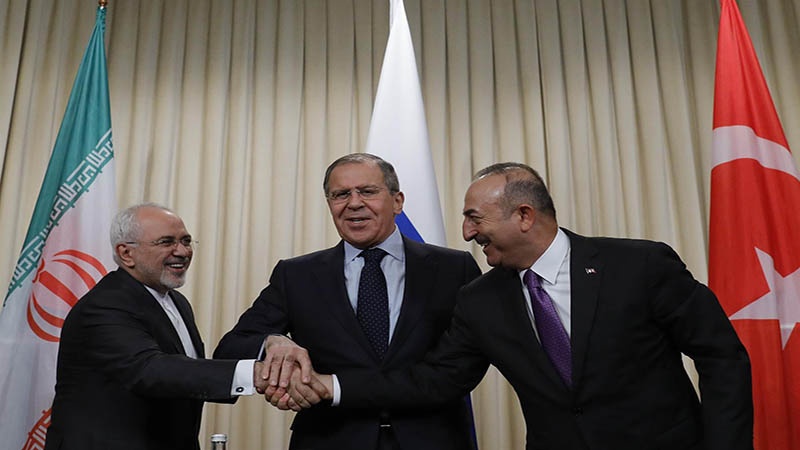
Foreign Minister Mohammad Javad Zarif says military approaches will fail to resolve the Syrian crisis, stressing that military intervention of certain countries has only prolonged the sufferings of people in the war-stricken state.
According to Press TV, Zarif was speaking at a joint news conference with his Russian and Turkish counterparts Sergei Lavrov and Mevlut Cavusoglu, respectively, on Saturday in Moscow, where the three top diplomats, whose countries act as guarantors of the Syria ceasefire, discussed the latest developments in Syria.
After the launching of the Astana peace process some 16 months ago, Tehran, Ankara and Moscow made attempts to alleviate the Syrian people's sufferings and find a political solution to the Arab country's crisis, he said.
He added that the process was still the only option to restore peace to Syria with the help of the United Nations.
"We have announced since the outset that [the crisis in] Syria has no military solution and that the sides must focus on a political solution," Zarif pointed out.
The Astana peace talks, which have usually involved delegations from the Syrian government and opposition, began in January 2017 with the mediation of Russia and Iran, two Syria's allies, as well as Turkey, which backs several armed opposition groups operating against Damascus.
The presidents of Iran, Russia and Turkey on April 4 reaffirmed their commitment to work toward achieving a sustainable ceasefire between the warring sides in Syria and bringing peace and stability to the war-torn Arab country.
Iran’s Hassan Rouhani and his Russian and Turkish counterparts, Vladimir Putin and Recep Tayyip Erdogan, “reaffirmed their determination to continue their active cooperation on Syria for the achievement of lasting ceasefire between the conflicting parties and advancement of the political process envisaged by UN Security Council Resolution 2254,” said a joint statement issued at the end of the meeting of the three leaders in Ankara.
The Iranian foreign minister also criticized a US-led military attack against Syria earlier this month and said, "The Islamic Republic of Iran, as the biggest victim of chemical weapons, condemns any use of chemical arms."
He expressed hope that an objective international investigation on the ground in Syria by the Organization for the Prohibition of Chemical Weapons (OPCW) would lead to results as soon as possible.
He said those countries, which supported Iraq during its use of chemical weapons against Iran, have no right now to accuse the Syrian government.
The top Iranian diplomat further said the Islamic Republic has played a role in fighting terrorist groups such as Daesh and Jabhat Fateh al-Sham, formerly known as al-Nusra Front, but the US has always had a destructive role and sowed discord among various factions and groups in Syria.
Zarif also criticized US President Donald Trump's demands regarding a multilateral nuclear agreement, officially known as the Joint Comprehensive Plan of Action (JCPOA), signed between Iran and the P5+1 group of countries in 2015.
He said Trump has always opposed the deal and UN Security Council Resolution 2231, which endorses the JCPOA, and has today excessive demands "which are neither acceptable to us nor to other members [of the P5+1 countries.]
SS