CNPC unit seeks major stake in newly-found Namavaran Oilfield
Nov 24, 2019 08:29 UTC
Oil has been produced in Iran in commercial quantities since 1908, making it one of the world’s oldest producers. Iran’s proven oil reserves of 160 billion barrels, almost 10 percent of the world total, rank it fourth after Venezuela, Saudi Arabia and Canada.
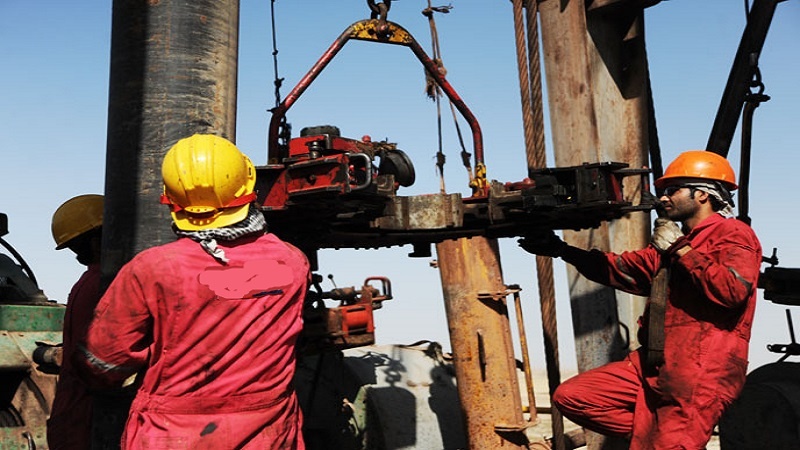
Clearly, Iran wants to bring its newly-discovered field into production as quickly as possible and ever since the scope of the Namavaran reservoir has become clear, it has engaged on two fronts to do just this. Iran has significant domestic expertise in geology and oil engineering but needs access to modern equipment and technology, as well as substantial investment and better management of the oil and gas industry.
The following is a news report concerning this issue by staff writers of Iran's English language paper 'Iran Daily' under the heading "CNPC unit seeks major stake in newly-found Namavaran Oilfield."
OilPrice.com has cited a senior source close to Iran’s Oil Ministry as saying that the Islamic Republic is set to announce that an operating unit of the China National Petroleum Corporation (CNPC) will be the major stakeholder in the development of its supergiant newly discovered oilfield, Namavaran.
Namavaran is the second-largest oilfield discovered in Iran with 54 billion barrels of oil in place, following the Asmari oil layer in Gachsaran with 68 billion barrels.
According to the senior Iranian source, this figure may be increased as there is a good chance of a continuation of the overall reservoir to the south. The entire reservoir measures nearly 2,400 kilometers up to a mean average depth of 80 meters and consists of relatively dense and heavy crude oil.
It was first probed in early 2016, at which time initial testing showed the presence of around 32 billion barrels. Since then, more rigorous testing over a wider area has pointed to a further 22 billion barrels or so of oil, thus giving the figure of just about 54 billion barrels.
The reservoir encompasses areas of previous development that were thought to be distinct fields, including Ab Teymour, Mansouri, Soosangerd, Darkhovin, Jofeir and Sepehr. Some of these fields take up part of that original 32 billion barrels, although the precise amount has yet to be determined but in any event, Iran is currently working on the basis that the new immediately exploitable find is between 22 and 27 billion barrels.
At the moment, the only developer on the spot is Iran’s Khatam al-Anbiya Construction Headquarters (KAA) which is the target of primary illegal sanctions by the US.
The Minister of Oil Bijan Namdar Zanganeh has said assuming 10 percent recovery rate in the field, 2.2 billion barrels of crude oil would be produced from Namavaran.
Iran has significant domestic expertise in geology and oil engineering but needs access to modern equipment and technology, as well as substantial investment and better management of the oil and gas industry.
Iran’s output is typically sour, but most fields produce medium-density oil with API ranges from 32 to 40 degrees, which is very attractive to refiners.
Zanganeh has said the oil in place in Namavaran is very dense and heavy, with a specific API gravity of over 20 degrees, which could make it technically difficult to extract. The American Petroleum Institute gravity, or API gravity, is a measure of how heavy or light a petroleum liquid is compared to water: if its API gravity is greater than 10, it is lighter and floats on water; if less than 10, it is heavier and sinks.
Iran’s oil resources are mostly contained in large, conventional reservoirs with excellent geological properties that make them highly productive at a relatively low cost.
Most of Iran’s oil and gas fields are found in a narrow belt running along its maritime boundary in the Persian Gulf and the foothills of the Zagros Mountains.
The sediments comprising the Zagros Basin are up to 12,000 meters thick. Oil and gas have been trapped in and produced from various layers, but by far the most important is the Asmari limestone.
Like Namavaran, the Asmari formation is not intrinsically very porous or permeable, which would make it a poor choice for oil and gas production. But the formation has been heavily fractured because of the folded nature of the Zagros Basin, making it an excellent producer.
A single oil well in some reservoirs can produce up to 80,000 bpd on a sustained basis, the highest in the world, and one well can drain a large area through the natural fracture system.
In terms of the quality of its oil and the geology of its reservoirs, Iran’s oil competes directly with Iraq and more indirectly with Saudi Arabia, Kuwait and the United Arab Emirates.
According to British Petroleum (BP), Iran’s proven oil reserves of 160 billion barrels, almost 10 percent of the world total, rank it fourth after Venezuela (300 billion barrels), Saudi Arabia (265 billion barrels) and Canada (175 billion barrels).
The country also has the world’s largest proven gas reserves of almost 34 trillion cubic meters (18 percent of the global total), putting it ahead of Russia (17 percent) and Qatar (13 percent).
According to Reuters, Iran’s oil and gas accumulations are the result of organic material deposited on the floor of an ancient ocean, Tethys, around 250 million years ago.
Tethys disappeared with the collision of the Indian, African and Arabian tectonic plates into the Eurasian continent - though remnants are left as the Black, Caspian and Aral Seas.
Thick layers of ancient limestone and sandstone deposited on the floor of Tethys were trapped and warped in the collision and became the world’s biggest oil and gas accumulations around the Persian Gulf.
On the Arabian side of the Persian Gulf, the ancient marine sediments became the giant oil and gas fields of Saudi Arabia’s Eastern Province as well as adjacent areas of Iraq, Kuwait and the United Arab Emirates.
On the Iranian side, where the Arabian plate collided with the central Iranian plateau it created an extensive folded zone and threw up the Zagros Mountains.
Oil has been produced in Iran in commercial quantities since 1908, making it one of the world’s oldest producers. With some of the fields having been in production for 50 years or more, they are heavily depleted, and require modern technology to coax more oil from them.
Clearly, Iran wants to bring its newly-discovered field into production as quickly as possible and according to OilPrice.com, ever since the scope of the Namavaran reservoir has become clear, it has engaged on two fronts to do just this.
The energy news site said “One of them was, and remains, sounding out Western international oil companies (IOCs) to signal their willingness to take a stake in the 22-27-billion-barrel area as and when the US lifts illegal sanctions.”
According to various sources in Iran, London, and Paris spoken to by OilPrice.com recently, so far, three of the biggest and best IOCs have expressed a serious interest in doing so.
It said all three of these IOCs – one Anglo-Dutch, one French and another company – had already worked at one time or another on Iran oilfield developments before the US announced its unilateral withdrawal from the Joint Comprehensive Plan of Action (JCPOA) last year and renewed oil sanctions imposed on the country.
It added one of these three companies, China National Petroleum Corporation (CNPC), has unequivocally assured Zanganeh that it can “guarantee” an initial rate of recovery of 12-14 percent within the first year, rising to at least a “sustainable” rate of recovery of 15 percent within two years from moving on to site.
ME
Tags