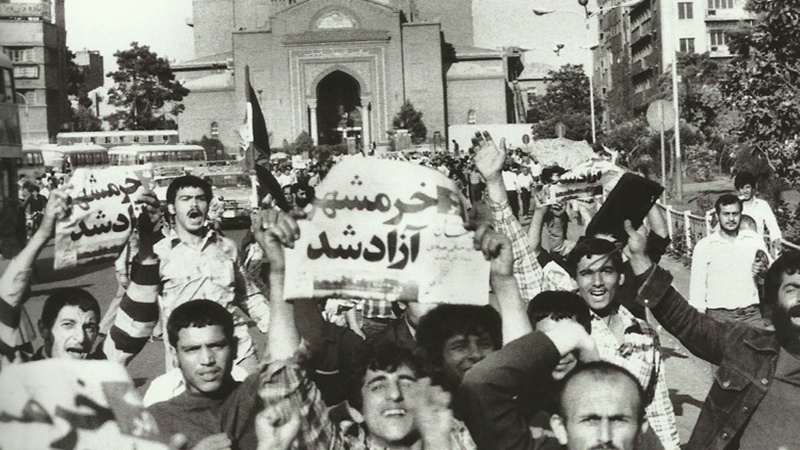
34th Anniversary of the Liberation of Khorramshahr
May 23, 2016 06:04 UTC
"God Liberated Khorramshahr," was the immortal expression of the Father of the Islamic Revolution, Imam Khomeini (God bless him), on hearing the famous radio broadcast: Khorramshahr azad shod which means Khorramshahr has been liberated.
These words continue to resonate till this day as the Islamic Republic of Iran celebrates the 34th anniversary of the victory of the epic Operation Bait ol-Moqaddas launched by the Iran's Muslim combatants to recapture parts of the Khuzestan Province occupied by forces of the repressive Ba'th minority regime of Baghdad.
The memorable victory was indeed divine support, because of firm faith in the Almighty Creator among Iran’s Muslim combatants that enabled them to defeat a far superior enemy, hardened by warfare, equipped by state-of-the-art technology of the east and the west, and bankrolled by the oil-rich Arab states of the Persian Gulf. The Islamic Republic of Iran was virtually alone on both the diplomatic and battle fields. It was practically fighting 40 world countries actively supporting the tyrannical Ba’th minority regime of Iraq during the 8-year long imposed war, the longest war of the 20th century. But in spite of the adverse circumstances it was yet another proof of the triumph of Islamic unity and national resolve. In other words it was a practical demonstration of the power of prayers coupled with the will to weed out every vestige of foreign occupation in the face of barely hidden hostility of the United Nations Security Council, which passed several anti-Iranian resolutions for immediate end to the clashes despite the fact that vast chunks of Iranian territory were under Saddam’s occupation. Imam Khomeini’s famous phrase “An imposed peace is worse than an imposed war” was the inspiration for the Iranians against yielding ground to the enemy.
The Ba'thist invaders had occupied Khorramshahr early in the war on 26 October 1980, but not after stiff resistance by Iranian defenders lasting several days that saw house-to-house and street-to-street fighting. On April 24, after a month and a half of Iraqi occupation, the Iranian defenders launched the first attack of the Bait ol-Moqaddas Operation on 24 April 1982 and until 12 May succeeded in pushing the Ba'thist forces out of the Ahvaz-Susangerd area. The Ba'thists withdrew to Khorramshahr, and on 20 May launched a heavy but unsuccessful counterattack against the Iranians who stood their ground. The Iranians then launched an all-out assault on Khorramshahr, capturing two of the defense lines in the Pol-e Nou and Shalamcheh region. Iran's Muslim combatants then gathered around the Arvand Rud in Iran waterway, surrounded the city of Khorramshahr and began a second siege. The Iranians finally recaptured the city on the 3rd of the Iranian month of Khordad 3, corresponding to 24 May 1982, after two days of bitter fighting and heavy losses.
In one of the most brilliantly executed operations by the Iranians, the well-entrenched Ba’thist forces found themselves outmaneuvered and within 45 hours of the start of the final phase of the offensive the once thriving port city had been cleansed of all vestiges of the invaders after almost 19 months of occupation. When the dust settled, some 16,000 Ba’thist forces lay dead on the battlefield while 19,000 of those who could not escape into Iraq across the Arvand-Round, surrendered to Iran’s Muslims combatants. Khorramshahr thus proved how an inspired force of mostly volunteers could defeat a professional army that was armed to the teeth. As many as 511 Iraqi tanks were destroyed.
The Ba'thist dictator Saddam was shocked and furious by the resounding defeat suffered by his forces in Khorramshahr. The Iranians had shown incredible determination and an iron will. The commander of the Iraqi forces in the city, Colonel Ahmad Zeidan, attempted to flee but was trapped in a minefield which was set up on his orders and killed when he stepped on a mine. An angry Saddam ordered the execution of a number of top Iraqi officers responsible for the defence of Khorramshahr, including the commander of the 9th Division. Iranians thus celebrate the anniversary of Liberation of Khorramshahr every year, and since 2016 was a leap year with February having 29 days instead of 28, the anniversary, that is 3rd of Khordad, has fallen on May 23 this year. Khordad 3 is thus a Red Letter Day in the history of the Islamic Revolution. This epic has become an indispensable part of the cultural legacy of Islamic Iran.
There's a popular song in Persian, known as "Mammad Naboodi", meaning "Mammad" the colloquial variant of the proper name Mohammad, was not present to see the memorable liberation of Khorramshahr. Written by Gholam Koveitipoor, it is a tribute to the bravery of Mohammad Jahanara, the IRGC commander who was one of the last Iranians to leave Khorramshahr when it fell to the Iraqis. He would go on to fight in the successful uplifting of the Siege of Abadan and lead Iranian forces to recapture Khorramshahr, but achieved martyrdom on May 24, in a plane crash incident, before observing the eventual liberation of the city.
The liberation of Khorramshahr is thus a lesson for not Iranians and Iraqis alone, but for Global Arrogance as well. For Iranians, because it is a constant reminder to them of the necessity to safeguard and keep alive memories of the Sacred Defence; for Iraqis, because it is treason against faith to fight fellow believers on fear of the tyrants in power as could be further confirmed by the present pathetic situation of their occupied country; for Global Arrogance, because no military might will ever be able to intimidate and overawe a nation of true believers determined to end the hegemony of the rogues. Today, 34 years later, Iran may not have been given the keys to the Iraqi port city of Basra, as promised by the now executed Saddam on the eve of the epic of Khorramshahr. But in view of the Islamic Republic’s spiritual influence on Iraq and beyond following election of a truly representative government in Baghdad, much to the chagrin of the Americans, it is an undeniable fact that whatever intricate plots Global Arrogance had hatched to beef up the Ba’thists after Khorramshahr including supply of chemical weapons to massacre Iranians and Iraqis alike, have evaporated into thin air with the brotherly Muslim people of Iraq and Iran knitting ranks to begin the countdown to the day when the last American soldier will be kicked out from the whole region.
AS/MG
Tags