Imamate and Vilayat-e Faqih from Imam Khomeini’s point of view
Jun 04, 2016 04:39 UTC
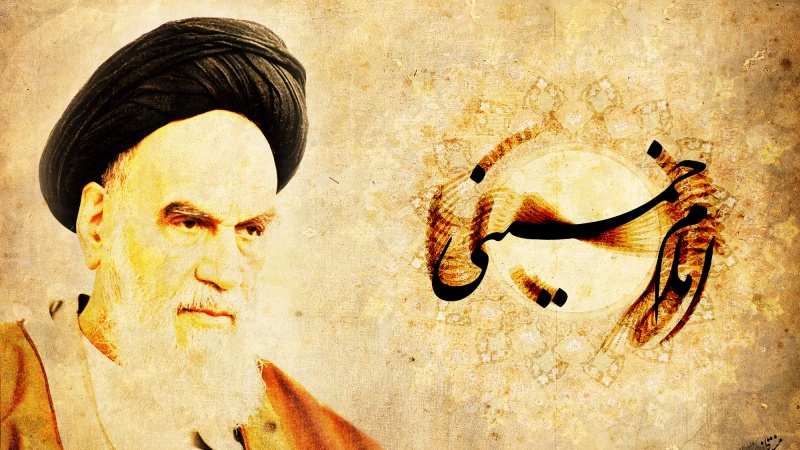
The Iranian month of Khordad in which the Father of the Islamic Revolution departed from the mortal world, has a special relation to Imam Khomeini (God bless his soul).
It was on the 15th of this month in 1963 that the Sage of the Age lit the first spark of the Islamic Revolution against the dictatorial regime of the British-installed and American-supported Pahlavi potentate. In other words, the people's grassroots movement which started on 5th June 1963 reached its climax some 16 years later in February 1979 with the casting into the dustbin of history of the monarchial system. On 14th Khordad, on the eve of the 26th anniversary of the 1963 uprising, Imam Khomeini breathed his last, but not before ensuring that the system he established will firmly continue on the Islamic course he had charted out for Iran, whose growing influence on the region and beyond is evident today. Here on this occasion we present you a feature titled "Imamate and Vilayat-e Faqih from Imam Khomeini’s Point of View". Stay with us.
Imam Khomeini, whose title Imam or Leader, should not be confused with the Infallible Imams of the Household of the Prophet of Islam, was a Mutahed or Authority on Islam, who wielded, and continues to wield profound influence on religious and academic circles. He changed the history of revolutions by focusing on the principle of Vilayat-e Faqih or Governance of the Supreme Jurisprudent, in order to establish the egalitarian laws of Islam as the basis for building a sound and healthy state, free of both capitalism and communism. As a devotee of Prophet Mohammad (blessings of God upon him and his progeny) and the Infallible Imams of the Ahl al-Bayt, he defined to the world the meaning of Imamate and on its basis the principle of Vilayat-e Faqih. The Late Imam's worthy successor, Ayatollah Seyyed Ali Khamenei in a message on the anniversary of the victory of the Islamic Revolution once said: Our Great Imam with reliance on the Islamic teachings and trust in people’s faith, and through his own sincerity and bravery, endured hardships in order to make people familiar with the realities. The Iranian nation which responded to the call of this divine man, demonstrated the spirit of firm faith in Islam and in the process created set example of memorable self-sacrifices. Imam Khomeini, while guiding people in those crucial days of rivalry between western capitalism and eastern socialism, projected Islam as the right path towards success in the world and salvation in afterlife.
From the start, the Islamic Revolution was unique, unlike the revolutions that had occurred in other parts of the world over the past two centuries. As a matter of fact, the movement launched by Imam Khomeini made the equations of the bipolar international system go awry, making the two antagonist superpowers – the Americans and the Soviets – to set aside their mutual animosity in order to adopt a single stand against the Islamic Revolution. An evident example in this regard was the 8-year war imposed by Saddam of Baghdad's repressive Ba'th minority regime against the Islamic Republic of Iran. Both the Soviet Union and the US, along with their satellite states, provided all-out support to Saddam's bloodthirsty regime. Imam Khomeini, as an unrivalled Islamic Scholar, who had brought about a great Islamic Revolution, took the opportunity to expound to the world the basic principles of the political ideas of the School of the Prophet's Ahl al-Bayt, also known as Shi'a Muslims. The School of the Ahl al-Bayt believes in Twelve Infallible Successors after the passing away of Prophet Mohammad (blessing of God upon him and his progeny). The belief is that, since the Prophet was the emissary of God to mankind and was chosen by the Almighty, his successors ought to be divinely-designated, and not chosen, elected, selected, or nominated by the fallible human beings. This belief is known as Imamate. The Imam, like the Prophet is the representative of God on earth, as the Prophet proclaimed on the plain of Ghadeer-Khom near Mecca on 18th Zilhijja 10 AH, by announcing God's commandment to declare his virtuous cousin and son-in-law as vicegerent, whose love and affection is incumbent upon all true believers. This outlines the fundamental principle of Vilayat, that is absent in other schools of Islam.
Ayah 59 of Surah Nisa shows the righteousness of Imamate when it says:
O you who have faith! Obey Allah and obey the Prophet and those vested with authority among you.
The Prophet expounded the meaning of this ayah regarding the term "those vested in authority" by emphasizing to the Ummah the famous Hadith Thaqalain or Two Weighty Things. This famous statement of the Prophet which is found in the books of all denominations of Islam, including Sunni and Shi'a, unanimously say that before his passing away, while addressing the huge throng of Hajj pilgrims from Jabal ar-Rahma or Mount Mercy on the Plain of Arafaat, the Prophet said:
"Indeed, I am leaving behind among you the two precious things (Thaqalayn) among you: the Book of Allah (i.e. the holy Qur'an) and my progeny the Ahl al-Bayt. Hold fast to them, for the two never separate from each other even when they return to me at the Fountain (of Kowthar on the Day of Judgement)."
The scholars of Islam, including the majority of Sunni Muslims, say the term Ahl al-Bayt refers to the Prophet's immediate family, that is, his daughter Hazrat Fatema Zahra, her husband Imam Ali and the couple's two sons, Imam Hasan and Imam Husain (peace upon the). Through extension the term Ahl al-Bayt includes all the Twelve Imams specified by the Prophet including the Last One, Imam Mahdi (AS), who will reappear in end times to establish the global government of peace, prosperity and justice by eradicating all vestiges of corruption and oppression. This belief in the great global reformer is central to all religions, although none of them has such clarity of vision on the identity of the Redeemer of mankind, as the School of the Ahl al-Bayt or Shi'a Muslims.
One of the issues elaborated by the ulema is the condition of the society during the absence of Imam Mahdi (May God speed up his reappearance). According to Imam Khomeini, the necessity of Imamate is felt in every era, even our present times when the 12th Imam, by the Will of God, is in the state of ghaybat or Occultation. Only with the existence of Imam, continuation of religious injunctions and their implementation is guaranteed, because the Imam is protector of religion and the true executor of the commandments of God Almighty. As specified by Imam Khomeini, the Divinely-designated Imamate is continuation of Prophethood for implementing divine injunctions. Therefore without Imamate, religion is imperfect. In order words, it becomes perfect only with the presence of the Infallible Imam. Therefore, in his absence, the virtuous and knowledgeable jurisprudent of the times, who is wise, brave, just, and aware of the circumstance, should be in charge of leading the society – as is evident by certain hadith. Therefore, on this basis, Imam Khomeini came up with his idea of Vilayat-e Faqih or Governance of the Supreme Jurisprudent in the absence of the Infallible Imam of the Prophet's Household. Following the victory of the Islamic Revolution, Imam Khomeini practically implemented the concept of Vilayat-e Faqih, on the basis of which Iran presents the model of the ideal Islamic society.
AS/ME
Tags