Saudis destroyed Islam’s holiest stone of the Ka’ba
Aug 28, 2017 04:51 UTC
The heretical Wahhabis of Najd who are in occupation of the holy cities of Mecca and Medina since 1925, when at British behest they massacred tens of thousands of Muslims in and around Islam’s two most holiest shrines, and for their desecration of sacred sites, including the Jannat al-Baqie Cemetery, they were gifted by London in 1932 with the spurious entity called Saudi Arabia, continue to sacrilege the sanctities of Muslims.
Here we present you undeniable historical facts of how the “Saudis destroyed Islam’s holiest stone of the Ka’ba”.
The Saudi regime destroyed the most sacred stone in Islam, a rare book by an Austrian academic has revealed.
The shocking discovery of a key event in Muslim history hidden for two centuries was reported by Alois Musil, a 19th century Czech-Austrian academic, explorer and author of several books on West Asia.
In his book "Aal-e Saud", Musil reported that the “Hajar al-Aswad” or Blackstone, the original sacred stone at the corner of the holy Ka’ba, Islam's holiest edifice visited by millions of pilgrims every year, was destroyed by the Saudi hordes when they ransacked Mecca for the first time in the spring of 1806 – before being ousted from Hijaz by Egypt’s Mohammad Ali Pasha, whose son, Ibrahim Pasha pursued the Najdis right up to their stronghold in Dirriya in 1814 and sent the Saudi ruler in chains to Istanbul for execution at the main public square on the orders of the Ottoman sultan.
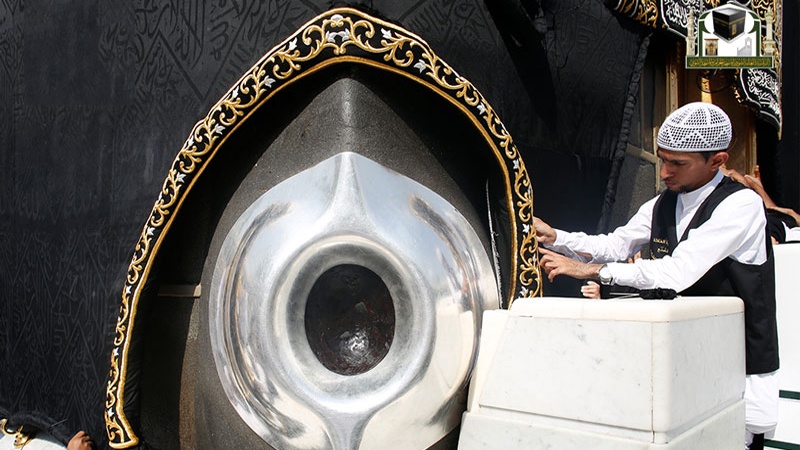
The Hajar al-Aswad is Islam's holiest stone and Muslims when they visit the Grand Mosque, the most revered in Islam, vie with each other to touch it, or at least have a sight of it. Muslims preforming pilgrimage, whether the annual Hajj or the Umrah, salute the stone on sighting it, or if it is possible to reach it, they kiss it in reverence.
The Hajar al-Aswad marks the beginning of the ritual of tawaf or circling the holy Ka’ba seven times. According to hadith the Hajar al-Aswad was brought from heaven by Archangel Gabriel to the father of the human race, Adam, who built the first ever edifice of the Ka’ba.
Musil's account got a nod from a Mecca goldsmith, whose family has been maintaining the stone for over 100 years, well before the present Saudi occupation of Hijaz and the holy cities. Faisal Badr, the goldsmith in charge of maintaining the Hajar al-Aswad told TV Al-Arabiya TV in June 2017 that only eight small pieces of the original stone remain today. He said that he uses a natural black tree gum called ‘luk’ to hold them together and to give the oval orifice its shiny black appearance.
Badr said he repairs the stone three to five times a year by removing the old gum and applying a fresh coat. There is no independent evidence that these stone pieces are parts of the original Hajar al-Aswad which the Saudis had sacrilegiously removed from the corner of the holy Ka’ba in 1806, smashed it and taken it to Najd, before its pieces were recovered by Ibrahim Pasha 8 years later, brought back to Mecca and re-installed in the original place of the Symbolic House of the Unseen but Omnipresent God.
Musil's discovery remains largely unknown due to enormous sensitivities surrounding the holy Ka’ba. The Saudi regime, which bills itself as the Custodian of Islam's most revered holy shrines, has kept this greatly embarrassing secret hidden, out of fear that it will reveal its deep-rooted extremist ideology of Wahhabism and contradicting Islam itself.
Destroying or harming the Blackstone undermines Saudi claims that they are serving Islam or upholding its basic tenets. It would be extremely damaging to the Saudi ruling clan if millions of Muslim pilgrims who travel to Mecca annually and bring billions of dollars to the Saudi state realized they were kissing tree gum and not the heavenly Hajar al-Aswad they revere.
It is hardly a coincidence that the Saudi Wahhabi ideology, which has destroyed Islam's holiest stone and looted the Prophet resting place, has also fueled the most devastating terrorist attacks around the world targeting Muslims and non-Muslims alike. It is a common thread that runs through the terror waves that struck many European capitals, and the multitude of bombings and mass killings in Iraq, Syria Afghanistan and Pakistan.
Musil also reported that Saudi clan violated the sanctity of the resting place of Prophet Mohammad (blessings of God upon him and his progeny), and robbed its treasures, including gifts to the holy shrine from various Muslim rulers, including the Ottomans, the Shahs of Persia, and the sultans of India.
The valuables looted from the Prophet's resting place included an expensive diamond known as “al-Kawkab ad-Durri” or the Priceless Planet, which was commissioned and gifted by Ottoman Sultan Ahmad the First in 1613 to the Prophet’s Shrine.
It was the Saudi looting of Mecca and Medina that prompted the Ottomans to take action and send the Egyptian army led by Ibrahim Pasha to sack ad-Dirriya, the stronghold of the Aal-e Saud in Najd.
“Al-Kwakab ad-Durri” was recovered by Ibrahim Pasha who destroyed al-Dirirya and sent the Wahhabi ruler, Abdullah bin Saud, to Istanbul for trial and execution. “Al-Kwakab ad-Durri” was brought back to the Prophet’s shrine in Medina until 1917, when during the First World War, the last Ottoman governor of Medina, Fahreddin Pasha, sent most of the treasures of the Prophet's shrine to Turkey for safekeeping before Medina fell to the British-backed forces in January 1919. The diamond and other treasures remain in Turkish museums to date.
The Institute for Persian Gulf Affairs obtained a copy of an Arabic translation of the rare book written in German 1917. The book was translated in 2003 by Dr. Sa’eed Fayez as-Sa’eed. An author of Arabia, who wanted his identity to remain private for safety reasons, said the Saudi regime has bought the rights to many western books reporting on the origins of the Saudi and altered their contents. The source who disclosed this works at Abdul-Aziz Centre, the main Saudi arm for such purchases.
The exposure of the Saudi crime at the holy Ka’ba, striking as it is, is just another fact in a long history of the Wahhabi regime's systematic efforts to eradicate every trace of Islam's culture, history and traditions.
Just over the past 40 years, the Saudi forces have destroyed an estimated 1,000 historical landmarks across the country, including ancient mosques, and the house where the Prophet was born and lived.
One of the prime targets of the Saudi was the 1,400-year old Masjid Radd ash-Shams built in Medina during the era of the Prophet at the place where on Divine Commandment his supplication had made the Sun miraculously turn back for a while after it had set so that Imam Ali (AS) who had performed the Asr ritual prayer in a sitting-manner so as not to disturb his cousin the Prophet whose head was resting on his lap, could perform it in the proper manner.
The Aal-e Saud's history of looting has been reflected through their own sources, including "The History of the Najd region from the mid-18th to mid-19th century" by historian Othman ibn Abdallah ibn Bishr. Ibn Bisher, who is a Wahhabi, unabashedly details the many Saudi robberies and looting of Muslim shrines in Medina, Mecca, Karbala and other cities, and mass killing of Muslim civilians.
Muslim shrines were a preferred target of Saudi forces because they housed priceless treasures gifted to the key figures in Islamic history by kings, envoys and wealthy people. In April of 1802, Saudi brigands had attacked the holy city of Karbala in Iraq, and robbed the treasures of the shrine of Imam Husain (AS), the grandson of the Prophet, after killing thousands of men, women, and children.
Some of the Saudi forces' recent desecrations include the desecration of the Jannat al-Baqi Cemetery of Medina in 1925 where are located the tombs of many of the prominent figures of early Islam, including the Prophet’s companions, his aunts, his wives, and most important of all, the towering magnificent mausoleum housing the tombs of four of the Prophet’s 12 Infallible Successors, that is, Imam Hasan Mojtaba, Imam Zain al-Abedin, Imam Mohammad Baqer, and Imam Ja’far Sadeq (peace upon them). The same year, the Saudi desecrated and destroyed the Jannat al-Mo’allah Cemetery in Mecca containing the blessed shrine of the Prophet’s loyal wife of 25 long years the Mother of all True Believers, Hazrat Khadija (peace upon her), as well as the tombs of the Prophet’s monotheistic grandfather and great grandfather Abdul-Muttaleb and Hashem, and the Prophet’s beloved uncle and guardian Abu Taleb.
In Medina, the Wahhabi razed of the mausoleum of the Prophet’s uncle Hamza and the other martyrs of the Battle of Ohud
In the 1980s, the Saudis razed to the ground the historic Bani Hashem locality of Medina where the Prophet’s descendants still lived. They also destroyed the well-preserved houses of the Prophet in Mecca and Medina. In 2002 the Wahhabis pulled down 800-year old Ajyad Fort in Mecca, and in 2013 they destroyed the 600-year old an-Namas Fort. In 2013 they also destroyed a 2000-year old mud and stone structure in Qatif in the eastern Shi’a Muslim populated region.
The latest crime of the Saudis is destruction earlier this month of the 400-year old al-Mosawra district in the town of al-Awamya, after a month of intense artillery barrage to force the inhabitants to leave the place.
AS/MG
Tags