Ramadhan, the Month of God (12)
May 18, 2019 03:59 UTC
Welcome to the 12th episode of “Ramadhan, the Month of God”.
We start with the special supplication to God for the 12th Day of Ramadhan, which reads:
“O Allah, adorn me this day with modesty and chastity, and cover me in it with the garments of contentment and sufficiency! Urge me therein toward justice and fairness, and grant me security in it from all that I fear; with Your Protection, O Preserver of the frightened!”
Fasting of the blessed month of Ramadhan is an opportunity for all Muslims to reflect upon the course of sublimity and progress for themselves and their society. Fasting is a kind of exercise to purify the self and it is a suitable path for to make man to be in control of his/her self and fight carnal desires. Fasting is an effective factor to materialize the ultimate goal of human creation, i.e. attaining perfection and proximity of God.
Fasting of the month of Ramadhan helps a person to avoid sins when the fasting person for the sake of God, abstains from even permissible things in the daylight hours, such as food, drink and other lawful pleasures of flesh. The fasting of the blessed month of Ramadhan is means to revive the sense of sympathy with the poor and the needy.
Imam Hassan Askari (AS), the 11th Infallible Heir of Prophet Mohammad (SAWA), was asked as why fasting has been obligated; to which he replied: "So that the rich understands the suffering of the hungry and pays attention to the poor."
The Prophet’s 6th Infallible Successor, Imam Ja'far Sadeq (AS), was posed a similar question, and he answered, "God has obligated fasting so that the rich and the poor become equal; because the rich has not experienced suffering and hunger to have mercy upon the poor and whenever he has desired something he has been able to achieve it with the power he has. God has intended to create equation among His servants and has willed that the rich feels hunger; otherwise, the rich wouldn't have mercy upon the destitute and hungry."
Another social benefit of fasting of the blessed month of Ramadhan is to struggle against extravagance and overconsumption. Fasting destroys discrimination and class gap.
The Commander of the Faithful, Imam Ali (AS) says, "Poverty and penury is a very big and calamitous death."
The remarks of Imam Ali (AS), mean that one faces severity of death only once, while the torments of poverty and penury is countless. Fasting delivers man from indulging in carnal desires and hedonism. Such a person will feel needless of others and will not give in to unjust requests. Fasting enhances the spirit of resistance in us.
One of the most important dimensions of fasting is social justice as it bolsters the sense of altruism. Public arrangement of Iftar at mosques and other places demonstrate cooperation and social equality, as the rich and the poor sit together to share the meal. Ramadhan brings people of different social strata to one common table.
The fasting of Ramadhan strengthens moral values such as honesty, loyalty, trustworthiness, brotherhood, bravery, self-sacrifice and so on. This leads to a dynamic society. The most important impact of Ramadhan is the strengthening of social conscience. In other words, when an individual shuns ethical vices such as telling lies, backbiting, ridiculing, gossiping, slandering, etc., the ground is set for refreshment of the society and revival of morality.
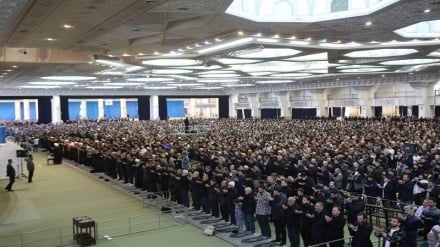
On the day of Eid al-Fitr a collective spirit can be seen as people gather together after a month of worship to celebrate the feast by performing the special congregational prayer. This can lead to unity and solidarity amongst Muslim communities.
Industrial societies, in spite of material progress, feel a great vacuum that has been warned by their thinkers. That vacuum is lack of religion and absence of spirituality. French sociologist, August Comte, believes that the foundation of social order and unity is hidden in religion. His compatriot, David Emile Durkheim, maintained that the more the consistency and unity of the individuals of a society, the less the rate of suicide will be.
As the social consistency is the highest in Ramadhan, the rate of suicide will surely be at the lowest point. According to researches, social crimes and felonies are reduced notably in Ramadhan. This is because of people's inclination toward spirituality and morality. This can act as a role model for western decadent societies that are grappling with immoralities.
In short, the blessed month of Ramadhan causes people more think of pleasing God rather than pursuing their personal desires, since the month of fasting promotes a spiritual atmosphere in Muslim societies. The person who has been granted a virtuous life, strives more to earn the satisfaction of the All-Merciful Lord. Thus, such a person, whether male or female feels a sense of purity and joy deep in the soul, which is immeasurable, since he/she finds himself/herself immersed in a never-ending life leading towards progress and prosperity in the real sense of these terms.
RM/AS/MG
Tags