US folly in Afghanistan and media complicity
Jul 31, 2019 05:07 UTC
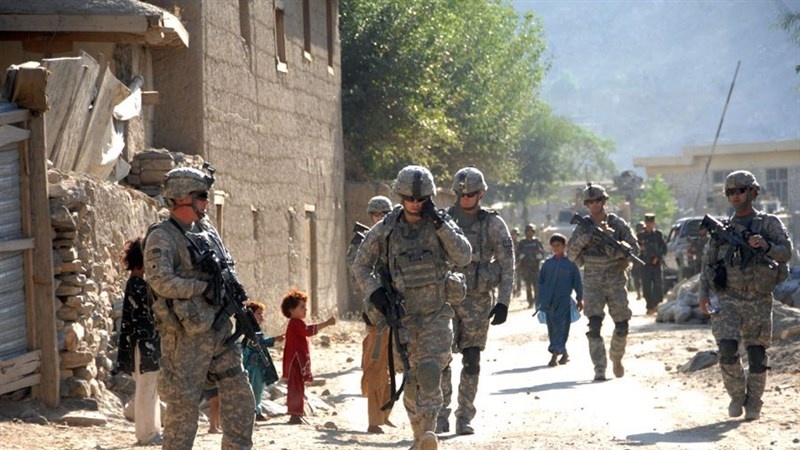
Washington is messing up the situation in Afghanistan when the only solution to unending war of the past 18 years is American withdrawal from this beleaguered South Asian country, where the US cannot win.
Now we have an article in this regard for ‘Asia Times’ by retired US lieutenant colonel, William J. Astore, who for the past fifteen years has taught history at military and civilian schools.
The article is titled: “US folly in Afghanistan and media complicity”.
On NBC News this week, I came across the following, revealing, headline, which read: “The US is eager to end its longest war. In interview, Taliban gives little sign it’s ready to change.”
Aha! The US military is allegedly seeking an end to its Afghan war, but it’s being stopped in its tracks by stubbornly uncompromising Taliban forces. So, it’s not our fault, right? We’re trying to leave, but the Taliban won’t let us.
I’ve been writing against the Afghan war for a decade. It was always a lost war for the United States, and it always will be. But the US military doesn’t see it that way, as Andrew Bacevich explains in a recent article on America’s flailing and failing generals. These generals, Bacevich notes, have redefined the Afghan war as “successful to date.” How so? Because no major attack on America has come out of Afghanistan since the suspicious incidents of 9/11/2001 in New York. As Bacevich rightly notes, such a criterion of “success” is both narrow and contrived.
So, according to Mark Milley, the most senior general in the US Army, soon to be head of the Joint Chiefs, America can count the Afghan war as “successful.” If so, why are we allegedly so eager to end it? Why not keep the “success” going forever?
Back in November of 2009, I wrote the following about America’s Afghan war.
We have a classic Catch-22. As we send more troops to stiffen Afghan government forces and to stabilize the state, their high-profile presence will serve to demoralize Afghan troops and ultimately to destabilize the state. The more the US military takes the fight to the enemy, the less likely it is that our Afghan army-in-perpetual-reequipping-and-training will do so.
How to escape this Catch-22? The only answer that offers hope is that America must not be seen as an imperial master in Afghanistan. If we wish to prevail, we must downsize our commitment of troops; we must minimize our presence.
But if we insist on pulling the strings, we’ll likely as not perform our own dance of death in this “graveyard of empires.”
Pulling out an old encyclopedia, I then added a little history:
“Some two centuries ago, and much like us, the globe-spanning British Empire attempted to extend its mastery over Afghanistan. It did not go well. The British diplomat in charge, Montstuart Elphinstone, noted in his book on “Caubool” the warning of an Afghan tribal elder he encountered: “We are content with discord, we are content with alarms, we are content with blood; but we will never be content with a master.”
As imperial masters, British attitudes toward Afghans were perhaps best summed up in the Encyclopaedia Britannica, Ninth Edition (1875). The Afghans, according to the Britannica, “are familiar with death, and are audacious in attack, but easily discouraged by failure; excessively turbulent and unsubmissive to law or discipline; apparently frank and affable in manner, especially when they hope to gain some object, but capable of the grossest brutality when that hope ceases.”
One wonders what the Afghans had to say about the British.
The accuracy of this British depiction is not important; indeed, it says more about imperial British attitudes than it does Afghan culture. What it highlights is a tendency toward sneering superiority exercised by the occupier, whether that occupier is a British officer in the 1840s or an American advisor today. In the British case, greater familiarity only bred greater contempt, as the words of one British noteworthy, Sir Herbert Edwardes, illustrate. Rejecting Elphinstone’s somewhat favorable estimate of their character, Edwardes dismissively noted that with Afghans, “Nothing is finer than their physique, or worse than their morale.”
We should ponder this statement, for it could have come yesterday from an American advisor. If the words of British “masters” from 150 years ago teach us anything, it’s that Afghanistan will never be ours to win.
I stand by that last sentence. Your “successful to date” war has been nothing but folly, General Milley, a reality mainstream media sources are determined not to survey.
AS/ME
Tags