Hidden costs of US air war
May 03, 2016 05:21 UTC
There is near-total silence when US bombs kill civilians in Iraq or Syria.
Nicolas J. S. Davies is the author of Blood On Our Hands: the American Invasion and Destruction of Iraq. He has written a disclosing article on the issue, which was appeared on the Consortium News.
USA Today reported just recently that U.S. air forces bombing Syria and Iraq have been operating under new, looser rules of engagement since last fall. The war commander, Lt Gen Sean McFarland, now orders air strikes that are expected to kill up to 10 civilians without prior approval from U.S. Central Command, and U.S. officials made it clear to USA Today that U.S. air strikes are killing more civilians as a result of the new rules.
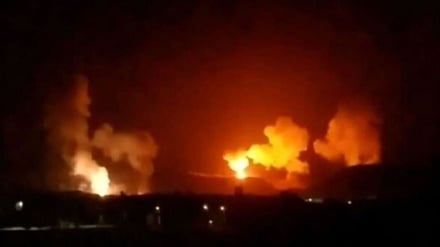
Under these new rules of engagement, the U.S. has conducted a major escalation of its bombing campaign against Mosul, an Iraqi city of about 1.5 million people, which has been occupied by Daesh since 2014. Reports of hundreds of civilians killed in U.S. air strikes reveal some of the human cost of the U.S. air war and the new rules of engagement.
Previous statements by U.S. officials have absurdly claimed that over 40,000 U.S. air strikes in Iraq and Syria have killed as few as 26 civilians. Speaking to USA Today, a senior Pentagon official who is briefed daily on the air war dismissed such claims, noting that heavier civilian casualties were inevitable in an air war that has destroyed 6,000 buildings with over 40,000 bombs and missiles.
Professor Souad Al-Azzawi, the award-winning Iraqi environmental scientist from Mosul who conducted the first studies of the health effects of depleted uranium after the First Persian Gulf War, has compiled a partial list of air strikes that have killed civilians and destroyed civilian infrastructure in Mosul, most of them since the new U.S. rules of engagement went into effect. The list is based on reports by Mosul Eye, Nineveh Reporters Network, Al Maalomah News Network, other local media and contacts in Mosul and is not intended as a complete list of civilian casualties or civilian infrastructure destroyed.
This kind of “passive reporting” from war zones can only capture a fraction of actual civilian casualties, and an even smaller fraction in areas outside government control and beyond the reach of conventional media:
Many government buildings have been destroyed. As U.S. officials told USA Today, such attacks are often conducted at night to minimize civilian casualties, but they have killed night-time security guards and civilians in neighboring buildings.
Telephone exchanges have been systematically bombed and destroyed.
Two large dairies were bombed, killing 100 civilians and wounding 200 more, including local people lining up outside to buy milk and dairy products.
Multiple daytime air strikes on Mosul University on March 19 and 20, the 13th anniversary of the U.S. invasion of Iraq, killed 92 civilians and wounded 135, mostly faculty, staff, families and students. Targets included the main administration building, classroom buildings, a women’s dormitory and a faculty family apartment building from which only one child survived. Some 50 civilians, including entire families, were killed and 100 wounded by air strikes on two apartment buildings, Al Hadbaa and Al Khadraa. Moreover, a mother and her four children were killed in an air strike on a house in the Hay al Dhubat district in East Mosul on April 20, next door to a house used by Daesh that was undamaged. At least 22 civilians were killed, including 11 members of one family, in an air strike on houses in front of the Mosul Medical College.
The Nineveh Plains water treatment plant was bombed in October 2014, and another water treatment plant and a hospital were shut down by an air strike on a power station in northeast Mosul in July 2015. Flour mills, a pharmaceutical factory, auto repair shops and other workshops have been bombed, with civilian casualties, all over Mosul. The Central Bank of Mosul in Ghazi Street and the main and local branches of two other banks, Rafidain and Rasheed, have been bombed, with heavy damage and civilian casualties in the areas surrounding each of them. After the first bank was struck, all the cash was removed from the others before they were bombed a few weeks later.
An air strike on a fuel depot in an industrial area ignited an inferno that caused 150 casualties on April 18. Urban planning and engineering planning offices were bombed in Hay Al Maliyah. The US air strikes targeted a food warehouse, power plants and electric sub-stations across West Mosul, and the Al Hurairah Bridge was destroyed.
At the very least, U.S. air strikes have killed hundreds of civilians in Mosul, as well as destroying much of the civilian infrastructure that people depend on for their lives in already dire conditions. And yet this is, by all accounts, only the beginning of the U.S. campaign to retake Mosul.
One and a half million civilians are trapped in the city, 30 times the United Nation’s estimate of the number of civilians in Fallujah before the November 2004 assault by U.S. Marines that killed 4,000 to 6,000 people, mostly civilians. Meanwhile Daesh is preventing civilians from evacuating the city, believing that their presence protects its forces from even heavier bombardment.
International humanitarian law is absolutely clear that military attacks on civilians, civilian areas and civilian infrastructure are strictly prohibited. The presence of several thousand Daesh terrorists in a city of 1.5 million people does not justify indiscriminate bombing or attacks on civilian targets. This is while, there have been reports of support for such terrorist groups by certain regional and western countries, the US in particular.
As the United Nations Assistance Mission in Iraq warned U.S. officials in a Human Rights Report in 2007, “The presence of individual militants among a great number of civilians does not alter the civilian nature of an area.” Bombing food warehouses, flour mills and water treatment plants is also a war crime.
As Jean Ziegler, the U.N.’s Special Rapporteur on the Right to Food, protested in 2005, as U.S. forces besieged other cities in Iraq, “A drama is taking place in total silence in Iraq, where the so-called coalition’s occupying forces are using hunger and deprivation of food and water as a weapon of war.” He called this, “a flagrant violation of international humanitarian law.”
The controlled leak of the new rules of engagement to USA Today appears to be an “information operation” to provide political cover for air strikes that violate the laws of war and are killing large numbers of civilians, as the U.S. escalates its air strikes against Mosul and other cities occupied by the Takfiri Daesh, which is backed by the West, Saudi Arabia and certain other regional countries. Post-Cold War U.S. military strategists have theorized that sophisticated U.S. “information warfare” can shape public perceptions to remove political constraints on the use of U.S. military force.
On the domestic front, the U.S.’s information warfare has proven so effective that most Americans know almost nothing of the real impacts of U.S. military operations. The median response to a 2007 AP-Ipsos poll that asked Americans how many Iraqis had died as a result of the U.S. invasion and occupation of Iraq was 9,890, or 1.5 percent of the total revealed in 2006 by a comprehensive mortality study. But internationally, the wartime conditions now afflicting people from Afghanistan to Nigeria to Ukraine have created new realities that render Western narratives increasingly suspect and drive an urgent quest for other ones that can better explain the violent and chaotic world in which more and more people are forced to live.
The presumption that U.S. information warfare could brainwash the world to provide political cover and impunity for systematic U.S. aggression and other war crimes is collapsing under the real-world impacts of U.S. policy.
Wahhabi Takfiri ideology is thriving in the new reality born of the U.S. government’s wrong policy. The fundamental contradiction of the militarized so-called “war on terror” has always been that U.S. aggression and other war crimes only reinforce the narratives of the terrorist groups.
U.S. officials, not least President Barack Obama, have acknowledged publicly that there is therefore “no military solution” to what he claimed to be fight against Daesh and other forms of terrorism. But successive U.S. administrations have proven unable to resist the lure of military expansion and escalation at each new stage of the crisis, unleashing wars that have killed about 2 million people, plunged a dozen countries into complete chaos and exploded Wahhabi Takfiri ideology from its original safe havens in Saudi Arabia, Afghanistan and Pakistan to countries across the world.
However, although Al Qaeda and Daesh have proven adept at manipulating U.S. leaders into ever-escalating cycles of violence, the terrorists cannot directly order American pilots to bomb civilians. So this is the US leaders who should bear the moral and legal responsibility for these atrocities, just as Daesh leaders must bear the responsibility for theirs.
EA
Tags