Children are still dying in Afghanistan
Oct 09, 2019 13:46 UTC
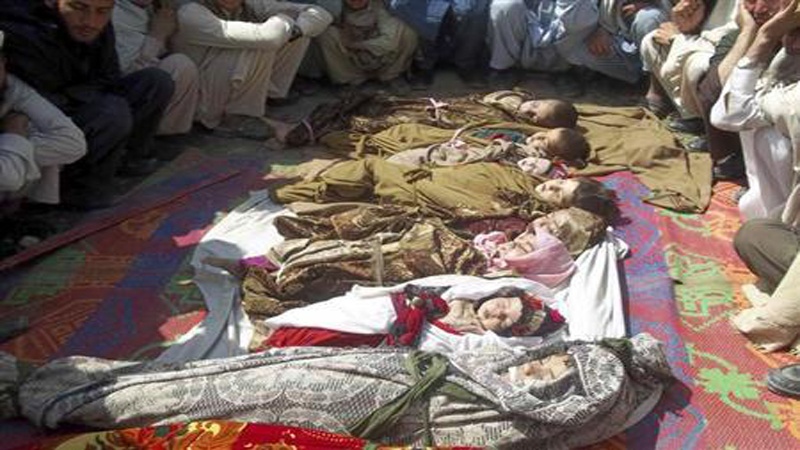
Sadly, children in Afghanistan have known nothing but heart-breaking realities as a result of violence and US-led war and occupation. The number of child casualties is appalling, and the time is now to call on the US-led occupation to immediately put an end to the suffering of children.
The growing civilian death toll has mostly come as a direct consequence of US-led aerial attacks since 2015. Since the beginning of that year, some 1,049 children were killed or injured in attacks from the skies.
Here we present you an article in this regard by staff writers of Iran’s English language website of Fars news agency under the heading: “Children are still dying in Afghanistan.”
The past four years were among the deadliest for children in Afghanistan since the US-led invasion of 2001, with nearly 13,000 youngsters killed and injured in that period.
According to a new report by UN Secretary-General António Guterres on children and armed conflict in Afghanistan, 12,599 youngsters were killed or injured by fighting between 2015-2018 - 82 percent more than between 2011-2014. The report serves as a potent reminder that while so-called peace talks between the US and the Taliban are claimed to have made some progress, life for ordinary Afghans remains blighted by violence and hardship.
The global community should be disturbed by the scale, severity and recurrence of these grave violations endured by innocent boys and girls in Afghanistan over recent years. The 17-page study, which bears Guterres’ name but was compiled by his Special Envoy on Children in Wartime, Virginia Gamba, says that youngsters made up almost a third of all civilian casualties in Afghanistan.
This includes those who were killed in schools by US-led airstrikes and bombings. They were also killed or maimed by fighting on the ground, improvised explosive devices, suicide bomb blasts, and from unexploded weapons that detonated unexpectedly after they were deployed.
Sadly, children in Afghanistan have known nothing but heart-breaking realities as a result of violence and US-led war and occupation. The number of child casualties is appalling, and the time is now to call on the US-led occupation to immediately put an end to the suffering of children.
The growing civilian death toll has mostly come as a direct consequence of US-led aerial attacks since 2015. Since the beginning of that year, some 1,049 children were killed or injured in attacks from the skies. In one extreme case, US helicopters in April 2018 fired rockets and heavy machine guns at an open-air graduation ceremony at a madrasa in Dasht-e Archi district of Kunduz province, killing at least 30 children and injuring 51 others.
While the protection and well-being of children can only be reached through long-term peace, the world community must seize all available opportunities to improve right now the protection of boys and girls in Afghanistan. The report comes after US and Taliban negotiators struck a draft peace deal last month aimed at leading to drawdowns of the 14,000 US occupation troops and thousands of NATO troops in the landlocked, South Asian country. Still, the country is better off without US occupation and terror.
This is a reckless strategic failure that benefits no one - are no less applicable now than they were in 2001. Just as then, those against withdrawal show no sign of ever wanting this war to end. That stagnation is a telling indictment of what passes for foreign policy in Washington. Too many policymakers seem incapable, if not unwilling, of considering the big picture, of asking whether continuing this war is in any sense good, useful, or even in conformity with the will of the people they ostensibly represent.
US President Donald Trump, like President Obama before him, campaigned on shuttering reckless wars of choice, lambasting mission creep and the ineffectual nation building it so often entails. Yet neither president has pushed past the inertia of what’s been called the foreign policy “blob”. While the rest of the country is past ready to move on, the locus of Washington’s foreign policy conversation about Afghanistan is about the scale at which military intervention should continue forever, not whether it should continue at all.
There is no US-imposed, militarily enforced solution to Afghanistan’s woes, and indefinitely prolonging US occupation cannot and will not change that. The US government is trying to bomb and spend Afghanistan into a political order that can only be achieved by those who must live with the outcomes, both through promising diplomatic efforts led by the United Nations and through conversations among various factions of the Afghan people themselves.
Whatever course and time frame those negotiations may take, the business at hand for Washington remains the same: US military intervention and occupation in Afghanistan must come to an end. It’s the only way to save children from dying in the war-torn country.
Moreover, recently Donald Trump announced that he was canceling peace talks with the Afghanistan’s militant group the Taliban following an attack in Kabul which led to the death of an American soldier.
The president had aimed to broker a settlement and ceasefire with the militant group in the bid to wind down a conflict that has plagued the Central Asian country since a NATO-led coalition overthrew its rule in 2001 as part of the so-called “War on Terror.”
Over the near 20 years since, allied forces have failed to eradicate the militant group's presence in the country. The Taliban refuses to recognize the local Afghanistan government. The ordeal has subsequently taken the lives of thousands of Afghan and American troops, as well as that of supporting countries, cost billions of dollars and shows absolutely no sign of coming to an end.
Given this, one must question whether Trump can "win" in Afghanistan. The president, spurred by his so-called "America First" agenda, would very much like to try and secure peace so that he can pursue his foreign policy priorities elsewhere.
As unrealistic as this is, he is pressed by many in the American political system who see such an effort as a strategic abandonment of the country, doomed to be violated by the Taliban who will inevitably retake power. Attempts to force them to concede will also not work. In this light, it will continue to be Washington's quagmire for the foreseeable future.
Why is the United States in Afghanistan? The reality of Afghanistan's desolation might be attributed to the fact that it has been a never-ending center of insurgency, war and geopolitical ambition.
Nicknamed "The Graveyard of Empires," the region has experienced a lot. The United States has contributed thoroughly to its demise as a nation, with Washington having invested heavily in its support of insurgent movements in the 1980s to defeat the influence of the Soviet Union and the Afghan socialist state.
In the long run, it was a move which backfired in its empowerment of extremism and the subsequent rise of Taliban rule, who were then linked by Washington to the September 11 attacks thus leading to the invasion of the country by a NATO coalition.
Since that time, the United States has persistently lingered in Afghanistan in the bid to supposedly support its government and to try and uphold stability.
The Taliban, however, has been resilient against the foreign presence, thriving on the country's poor governance structures and desolate economy to sustain influence.
This has created a perpetual game of cat and mouse which has produced a never-ending trajectory of casualties and attacks, but no results to show for it. It has become a headache and conundrum for American foreign policymakers.
Trump, not surprisingly, feels different. Under his "America First" mantra, he has opposed the deployment of American troops for causes that do not contribute to the direct gain of the United States.
He criticized operations and occupations as "expensive" and has attempted to end US-led conflicts in given regions by brokering peace deals. Afghanistan is one of these locations. Trump does not see the country as strategically important, but a distraction. However, as with all his proposals to withdraw US troops or rescale operations, the president persistently fails to come up with a tangible strategy.
The question is what can be done? If Trump aims to pressure or force the militant group to capitulate, he is wrong. To try and do so would only be a bigger distraction to US foreign policy and resources.
In this case, it becomes a lose-lose situation for the United States: not only after 20 years does it seem less plausible than ever to defeat the Taliban, but certainly peace seems far-fetched and idealistic at best. As a result, this country has truly become America's quagmire; for the foreseeable future. There is no way out.
ME/SS
Tags