Life in the most drone-bombed country in the world
Nov 06, 2019 14:41 UTC
As of August 31 this year, the Bureau of Investigative Journalism had documented at least 4,251 aerial strikes in Afghanistan for 2019, more than double the total for the whole of 2018. Most of these, it says, are thought to be by drones. These attacks are exacting an increasing toll on the Afghan people.
This year, according to the United Nations, foreign occupation forces were responsible for more civilian deaths than the Taliban or Daesh-allied forces for the first time since its Afghanistan mission began recording civilian casualties in 2009. Between January 1 and June 30, international military forces were responsible for 89% of the 519 civilian casualties—363 deaths and 156 injuries—caused by aerial operations.
Stay with us for an article in this regard written by ‘Ali M. Latifi’, a journalist based in Kabul, under the heading: “Life in the most drone-bombed country in the world.” The article was taken from the Technologyreview.com.
Khalid still remembers the first time he heard about drones. He was 10 years old, sitting in his school classroom in Khogyani, a district near the Durand Line in eastern Afghanistan’s Nangarhar Province. A group of his friends animatedly discussed the recent death of a local man.
Imitating the whistling noise of an unmanned aircraft, one of them said “Then the drone came,” “and he was dead.”
Khalid didn’t understand what they were saying. It was as if he was the only one left out of a secret. He finally decided to ask his teacher. What did the other boys mean? What was a drone?
The teacher’s response was both ominous and prescient. He told Khalid “It’s something that, once you come to its attention, you will not be left to live.”
That was in 2007. Khalid is 22 now, a young man. American military involvement in Afghanistan—sparked by suspicious attacks on September 11, 2001—was already six years deep by the time he learned about drones, but the strikes go back nearly as far.
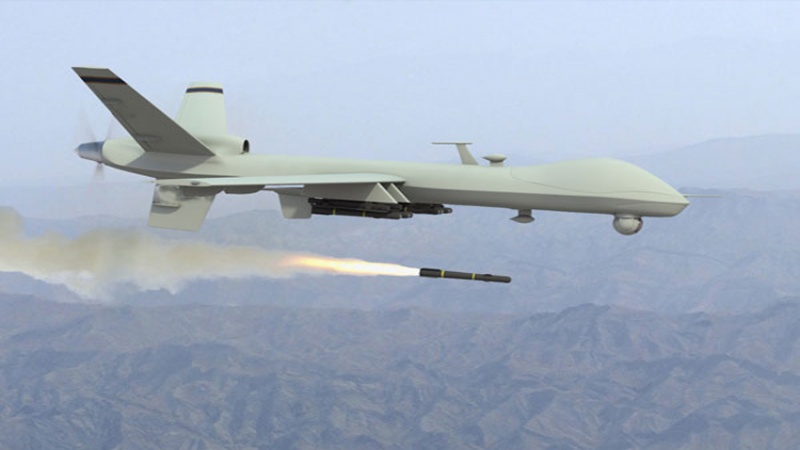
The first instance of a drone killing civilians in Afghanistan was in 2002, when a man by the name of Daraz Khan was killed by a Hellfire missile dropped by a Predator drone in the Eastern Province of Khost. The US suspected that he was Osama bin Laden; residents maintain that Khan was merely out searching for scrap metal.
Since then, Khalid’s Province of Nangarhar has become a hub for armed groups—first the Taliban, and later forces claiming allegiance to Daesh—and a bustling drug trade. It has also become one of the most drone-bombed provinces in the most drone-bombed country in the world.
The American public, though, has largely forgotten this. The war in Afghanistan has been running for 18 years, making it the longest conflict in American history, it passed the previous milestone, set by the Vietnam War, in February 2019. Over the years, press coverage has fallen dramatically. According to the Pew Research Center for Journalism and the Media, Afghanistan accounted for 1% of all media coverage in the US in 2007 and just under 4% in 2010, when the Pentagon deployed 100,000 troops and dropped 5,101 bombs on the country. Today, the level of coverage is insignificant: Pew no longer even tracks it as a topic.
In fact, military activity in Afghanistan is on the increase again. The number of US occupation troops there started rising again under the Trump administration; there are now 15,000 American military personnel officially deployed in the country. Air strikes are at a record high, according to the US Air Forces Central Command: 2018 saw 7,362 bombs dropped by US forces in Afghanistan.
As of August 31 this year, the Bureau of Investigative Journalism had documented at least 4,251 aerial strikes in Afghanistan for 2019, more than double the total for the whole of 2018. Most of these, it says, are thought to be by drones. These attacks are exacting an increasing toll on the Afghan people. This year, according to the United Nations, foreign occupation forces were responsible for more civilian deaths than the Taliban or Daesh-allied forces for the first time since its Afghanistan mission began recording civilian casualties in 2009. Between January 1 and June 30, occupation military forces were responsible for 89% of the 519 civilian casualties—363 deaths and 156 injuries—caused by aerial operations.
It’s not just drone warfare that has expanded dramatically, however. The US military has used the war to test and improve other tactics, too.
In 2007, American forces began taking photographs, fingerprints, and iris scans of almost every Afghan they came across. By 2011, almost two million people—more than 5% of the population—had had their biometric details captured by the US military. In most cases it was claimed that this was done in a check for suspected militants, or as part of the application process for jobs with government security forces or on coalition bases, but it could happen at any time, and for almost any reason.
The Pentagon claimed the move, a tactic it calls “identity dominance,” was intended to spot insurgents and prevent infiltration. But it’s believed that US Navy Seals used their identity system to confirm that they had found Osama bin Laden during the raid on his compound in Pakistan in 2011. And in Iraq, where the US had previously tried biometric capture, it was used to control people’s movements, especially in high-conflict areas like Fallujah.
Unsurprisingly, perhaps, the fear of surveillance is pervasive among ordinary Afghans. Rumors circulate about new techniques being used to spy on people: Khalid and his friend Naimatullah tell stories about a substance that can be rubbed on your clothes to make you more easily traceable. These tales have apparently led to a new defense mechanism among Nangarharis. Naimatullah said “You just take off your clothes and run into some water. They say that somehow jams the signals.”
Obaid Ali, a Kabul-based analyst at the Afghanistan Analysts Network, who has written extensively on aerial operations, says he has been told about physical tracking devices—albeit slightly more traditional ones. He told me “They’re really small electronic devices that are slipped into someone’s clothing.”
A Department of Defense spokeswoman said the Pentagon could not comment on tactics, techniques, or procedures for operational security reasons. Rahmatullah Nabil—a presidential candidate who twice served as Afghanistan’s chief of intelligence during 2010 to 2015—says people are definitely tracked: but that most of that is done through mobile-phone signals. Nabil says: “This has led the Taliban to rely on some familiar tactics to keep them from being traced: “They use the simplest possible mobile phones and are constantly changing their locations every few hours. They never spend more than 48 hours in a single area.”
In many areas of the country, phone service is cut off, usually by the Taliban, at sundown. And in August, the Taliban announced that they would begin targeting employees of the state-run provider Salaam Telecom, saying the company’s workers are “tied to intelligence agencies.”
In many areas under Taliban control, simply owning a smartphone can create suspicion that someone is an intelligence agent. That means even though people often use phones to check on loved ones after a terrorist attack or security operation, some have chosen to give up on them altogether.
The device that fell on a small village in Nangarhar’s Achin district, an hour’s drive along a treacherous road from Jalalabad, in April 2017 wasn’t just any bomb. The GBU-43/B Massive Ordnance Air Blast Bomb, or MOAB, weighed 21,600 pounds (9,800 kilograms) and cost $170,000. It was the most powerful non-nuclear weapon ever used, capable of destroying an area the size of nine city blocks. It quickly became known as the “Mother of All Bombs.”
The US defense department tried to justify the strike by saying it had killed at least 94 Daesh fighters. But former President Hamid Karzai called it a prime example of how the US was using Afghanistan for what amounted to experimental warfare. He wrote on Twitter “This is not the war on terror but the inhuman and most brutal misuse of our country as testing ground for new and dangerous weapons.”
In the two and a half years since, journalists and investigators have still not been able to get to the exact site of the attack in order to decipher what happened.
So why was such a large bomb used? A few days after MOAB dropped, Vice President Mike Pence suggested one motive: as a demonstration of power. He said in an address in Seoul “Just in the past two weeks the world witnessed the strength and resolve of our new president in actions taken in Syria and Afghanistan. North Korea would do well not to test his resolve or the strength of the armed forces of the United States in this region.” He added, “The era of strategic patience is over.”
All this is made worse because the US military has not always been transparent about its operations. Emran Feroz, an Afghan-Austrian journalist and author who has been tracking aerial operations in Afghanistan since 2011, concurs: “The central problem is most of these strikes are conducted under the cover of night in hard-to-reach areas, often under the control or influence of groups like the Taliban, which makes it very difficult for anyone to go and investigate in a timely manner.”
Nearly 20 years in, and with the conflict once more intensifying, there are no signs of an ending. Diplomacy between the Taliban, the Afghan government, and the Trump administration seems to be making little progress. Trump, who claimed to have canceled a secret meeting with the Taliban on US soil planned for September, has vowed to halt talks so long as Taliban fighters keep attacking Afghan civilians and US occupation forces.
MUSIC
In September, at least 30 civilians were killed in a US drone strike near a pine nut field in Khogyani. Provincial officials say the attack was meant to target a hideout of Daesh forces, but residents say it was civilians who paid the price once again.
Nabil, the former intelligence chief, says the best way to improve things is to shift away from technology and back toward proper intelligence gathering. He says “We have to be better than the Talibs—we must ensure that we protect civilian life at all costs.”
Khalid and Naimatullah agree that the increasing frequency of strikes serves no purpose. They asked “Even people in the villages know where the Taliban and Daesh are, but why is it that civilians keep dying in these attacks?”
Naimatullah said “I was 16 when I saw someone die from a drone strike,” adding, “Since then I’ve cleaned up so many bodies, their blood, their brains. My heart is stone now, because it’s always innocent people dying.”
ME/SS
Tags