Through the ‘War on Terror’ looking glass
Apr 26, 2017 11:46 UTC
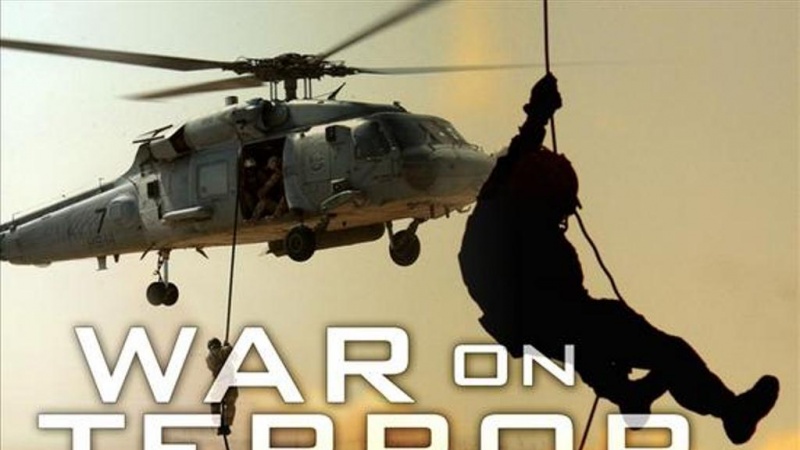
The U.S. government’s 15-year-long “global war on terror” has spread death and chaos across entire regions – while also imposing propaganda narratives on Americans – with no end in sight.
The Airwars.org U.K.-based monitoring group reports that 41 U.S-led air strikes allegedly targeting Daesh in Iraq and Syria killed at least 296 civilians during the week after the chemical weapons incident on April 4. U.S. cruise missiles killed many civilians in villages near the Shayrat airbase that was targeted on April 7th. But the fragmentary reports compiled by Airwars.org can only reveal a fraction of the true numbers of civilians killed by U.S. and allied bombing in Iraq and Syria. These are only the minimum numbers of civilians killed in 41 of the 178 air strikes reported by the U.S military that week.
In other war zones, when such compilations of “passive” reports have been followed up by more comprehensive, scientific mortality studies, the true number of civilians killed has proved to be between 5 and 20 times higher than numbers previously reported by “passive” methods. So, based on the fragmentary nature of passive reporting of civilian deaths and the ratios to actual deaths uncovered by more comprehensive studies in other war zones such as Rwanda, Guatemala, D.R. Congo and Iraq, it is likely that U.S.-led air strikes killed at least 1,500 innocent civilians in just this one week, or conceivably as many as 6,000. To put this scale of civilian deaths in the larger context of the U.S. bombing campaign in Iraq and Syria since 2014, the 589 bombs and missiles dropped in the week of April 4- 10 made this only an average week in a campaign that has been waged consistently at this intensity for more than two-and-a-half years.
Airwars has been investigating reports of civilian casualties caused by U.S. and the so-called “coalition” bombing since 2014. It has investigated U.S. or allied responsibility for incidents that have killed between 8.303 and 12,208 civilians reported by local and international media and groups like the Syrian Observatory for Human Rights. At this point, it has confirmed that 3,061 to 4,943 civilians have been killed in 1,197 U.S. or allied air strikes. Airwars classifies these deaths as “confirmed.” Airwars classifies the reporting as “fair” for another 454 strikes that have killed between 2,635 and 4,192 civilians, based on reporting by two or more credible sources and confirmation that an alleged U.S. or allied air strike did take place. Airwars classifies the remaining reports of a further 2,607 to 3,093 civilians as either “fair, but with no confirmed strikes,” “weak,” “contested,” or “discounted.”
Applying the 5 to 20 percent ratio of passive reporting to actual deaths found in other war zones to Airwars’ minimum and maximum figures for “confirmed” and “fair” reports of civilian deaths, a reasonable estimate of total civilians killed by U.S. and allied bombing in Iraq and Syria since 2014 would be between 28,000 and 180,000.
A similar effort by Iraq Body Count during the first three years of the U.S. occupation of Iraq only counted about one-twelfth of the violent civilian deaths subsequently revealed by a comprehensive mortality study of the same period. We will only know for sure whether Airwars has been more successful once we can compare its figures with a comprehensive epidemiological mortality survey of the present conflict in Iraq and Syria. Claims by U.S. officials that the true civilian death toll from the U.S. and allied bombing campaign in Iraq and Syria is in the hundreds, as opposed to the tens of thousands, have never been credible, as senior officers have occasionally admitted. The uncritical repetition of the U.S. military’s absurd claims by U.S. media as if they were credible estimates of civilian deaths is a journalistic scandal. This has only served to increase the near-total ignorance among much of the American public about the real human costs of the wars being waged in our name.
As with the reporting of domestic gun violence in the U.S., occasional reports of single acts of mass killing grab headlines, but give only a hint of the constant slaughter that rages on unreported, day in, day out, in Iraq, Syria, Afghanistan, Yemen, Libya, Somalia and across the ever-spreading area of the world being dragged into the bloodbath unleashed since 2001 by the U.S. “Global War on Terror!”
There is another critical factor in the under-reporting of these constant, daily atrocities, one that has probably been a common pattern in every war ever fought. George Orwell described it very well in an essay entitled “Notes on Nationalism” that was published in May 1945, as the allies celebrated Germany’s surrender at the end of World War II. Orwell wrote, “Actions are held to be good or bad, not on their own merits, but according to who does them, and there is almost no kind of outrage – torture, the use of hostages, forced labour, mass deportations, imprisonment without trial, forgery, assassination, the bombing of civilians – which does not change its moral color when it is committed by “our” side… The nationalist not only does not disapprove of atrocities committed by his own side, but he has a remarkable capacity for not even hearing about them.”
Far from treating this prejudice as a problem to be overcome through public accountability and serious journalism, the US current military and civilian leaders and their media mouthpieces treat this kind of nationalism as a weakness they can exploit to further suppress public awareness of their own atrocities. Then, when a single horrific incident like the mass casualty air strike on West Mosul on March 17 breaks through this wall of silence into the public consciousness, the propaganda machine is quick to frame the killing of civilians as “unintentional” and contrast it with the “deliberate” killing of civilians by the intruders’ enemies.
The eminent historian Howard Zinn pointed out the flaw in this frame of reference in a letter published in the New York Times in 2007, based partly on his own experience as a U.S. Air Force bombardier in World War II:
“These words are misleading because they assume an action is either ‘deliberate’ or ‘unintentional.’ There is something in between, for which the word is ‘inevitable.’ If you engage in something like aerial bombing, in which you cannot possibly distinguish between combatants and civilians, the deaths of civilians are inevitable, even if not ‘intentional.’ Does that difference exonerate you morally?” Howard Zinn concluded that, “The terrorism of the suicide bomber and the terrorism of aerial bombardment are indeed morally equivalent.” “To say otherwise is to give one moral superiority over the other, and thus serve to perpetuate the horrors of the time.”
The persistent role of chemical weapons in U.S. propaganda to justify attacks on Iraq and Syria turns on its head the way that Western powers actually used chemical weapons themselves in the past. During World War I, American factories produced 5,770 tons of chemical weapons for use by the U.S. and its allies on the Western Front, and this was only a small fraction of the weapons produced and used by the U.K., France and Germany. These days mark the centenary of the first time that chemical weapons were used in the Middle East, by British forces in the Second Battle of Gaza in April 1917, where they failed to dislodge the Ottoman defenders barring the British advance to Bait ol-Moqaddas and Damascus.
As British occupation forces faced a nationwide rebellion in Iraq in 1920, British leaders in London sent chemical weapons to Iraq. British forces relied mainly on bombing, and fire-bombing in particular, to put down the rebellion and enforce British rule in Iraq. Winston Churchill was a strong advocate for the use of chemical weapons. As Howard Zinn concluded, these claims to moral superiority only serve to perpetuate a mutually-reinforcing cycle of violence and to foreclose any attempt to resolve any of these conflicts except through even greater violence. The unwritten rule that the western propaganda seeks to impose on the world is that the U.S. and its allies have the right to use unrestrained, unlimited violence at will, with total impunity.
After George W. Bush’s administration’s crimes alienated much of the world, President Obama conducted the next phase of this aggressive policy under cover of his iconic image as a hip, sophisticated celebrity-in-chief with roots in African-American and modern urban culture. This triumph of style over substance constituted a new achievement in neoliberal “managed democracy,” allowing him to carry out policies that were the polar opposite of what his supporters thought he stood for. With Trump, the mask is off, and the world is suddenly faced with the unvarnished reality of an aggressive military power that accepts no legal constraints on its violence.
If the westerners, the US at the top, ever seriously want to prevent war crimes and hold war criminals responsible, we must start with the basic principle of justice invoked by Supreme Court Justice Robert Jackson at the London Conference that drew up the Nuremberg Principles in 1945. But this is a principle that Trump, Obama and other present-day U.S. leaders would find quite alien. Robert Jackson declared: “If certain acts in violation of treaties are crimes, they are crimes whether the United States does them or whether Germany does them, and we are not prepared to lay down a rule of criminal conduct against others which we would not be willing to have invoked against us.”
Through several administrations, across political parties, and with the active collaboration of the U.S. mass media, the American leaders, specially, have replaced the rule of law with the rule of propaganda, treating flaws in their public debates as weaknesses to be exploited, instead of dangers to beware of. Political skill across the spectrum is now measured in the ability to “connect” with the public in a way that is completely divorced from the actual details or effects of government policy. U.S. politics has gradually been reduced to the corrupt circus of smoke and mirrors now personified by President Trump.
As the US militarism escalates in Iraq, Syria, Yemen, Afghanistan, and many other places around the world, as U.S. warships bear down on Korea, and as the US leaders issue new threats against Russia and China, we, the Americans, may have less time to save ourselves, each other and our world than we have previously assumed.
That was from an article by Nicolas J S Davies, the author of Blood On Our Hands: the American Invasion and Destruction of Iraq.
EA
Tags