FIFA Peace Prize awarded to Trump: Innovation or politicization?
-
FIFA Peace Prize awarded to Trump
Pars Today – At the 2026 FIFA World Cup draw ceremony, Donald Trump received the new “FIFA Peace Prize”, which quickly sparked severe criticism. FIFA’s decision was seen as an attempt to strengthen political and economic ties with Trump, and many described it as “blatant flattery.”
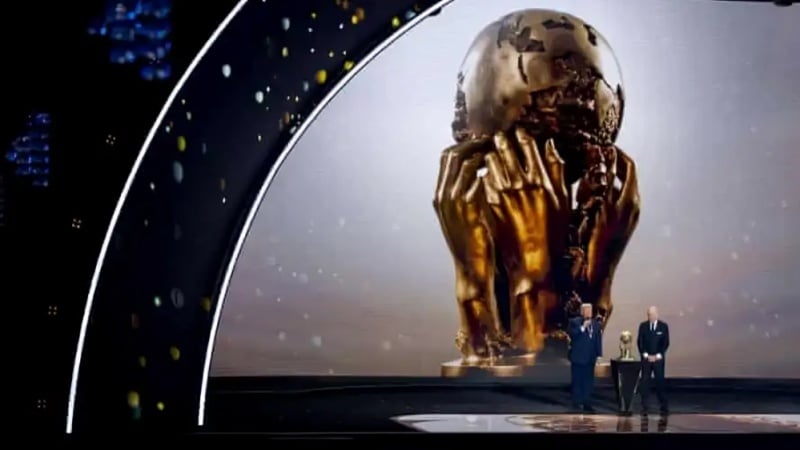
On 6 December 2025, the John F. Kennedy Center for the Performing Arts became the stage for a mix of political and sporting spectacle. The final draw for the 2026 FIFA World Cup, set to be held in the United States, Canada, and Mexico, featured a surprising moment: the awarding of the FIFA Peace Prize to Donald Trump, President of the United States.
The new award, officially named the “FIFA Peace Prize – Football Unites the World”, was presented for the first time to Donald Trump, immediately sparking a wave of reactions. Gianni Infantino, FIFA President, with a beaming smile, presented the gold medal to Trump, saying: “You can wear this beautiful medal wherever you like.” Trump, appearing satisfied at having compensated for his failure to win the Nobel Peace Prize, immediately placed the medal around his neck and described it as a symbol of his efforts for global peace.
FIFA introduced this award as an annual initiative, given to “individuals who have made exceptional and extraordinary efforts for peace and have united people around the world.”
Trump, who has consistently used media and awards to strengthen his personal brand, described the event as a “historic moment for football and peace” and promised to make the 2026 World Cup the “biggest peaceful event in history.” However, behind the scenes, sharp criticisms were brewing. Many viewed the award not as a genuine honor, but as “blatant flattery” aimed at ensuring the success of the 2026 World Cup.
FIFA, an organization that has traditionally emphasized political neutrality, has been drawn into the realm of politics by this move. Critics, including human rights activists, have called the decision frivolous and crass.
For example, Craig Mokhiber, a human rights activist, told Al Jazeera: “Infantino and his associates, after two years of FIFA’s complicity in the genocide of Palestinians, have now invented a new peace award to ally themselves with Trump.”
This criticism stems from Infantino’s close relationship with Trump, a connection that began with the U.S. hosting the 2026 World Cup and has included frequent meetings and mutual support. Western media have also seized the opportunity to mock the situation. The Guardian, in a satirical piece, wrote: “Trump wins FIFA Peace Prize – can VAR review it?” The publication described the ceremony as a cheap spectacle designed to flatter Trump.
Even within the United States, Democrats have called the move “FIFA’s political maneuvering to influence Washington.” USA Today reported that Trump had been the “certain winner” of the award for months, fueling suspicions that it was “engineered.” Notably, there was no actual competition, and Trump was the only nominee who received it. These criticisms are rooted in FIFA’s controversial history—a body that has faced corruption scandals and accusations of racism—and now, by entering the political arena, it has further endangered its credibility.
In the end, awarding the FIFA Peace Prize to Trump is more a reflection of the intersection of sports and politics than a symbol of unity. With this medal, Trump has added to his collection of personal awards, but FIFA, with this decision, has raised serious questions about its independence. Will this annual award become a tool for sports diplomacy, or a symbol of political corruption? Time—and perhaps FIFA’s actions in the coming years—will provide the answer. What is certain is that the event has shifted debates from the football pitch to the global stage, demonstrating that politics is always present in the world of sports.