Why is Trump wandering between threat and agreement?
-
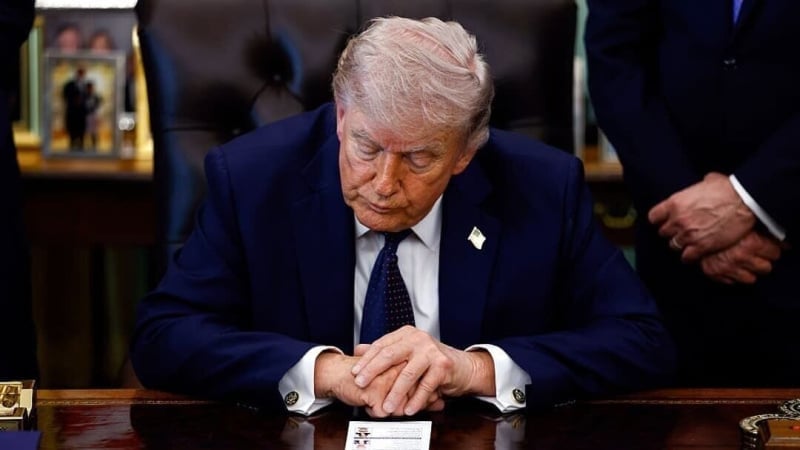
US President, Donald Trump
Pars Today – CNN has reported that the US government has become "confused" in its approach to Iran's nuclear issue.
Over the past few weeks, Donald Trump has changed his position several times regarding the fate of Iran's enriched uranium stockpile. One day he calls these stockpiles "insignificant" and deems satellite monitoring sufficient; another day he speaks of transferring it to the United States, then proposes burying and sealing it, and finally insists again on its destruction or removal. This inconsistency should not be reduced solely to Trump's unpredictable personality.
According to Pars Today, Washington's confusion primarily reflects the US strategic deadlock following the forty-day war against Iran. A war that, contrary to the initial calculations of the White House and Tel Aviv, neither led to the collapse of Iran's deterrence nor disrupted the Islamic Republic's strategic structures, nor forced Tehran to accept Washington's maximum demands.
Trump and his inner circle imagined that despite failing to achieve their main objectives in the military aggression against Iran, they could, through a combination of military, economic, and psychological pressure, place Iran in a position where it would make major concessions to end the crisis. These concessions included stricter nuclear limitations, curbing the missile program, and even redefining Iran's regional role. However, what happened on the ground painted a different picture. Iran not only managed to preserve its military capabilities and infrastructure but also, by targeting US bases in the region and maintaining internal cohesion, conveyed the message that the costs of any war would exceed Washington's initial estimates.
Trump now finds himself in a state of helplessness. He needs a political "achievement" to show, because a president who started the war with the slogan of quickly containing Iran now needs to demonstrate a tangible success to the American public and regional allies. The issue of Iran's enriched uranium has become a symbol in this context — a symbol the White House is trying to present as a "concession obtained from Iran." But the realities on the ground and technical facts have tied Trump's hands.
After years of sanctions, the assassination of nuclear scientists, elites, and political figures, sabotage, and political pressure, Iran has not only preserved its nuclear knowledge but has also managed to consolidate its indigenous technological cycle. Even if one assumes that part of the uranium stockpile is moved or limited, the technical know-how, human infrastructure, and capacity for rapid reconstruction of the nuclear program will remain. This very fact has caused parts of the US security establishment to doubt theatrical and propaganda approaches.
Trump's contradictory stances on the fate of enriched uranium in Iran stem from this same desperation. When he says "these materials don't matter," he is actually pointing to a technical fact: possessing uranium stockpiles does not necessarily mean an immediate capability to build nuclear weapons, and intelligence and satellite monitoring can track developments. But when he speaks of transferring or destroying the stockpiles, he is responding to his political need to present a symbolic victory. This duality also signals a deep disagreement within the US administration.
Part of Trump's team, including figures like Secretary of State Marco Rubio and Treasury Secretary Scott Bessent, continue to insist on the policy of pressure and extracting maximum concessions. They believe that backing down from demanding the transfer of uranium stockpiles would mean US defeat after the war. But on the other side, there is a more realistic current that understands that post-war Iran is not pre-war Iran, and Tehran is not in a position of weakness to accept imposed conditions.
More importantly, the US now faces geopolitical constraints as well. Washington is engaged in simultaneous rivalries with China and Russia and does not have the capacity to enter a new protracted crisis in West Asia. Moreover, the bitter experiences of Iraq and Afghanistan are still alive in America's strategic memory. Any attempt to escalate conflict with Iran could create unpredictable economic and security costs for the US and its allies. For this reason, what CNN describes as "confusion" is actually a sign of a deeper crisis: Washington's inability to translate military superiority into political gain.
After the forty-day war, Trump neither managed to force Iran into strategic retreat nor succeeded in outlining a clear framework for a post-war agreement. He is now trapped between two options: a realistic agreement that would likely fall short of America's initial expectations, or continued pressure that could lead to another diplomatic failure. From this perspective, Trump's vertigo over Iran's nuclear file is not a political inconsistency, but a reflection of the gap between America's geopolitical aspirations and the ground realities of Iranian power.
Washington is still seeking an agreement it can label a "victory," but the issue is that post-war Iran has shown more than ever that it is not willing to trade its security and strategic capacity for an unstable agreement.