Golestan Province: Iran’s new frontier for renewable energy
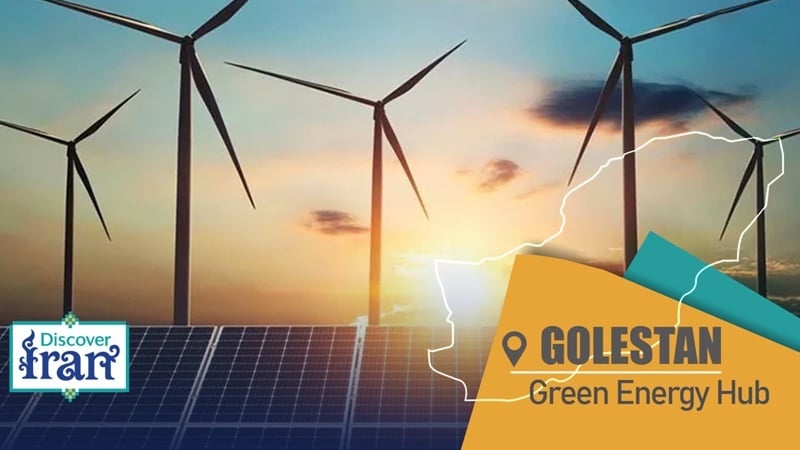
Pars Today – As the urgency of global sustainable development intensifies, Golestan Province is emerging as a strategic candidate poised to become a cornerstone of Iran’s green energy future.
The path for Golestan Province to position itself at the center of Iran’s green energy landscape is a multifaceted effort built on three main pillars: harnessing its distinctive solar and wind resources, implementing attractive public–private incentive schemes, and taking the lead in a distributed generation model that links energy security with social empowerment.
Golestan’s trajectory reflects a broader national shift toward renewable energy and illustrates how regions with moderate yet viable resources can, by combining modern technologies with community-driven investment, accelerate sustainable development, reduce carbon footprints, and redefine regional energy justice.
Solar potential beyond stereotypes
The fundamental argument behind Golestan’s green ambitions challenges a long-standing perception. Contrary to the common belief that northern provinces near the Caspian Sea are unsuitable for solar energy due to higher humidity and cloud cover, scientific assessments reveal a more complex and encouraging reality.
Detailed zoning studies, using data from ground-based stations and analytical models such as GEOS-5 and ERA5, show that Golestan possesses a mosaic of microclimates.
While the mountainous forested areas receive lower solar radiation, the southwestern highlands and northeastern plains of the province—known for their semi-arid conditions—enjoy annual radiation levels between 1,500 and 1,800 kWh/m², with a provincial average of about 1,485 kWh/m². Although this range is moderate compared to Iran’s central deserts, it is considered “fully sufficient for energy supply” and adequate to justify both large-scale solar farms and widespread distributed generation.
This potential is further reinforced by the province’s high number of sunny days, exceeding 300 per year in northern areas such as Gomishan, Bandar-e Torkaman, and Maraveh Tappeh, turning these regions from agricultural peripheries into prime candidates for solar infrastructure.
Wind energy potential
Alongside its solar narrative, Golestan Province is also associated with wind energy potential, particularly in northeastern corridors near Kalaleh and Maraveh Tappeh. A comprehensive long-term assessment of wind resources across five counties provides a data-driven counterpoint to overly optimistic claims.
The study, which analyzed 30 years of data, concludes that Golestan’s wind power density is “relatively low for large wind turbines” and generally classifies the province as Class 1, or “weak,” for major wind farms. However, it identifies seasonal and local opportunities, noting that during certain months, areas such as Maraveh Tappeh and Bandar-e Torkaman can reach Class 2 potential.
Strategic implications and broader outlook for Iran
Golestan’s potential transformation into a green energy hub carries implications that extend beyond provincial borders. Success here could serve as a model for a more decentralized and equitable energy transition in Iran, demonstrating that regions outside the traditional “solar belt” can still make a meaningful contribution to national clean energy goals.
This approach showcases a strategy where energy development is integrated with rural development, job creation, and poverty reduction—a holistic perspective often absent in projects focused solely on energy extraction.
For Iran, enabling Golestan’s success means geographically diversifying the renewable energy portfolio, which in turn enhances the overall resilience of the system and reduces transmission losses by generating electricity closer to northern consumption centers.
This represents a strategic move for the use of natural gas, which is currently burned for electricity production in the province, allowing it instead to be directed toward higher-value exports or domestic industrial use, thereby improving the country’s economic and energy security.
Golestan Province stands not on the edge of a guaranteed transformation but at the threshold of an exceptional and highly strategic opportunity. Its claim to become Iran’s next green energy hub is not based on overwhelming natural advantages, but on a pragmatic and integrated formula: linking credible—albeit moderate—renewable resources with innovative financial mechanisms, strong social engagement, and a multi-scalar implementation model.
The province is poised to become a key regional hub for clean energy—a center defined not by sheer output, but by diversity, distribution, and socio-economic integration. Golestan’s journey testifies to the reality that in the global transition toward sustainability, resilient and practical energy futures are built not only on the sunniest deserts or windiest peaks, but on comprehensive planning and community-aligned innovation.