US likely wiser than to harm own interests: Iran
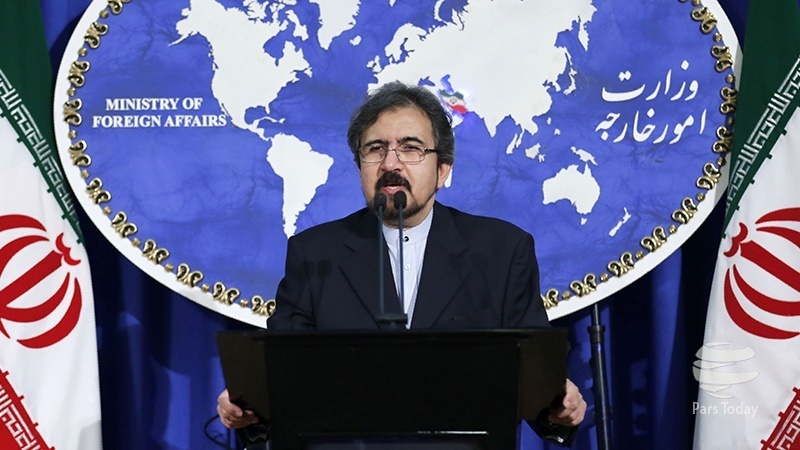
Foreign Ministry spokesman has implied that the incoming administration of US President-elect Donald Trump is unlikely to harm American and international interests by potentially denting or scrapping a multi-lateral nuclear deal with Iran, which has been negotiated by the outgoing US administration.
According to Press TV, referring to the rhetoric flip-flops by Trump, Foreign Ministry Spokesperson Bahram Qassemi said on Tuesday that it was still too soon to say what implications a Trump presidency would have for the nuclear deal.
“It is still soon to judge what is going to come about,” he said, adding that he believed there was enough rationality within the American society to prevent the potential endangerment of American and international interests.
He did say, however, that Iran would have contingency plans for any scenario that may play out.
“Iran anyway maintains its readiness and has prepared its options for whatever contingency. When the time comes, and if we feel that the American side is eventually about to take certain [unwelcome] measures in this regard, Iran will take necessary measures [of its own],” the Foreign Ministry spokesman said.
Qassemi said that the Joint Comprehensive Plan of Action (JCPOA), as the agreement is known, is a multilateral agreement, not a bilateral one, and that it has been endorsed by the United Nations Security Council.
“I do not think it would be an easy thing for a single party to trample upon the deal or offer to renegotiate it,” he said.
On the campaign trail, Trump had also said several times that he would renegotiate the deal. The bombastic president-elect has, however, not commented on Iran-related issues since winning the US presidential election on November 8.
Qassemi also said the Islamic Republic was optimistic about future convergence between Iran and the European Union (EU).
He hailed a recent statement by the EU that followed Trump’s victory and that urged commitment to the JCPOA.
“We have a lot in common with Europe and are not geographically so wide apart, and therefore, we can arrive at shared viewpoints concerning the Middle East and North Africa,” he said.
He also said that it had been agreed during a Friday meeting in Paris between French Foreign Minister Jean-Marc Ayrault and Deputy Foreign Minister Majid Takht-e Ravanchi that the countries’ joint economic commission resume work in the second half of January 2017 after a 20-year hiatus.
‘Syria breakup plans abortive’
Elsewhere in his remarks, Qassemi referred to a United Nations (UN) proposal for the establishment of an autonomous region in the militant-held district of a Syrian city and said such measures have always failed.
“Syria has many players and influence-wielders. Syria’s disintegration has many and serious opponents and cannot happen easily. We are not yet anywhere to start to treat these arguments as serious [ideas],” he said, referring to the plan for the partition of Aleppo, the Syrian city.
Syrian Foreign Minister Walid al-Muallem has strongly rejected the idea, calling it “a violation of our sovereignty.”
‘NATO not welcome in Mideast’
The Foreign Ministry spokesman also pointed to Kuwait’s recent announcement that it is ready to host regional headquarters for NATO.
Qassemi said that the entry of foreign forces to the region has never proven to be a solution to regional woes and has always been cause for instability and insecurity.
‘Anti-Iran letter result of ignorance’
Qassemi also referred to a recent letter to the UN by Saudi Arabia and 10 other Arab countries that accused Iran of “supporting terrorism” and said the signatories of the letter had little or no grounding in the history and culture of Iran and the Iranian people.
Among the signatories to the letter were such Saudi allies as Bahrain, Jordan, Kuwait, and Qatar.
Qassemi said it was Saudi Arabia that was the real sponsor of terrorism and that had been exporting it throughout the world for decades.
“Saudi Arabia harbors the chimera and irrelevant delusion that it can surmount its problems by having an enemy in, say, Iran,” he said.
Through such jockeying, he said, Riyadh believes it can derive some kind of advantage and cause some kind of trouble for Iran at the current juncture in time, which he said may be a “period of transition” in the US.
SS