IAEA, world leaders reject US claims on Iran nuclear deal
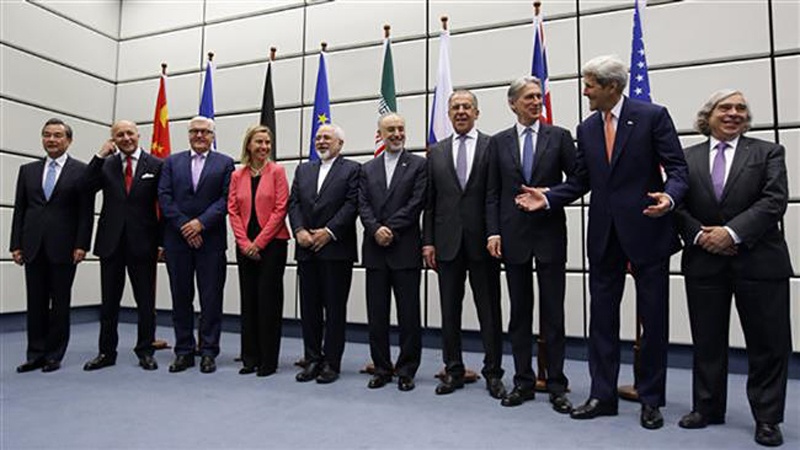
The International Atomic Energy Agency (IAEA) and many world leaders have unanimously thrown their weight behind the 2015 nuclear agreement between Iran and the P5+1 group of countries, rejecting US President Donald Trump’s claims that Tehran has violated the “spirit” of the deal.
According to Press TV, IAEA Director General Yukiya Amano in a statement on Monday once again confirmed that Iran was in compliance with its commitments under the nuclear agreement, known as the Joint Comprehensive Plan of Action (JCPOA).
“I can state that the nuclear-related commitments undertaken by Iran under the (nuclear agreement) are being implemented,” Amano said in prepared remarks during the 20th Edoardo Amaldi Conference in Rome.
Meanwhile, European Union's foreign policy chief, Federica Mogherini, also said on Monday that Iran's compliance with the JCPOA had been verified on at least eight separate occasions, calling for efforts to honor international cooperation instead of dismantling them.
Speaking through video conference, Mogherini said it was time to “invest in international cooperation” and “open new channels and not destroy the ones we already have," adding that it was “certainly not the time to dismantle them.”
In a related development, German Foreign Minister Sigmar Gabriel told reporters in Berlin on Monday that his country was concerned about Trump’s possible announcement that the JCPOA had not been adhered to, saying this would turn North Korea off any accord to halt its nuclear weapons program.
“We do not want to see this [nuclear] agreement [with Iran] damaged,” Gabriel emphasized.
“Our big concern is with regard to North Korea that it is very unlikely the North Korean dictatorship is ready to agree to an international agreement to renounce the building of nuclear weapons if the only agreement in the world that has allowed such a renunciation is at the same time called into question,” he added.
Designating IRGC as terror group can fuel crisis: France
Speaking at a daily briefing, French Foreign Ministry spokeswoman, Agnes Romatet-Espagne, expressed concern that designating the Islamic Revolution Guards Corps (IRGC) as a “terrorist” group by the US administration could exacerbate tensions in the region.
“In the context of regional instability, France is vigilant on any actions that could exacerbate the current crises," she said, adding that regional countries should play a “specific role and must show restraint and a sense of responsibility.”
The IRGC chief commander, Major General Mohammad Ali Jafari, said on Sunday that Iran would treat US troops like Daesh terrorists if the IRGC is designated as a terrorist organization by the US.
“As we have announced in the past, if America's new law for sanctions is enforced, this country will have to move its regional bases outside the 2,000 km radius of the Iranian missiles' range," Jafari said.
The IRGC commander’s warning came after reports that the US president was expected to announce new measures against Iran, including the prospect of additional targeted sanctions and the designation of the IRGC as a terrorist organization.
Possible US exit from JCPOA will have negative outcomes: Russia
The Kremlin spokesman, Dmitry Peskov, also warned against the negative consequences of a possible US withdrawal from the JCPOA, saying that Moscow was trying to analyze it.
Speaking to reporters, Peskov added that Russian President Vladimir Putin had repeatedly highlighted the importance of the agreement.
“Of course, the withdrawal of one of the countries, especially a key country like the United States, from this agreement will only have negative consequences,” the spokesman pointed out.
China hopes Iran nuclear deal will stay intact: Foreign Ministry
In a related development, spokeswoman of China's Foreign Ministry, Hua Chunying, expressed hope that the JCPOA would stay intact, saying that the deal played an important role in maintaining global peace.
She described Iran nuclear deal as a “good example” of how to solve something peacefully through dialogue.
“We have previously responded and explained that the Iran nuclear deal was an expression of multilateralism in the international community and a good example of how to solve something peacefully through talks,” the spokeswoman said.
“It has played a positive and important role in ensuring nuclear non-proliferation and protecting peace and stability in the Middle East. We hope that the comprehensive Iran nuclear agreement could continue to be earnestly implemented,” Hua added.
SS