Find out more about the Islamic Revolution (2)
Nov 14, 2018 11:12 UTC
Welcome to the second episode of the series Find Out More About the Islamic Revolution. One of the most important differences of Iran's Islamic Revolution with other major revolutions is related to geopolitics of Iran. Iran is situated in Middle East, and prior to Iran's Islamic Revolution, no other revolution had taken place in this region.
Therefore, Iran's Islamic Revolution was the first revolution in the Middle East, marking a turning point in this region. The other point in regard to Iran's geopolitics is that Islamic Revolution took place in a country, which was one of the main producers of oil and natural gas in the world, with oil and natural gas sector being highly impactful on international politics. The presence of huge oil and natural gas reserves in Iran, was one of the root causes of focus of world powers on Iran. it can be said that one of the main reasons behind the 1953 coup in Iran against the then government of Dr. Mohammad Mosaddeq was the nationalization of Iran's oil industry and termination of Britain's control over Iran's oil sector.
Furthermore, the oil shock ensuing the soaring oil prices in the 1970s even impacted the world order; and occurrence of a revolution in Iran could once again surge the price of oil, which was of paramount importance for the global economy. This fact shows the geopolitical significance of Iran. it also shows that Shah's despotic regime was the recipient of the world powers' unwavering support, given that the suppressive regime of Shah was one of the main providers of energy sources for the industrial states. Iran's Islamic Revolution took place under these conditions.
Iran's Islamic Revolution was the first religious revolution in the world, leading to revival of religion in Iran's political system and even within the domain of international political arena. Prior to culmination of Iran's Islamic Revolution; many Shia, and non-Shia movements transpired in a bid to liberate mankind from the yoke of oppression. However, none of these movements led to an all-encompassing and unified ideology, which would mobilize people against the ruling system. Iran's Islamic Revolution, upon the usage of religious values, proved its capacities.
The Islamic Revolution completely changed and developed the foundations of political, social, and cultural relations in Iran, while displaying the characteristic features of political, and social revolutions, both. The martyred Iranian scholar and thinker, Morteza Mottahari, named Iran's Islamic Revolution as a branch of the revolution of prophets; especially the revolution throughout the advent of Islam. This late thinker pointed out the revolution in the advent of Islam, in addition to being a religious revolution; was a political, spiritual, social, and economic revolution. This means the campaign for achievement of freedom and administration of justice, and for elimination of social prejudices and class gaps is embedded in Islamic teachings.
Many authors have referred to the topic of religion in distinguishing Iran's Islamic Revolution from the other major revolutions in the world. For instance, Jalal Derakhshe, notes: Iran's Islamic Revolution, unlike other major revolutions, such as the French and Russian revolutions which were based on secularism, relied on the religious beliefs of the members of the community. The sacred religion of Islam played a pivotal role in the victory of people of Iran against Shah's suppressive regime.
Oriental Scholar, Nikki Keddie, believes: The revolutionary movement of Iranian people aimed to change the Western ideological and cultural model which was imposed on the Iranian community so that a ruling system compatible with the cultural status of Islamic Iran, would be founded. Given that the historical and cultural identity of the Iranian nation is tied to religious thoughts and rituals, with religion being present in all social arenas for a number of centuries; promotion of an idea which neglected religion triggered deep-rooted ideological crises; the aftershocks of which were sensed in all political, cultural, and economic domains. In confrontation with this non-religious approach, Iran's Islamic Revolution tried to find a solution to this crisis. Thus, the most important aim of the Islamic Revolution was to revive religion and to present a unique role model, based on Iran's religious and national identity.
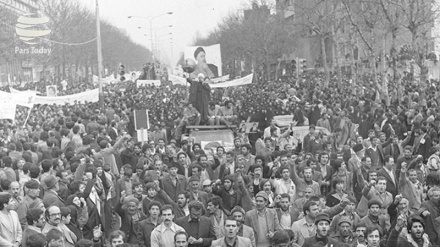
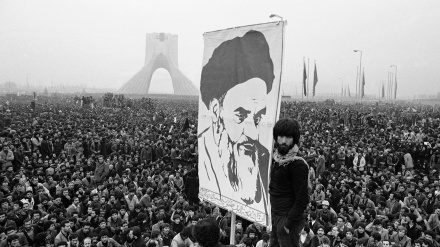
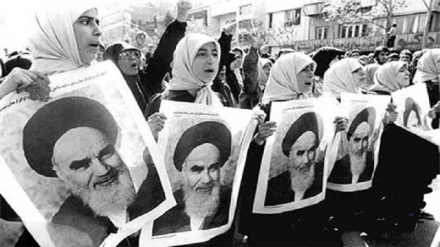
Although the economic and political issues played roles in the emergence and culmination of Iran's Islamic Revolution; however, large numbers of theorists strongly believe that the main motivation of people for participation in gory demonstrations was rooted in the opposition of Shah's dictatorial regime to Islamic values and laws. Iranian people demanded the formation of an Islamic community which would fulfill and maintain the principles, values, and ideals of the divine religion of Islam.
Thus, the most prominent aspect of Iran's Islamic Revolution was that it moved toward establishment of an Islamic community. In fact, Iran's Islamic Revolution, in addition to putting emphasis on the rule of people, also emphasizes the divine rule.
One of the differences of Islamic Revolution with other major revolutions across the globe was the economic and military conditions of the former despotic regime of Iran. Islamic Revolution emerged victorious in a country, whose former repressive regime was chosen as the regional policeman by the US. Given the soaring oil prices, Pahlavi regime maintained financial capacities, using its financial prowess to purchase modern military equipment from Western powers. Pahlavi regime maintained a 413,000-strong army and was one of the main military powers in the Middle East region. Iran's Islamic Revolution emerged victorious under these difficult conditions.
This is while, in the French and Russian revolutions, these two countries were on the verge of bankruptcy prior to occurrence of these two revolutions, and maintained undermined military forces due to their consecutive failures in several wars. In the year 1789, the French monarchic regime could not even provide bread for its people. In Russia, the Romanov Dynasty was bogged down in WW1 quagmire, experiencing a phase of political, social, and economic instability.
MR/SS
Tags