Significance of the Prophet's Me'raj
Jun 12, 2017 15:20 UTC
Today is the 17th day of the blessed month of Ramadhan, which happens to be anniversary of a memorable day in Islamic history preceded by the anniversary of one of the greatest nights in the history of mankind.
So before we present you an interesting feature on these two occasions that happened in separate years during the universal mission of the Almighty’s Last and Greatest Messenger, Prophet Mohammad (blessings of God upon him and his progeny), we recite to you the opening ayah of Surah al-Isra’:
“Immaculate is He who carried His servant on a journey by night from the Sacred Mosque to the Farthest Mosque whose environs We have blessed, that We might show him some of Our signs. Indeed He is the All-Hearing, the All- Seeing.”
As is obvious by the ayah we recited, it was in the stillness of the night, the One and Only Creator of the universe had the Best of His creation lifted to the highest point in the celestial heavens where no creature has ventured, and then sent him back to Planet Earth; all in a fraction of a single night.
The Best of creation is none other than Prophet Mohammad (blessings of God upon him and his progeny). This heavenly journey in physical form occurred in Mecca before the Prophet’s migration to Medina. It was audience with the Lord Most High granted to Prophet Mohammad (blessings of God upon him and his progeny). No other being including Archangel Gabriel had been summoned so near to the Celestial Throne. According to narrations, Gabriel descended with the celestial mount “Buraaq” whose speed is faster than the speed of light. The Seal of Messengers travelled to Masjid al-Aqsa or the Remote Mosque, which could be the one in Bayt al-Moqaddas, or as per other narrations, the one located in the heavens. Narrations also speak of his lightning visit that night to the Grand Mosque of Kufa in Iraq that used to be the house of Prophet Noah and was in ruins in those days. He also made stops at Medina, which in the near future would be the capital of his ideal government, and at Mount Sinai where God Almighty used to speak to Prophet Moses.
Thus, in the twinkling of an eye, Prophet Mohammad (SAWA) was in the ethereal heavens, meeting the prophets of the past, including Prophet Jesus, who is still alive and was never crucified as alleged, and will return in the end times to earth to assist the Prophet of Islam’s last and 12th Infallible Heir, Imam Mahdi (AS) in establishing the global government of peace, prosperity, and justice.
According to narrations, Prophet Mohammad (blessings of God upon him and his progeny) passed through the 7 heavens, beholding wonderful scenes which no human has ever witnessed. He met angels, who saluted him and was shown Paradise and its blissful denizens, as well as hell and its disgraceful dwellers. Then for the journey ahead, he mounted “Raf-Raf”, which is faster than “Buraaq” and no one knows its speed. Gabriel took him to “Sidrat-al-Muntaha”, the highest imaginable point in the heavens, and then requested him to proceed ahead, saying he himself cannot go any further, and his wings will be burned if he dared. It was God’s Will to summon the Best of his creation to His proximity, as is evident by ayahs 7 to 18 of Surah Najm of the holy Qur’an:
“While he was on the highest horizon; Then he drew nearer and nearer, until he was within two bows’ length or even nearer, whereat He revealed to His servant whatever He revealed. The heart did not deny what it saw. Will you then dispute with him about what he saw?! Certainly he saw it yet another time. Certainly he saw some of the greatest signs of his Lord.’ By the Lote Tree of the Ultimate Boundary, near which is the Garden of the Abode, when there covered the Lote Tree what covered it.The gaze did not swerve, nor did it overstep the bounds. Certainly he saw some of the greatest signs of his Lord.”
It is narrated that from behind the dazzling curtain of celestial light the Voice chosen to speak by God – Who is far glorious to have any place, form, shape, or voice – was that of Imam Ali (AS), because it was the most soothing voice for Prophet Mohammad (blessings of God upon him and his progeny).
God addressing the Prophet said:
“O Ahmad! I am an Entity that is not like anything else. I cannot be compared to anything else and I know all the secrets of your heart. With the exception of Ali ibn Abi Talib (AS), you have no other close friend. Thus, I speak to you with the voice of Ali ibn Abi Talib (AS) so that your heart will be at ease.”
Thus, the account of Me’raj or the celestial journey to the highest point in the heavens and back to Planet Earth in a fraction of a night is among the greatest miracles of Prophet Muhammad (blessings of God upon him and his progeny). The journey was physical and not spiritual, and neither a vision. Those who doubt it, or conjecture that it was journey of the soul and not the body, cannot be called true Muslims.
The details of mysteries revealed by God Almighty to the Prophet of Islam are found in the books of hadith and are outside the scope of this brief radio programme.
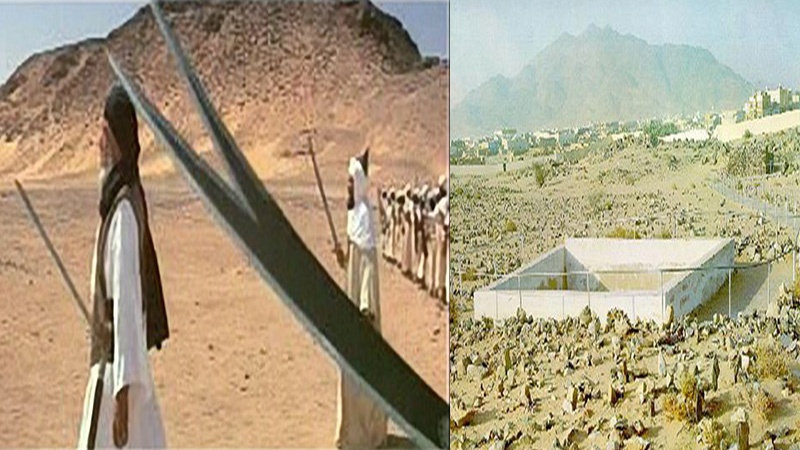
As we said earlier, the 17th of Ramadhan, also happens to be the anniversary of a memorable day in the year 2 AH, that is, in the second year after the Prophet’s migration from his hometown Mecca to Medina, because of the persecution by pagan Arabs. It was in this fasting month that the infidel Arabs of Mecca imposed upon the Prophet of Islam an armed encounter. In other words, the Prophet and the Muslims were forced to take up arms to defend their faith, security and honour. The result was the Battle of Badr, which was a decisive encounter that occurred near Medina at the spring of the same name. The lasting memories of this battle continue to impact the fate of Islam and Muslims all over the world, more than any national event that is at most transitory without any bearing on the particular land in which it took place, let alone the whole world.
To be precise, on this day, a modest force of 313 poorly-equipped Muslims managed to route a heavily-armed army of 950 polytheists of Mecca that included many a fearsome cutthroat, the mention of whose very name used to send shivers down the spines of some companions of the Prophet.
What brought about the debacle of the arrogantly over-confident infidels, who chose to start the battle with members of the Prophet's Hashemite clan and not with the rank and file of Muslims?
The answer is obvious. It was Divine help, of course!
Ayah 10 of Surah Anfaal says in this regard:
“Allah did not appoint it but as a good news, and to reassure your hearts. Victory1 comes only from Allah. Indeed Allah is All-Mighty, All-Wise.”
All chroniclers agree that of the 70-odd infidels who fell in battle, 36 were dispatched to the bowels of hell by the Prophet's cousin, the Commander of the Faithful, Imam Ali (AS). He made short work of the most terrorizing of the Meccans, such as Otba, his son Walid, Shayba, and Hanzala ibn Abu Sufyan. Hend, the daughter of Otba and the wife of Abu Sufyan, the archenemy of Islam and Muslims, bemoaned her kinsmen, and a year later at the Battle of Ohad, in brutal revenge, she had the Prophet's uncle Hamza, ambushed by her Abyssinian slave Wahshi, who subsequently tore out the liver of the martyr and presented it to her.
As for the exploits of Imam Ali (AS), the poet, Usayd bin Abi Iyyas, who witnessed the fight, has composed the verses that read:
"At every meeting there is a purpose which confounds you, a strong youngster who overcomes experienced full-grown horses.
"This is the son of Fatema (bint Asad) who has destroyed you in slaughter and death with a single blow not with (wild) striking.
"He destroyed them with violent death and blows which he struck as he used his sword whose blade did not (cease) striking (down).
As we said earlier, the number of Muslims that participated in the Battle of Badr was 313. This is because of the prophecy that in the end times, the Prophet's 12th and last successor, Imam Mahdi (AS), will re-appear to cleanse the Planet of all vestiges of corruption and oppression and to establish the global government of peace, prosperity and justice, when the number of his truly faithful companions reaches 313.
Thanks to such immortal occasions, truth is alive and universal.
Here it would be worth mentioning the courage of the Prophet. For the defence of Islam, he used to not only put his own life in danger but also sent his closest family members to the front before others. It shows his honesty and sincerity. In Letter number 9 of Nahj al-Balagha, Imam Ali (AS) writing to the rebel Mu’awiyyah ibn Abu Sufyan, who was one of the avowed enemies of Islam, reminded:
“When fighting became fierce and people began to lose ground he would send forward members of his family and through them protected his companions from the attacks of swords and spears, In this way his cousin Obayda ibn Haareth was martyred on the day of Badr, Hamza his uncle on the day of Ohod, and Ja’far ibn Abi Taleb his other cousin on the day of Mota.
Tags