Seh-Qal’eh Desert in South Khorasan: A paradise for stargazing
-
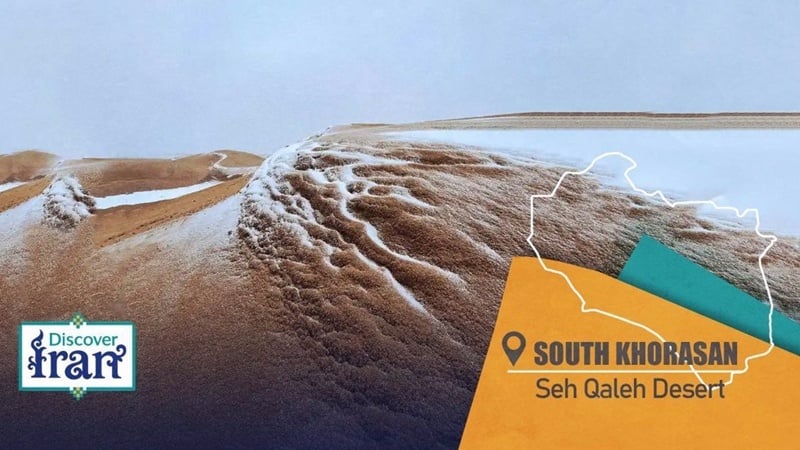
Seh-Qal’eh Desert, South Khorasan Province
Pars Today – In the heart of South Khorasan province, amid silence and starlight, the Seh-Qal’eh Desert appears like a celestial sanctuary — a place where the vastness of the land gently merges with the splendor of the sky.
Among Iran’s vast desert landscapes, the Seh-Qal’eh Desert in South Khorasan stands out as one of the country’s most breathtaking natural wonders — a place where adventure and stargazing come together in perfect harmony.
According to Pars Today, citing Press TV, the desert is located near the small town of Seh-Qal’eh in Sarayan County. Its unique geography and pristine environment have made it a top destination for nature lovers and astronomy enthusiasts alike.
The sky above Seh-Qal’eh is recognized as the darkest in Iran and one of the darkest in West Asia — an exceptional clarity that makes it a prime destination for both professional and amateur astronomers.
Its distance from dust storms, absence of light pollution, and wide-open horizons make Seh-Qal’eh one of the best locations in Iran for astronomical observation and stargazing events.

Seh-Qal’eh Desert: A fusion of naturalb and historical heritage
The Seh-Qal’eh Desert in South Khorasan has a semi-arid climate, with hot summers, cold and dry winters, and very low annual rainfall of around 100 millimeters. Despite its sparse vegetation, vast sand dunes, salt flats, and sculpted hills create breathtaking landscapes.
Geologists note that the region contains several major fault lines, and within a relatively small area, visitors can experience all four types of Iran’s desert climates: hot and dry, semi-arid, coastal, and cold.
Despite its dry and barren appearance, the endless sand dunes of Seh-Qal’eh invite visitors to walk barefoot, feel the profound silence, and witness sunsets that transform the horizon into a canvas of orange and purple.
It is this pristine, untouched beauty that makes Seh-Qal’eh a sanctuary for photographers, astronomers, and seekers of solitude.
Beyond its natural attractions, the region is home to several historical sites, including the Fazl Khan Water Reservoir from the Safavid era, the ancient-walled Kamroud Castle, and traditional windcatchers in the Mir-Ali-Agha and Khosravi houses from the Qajar period.
The Fazl Khan Water Reservoir is an example of Iranian ingenuity in water management — a brick-and-plaster structure built for public use in arid regions. Its underground, domed design kept the water cool, making it a symbol of advanced engineering during the Safavid era.

Kamroud Castle, with its ancient walls, stands as a symbol of Iran’s historical resilience and strategic architecture. The structure dates back to the early Islamic period, and its stone and mudbrick constructions once protected key trade routes. Its weathered walls hold layers of history within them.
Additionally, the historic Hesam al-Din House, featuring high arches and classical Iranian architecture, reflects the region’s rich cultural heritage. This house is a beautiful example of traditional residential architecture in Iran, with delicate plasterwork, wooden lattice windows, and a central courtyard that embodies the cultural values of its era.
Seh-Qal’eh is located about 50 kilometers from the city of Sarayan, and in recent years, several eco-lodges and traditional guesthouses have been established nearby, allowing travelers to spend the night under a star-filled sky.
Overnight stays in the area go beyond a simple night’s rest; they offer an experience of profound silence, darkness, and the endless wonders of nature, just as visitors often describe.
The best time to visit Seh-Qal’eh is from mid-autumn to winter, when the sky darkens earlier and the cool air creates ideal conditions for stargazing and night photography.
For those seeking a truly unique experience — one that blends the tranquility of the desert with the wonders of the cosmos — the Seh-Qal’eh Desert reveals nature at its most profound.