Iraq liberated from yoke of Daesh terrorist outfit
Jul 23, 2017 10:08 UTC
Undoubtedly, the people of Iraq were the main victims of the sinister presence of Daesh in Iraq.
June 14 is a reminder of a bitter incident for the people of Iraq. In June 2014, Daesh operatives entered the Iraqi city of Mosul. This incident occurred while Iraq had held legislative elections in April 2014 and the political groups were engaged in a dispute over instatement of the former Iraqi premier, Nouri Al-Maleki. In fact, Daesh terrorists entered Iraq with the assistance of a number of Iraqi elements and groups, especially the members of the dissolved Ba’th Party, and the support of states, who were opposed to the Shia Iraqi government. It should also be pointed out that that stage was set for emergence of Daesh outfit in Iraq upon the invasion of Iraq by the US In the year 2003, and based on the incidents which took place from 2003 to 2014, allowing Daesh to invade and occupy parts of Iraq.
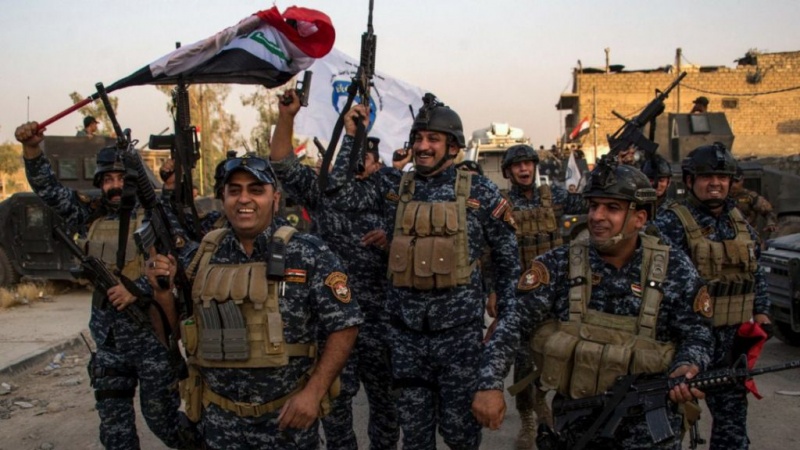
As of the very first days of presence of Daesh outfit in Iraq; its supporters came to realize that they have made a strategic blunder by supporting this terrorist outfit; given that, on one hand, the gruesome atrocities committed by Daesh showed that continued support for this outfit would hurt the world public opinion and would disgrace the related supporters, while the greed of Daesh to occupy the Kurdish regions of Iraq, on the other hand, did not serve the policies of the corresponding supporters of Daesh, such as the US. Therefore, only three months after the emergence of Daesh in Iraq, a US-led international coalition was established against Daesh, with the participation of sixty countries. In other words, roughly one third of world countries, which included global super powers and the regional powers of the Middle East, took part in this coalition. However, the bitter truth is that the ouster of Daesh in Iraq, thirty-six months after its emergence, was not carried out by the US-led international coalition, and in fact the Iraqi forces were the ones who forced Daesh into submission and celebrated the liberation of regions, which were occupied by this terrorist outfit. This fact reveals that the emergence of Daesh in Iraq served the interests of a number of states, such as the US and its Arab allies. Thus, elimination of Daesh was not on the agenda of these regimes and was only part of their publicity campaign.
Undoubtedly, the people of Iraq were the main victims of the sinister presence of Daesh in Iraq. Short term and long term blows were dealt against the people of Iraq, as the result of occupation of parts of that country by Daesh terrorists. Some of the short term repercussions of presence of Daesh in Iraq are death and injury of thousands of people; homelessness of millions; destruction of urban infrastructures; emergence of human catastrophes; and the disastrous fate of a large number of civilians, who were beheaded, burnt alive, or shot dead by terrorists. Meanwhile, the long-term consequences of presence of Daesh in Iraq will remain impactful for a long while. Some of the most important repercussions of presence of Daesh in Iraq include the mental disorder of those, who bore witness to horrendous crimes committed by Daesh against their loved ones; formation of a generation of children, who instead of attending schools, have been displaced in and out of Iraq; children who have lost a parent or their parents; families who have lost their sources of income throughout the three-year occupation of swathes of Iraq by Daesh; and parents who have seen their children, falling victim to Daesh atrocities.
Presence of Daesh in Iraq was a bitter experience for the Iraqi groups, figures, government, and people. The first lesson which was learnt from the presence of Daesh in Iraq was that a fragile government begets the emergence of terrorism and formation of a powerful government guarantees the security of a country like Iraq. The second learnt lesson was that maintenance of the territorial integrity should be the first priority of any given government and all groups. Otherwise, territorial integrity would be seriously threatened by terrorist outfits and militants. The third learnt lesson was that maintenance of solidarity crushes all threats, while disputes and divergence surge threats; and could even led to disintegration of a country. The fourth learned lesson was that the security of a land should be established and maintained by the national forces of that country.
It should be said that although Daesh is no longer present in Iraq; if once again sectarian and personal interests are prioritized; groups such as Daesh may resurge in Iraq. Meanwhile, the Iraqi government should see Iraq as a whole, and should pay equal attention to all regions of this country and all Iraqi nationals. Otherwise, the opponent states of the Iraqi government could take advantage of the related status quo, while the stage would also be set for the treason of a number of Iraqi elements. The opposition groups to Iraqi government should realize that resorting to Daesh for confronting the central government of Iraq does not just pose a threat to the Iraqi central government; and in fact endangers all groups and regions of that country.
MR/EA
Tags